By Mohammad Shahanshah Ansari
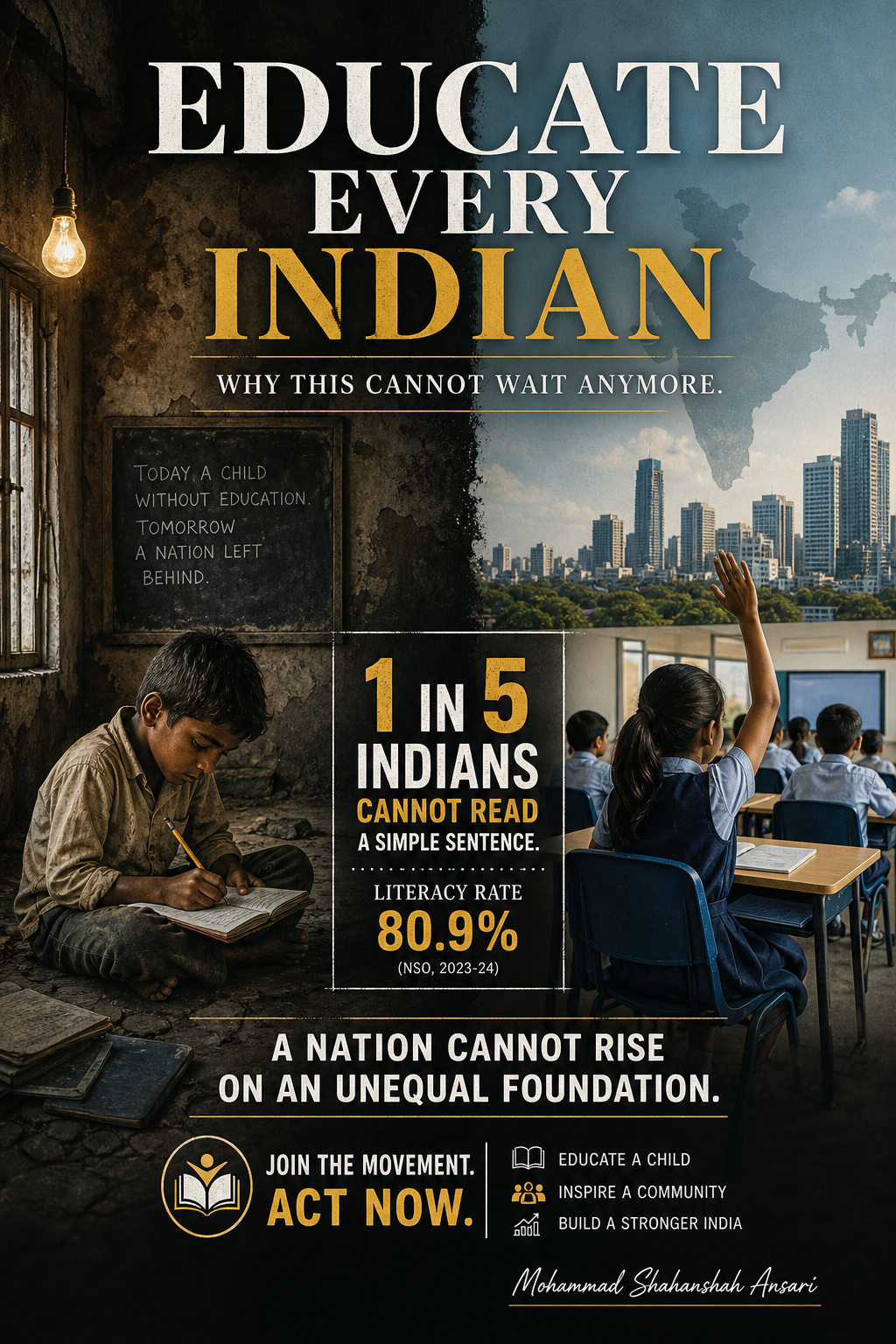
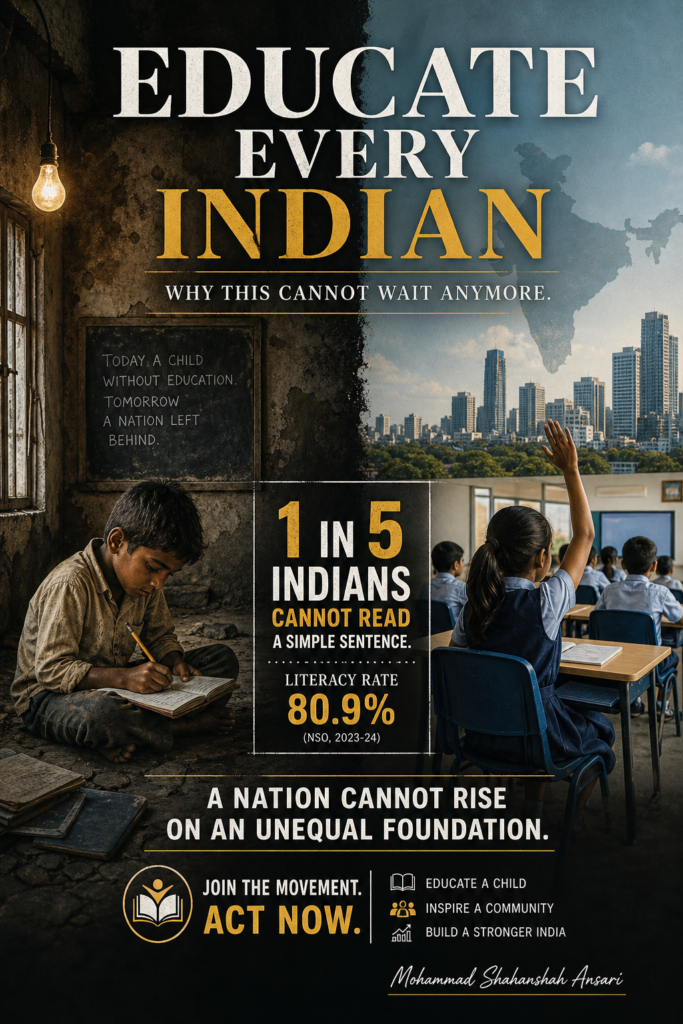 Every Indian concerned about the country’s future should consider one number: the National Statistical Office reports India’s 2023–24 literacy rate is 80.9%. At first, this suggests progress. But it means that one in five Indians aged 7 or older cannot read a simple sentence. In a nation of 1.4 billion, this isn’t just a statistic—it’s a problem we keep putting off.
We often talk about becoming a $5 trillion economy and celebrate IIT achievements, Silicon Valley Indians, and software exports. These successes are real, but they benefit only a small part of the population. Beneath this shining surface, there is another India—where children leave school before Class 5, girls never reach secondary school, and whole districts have been neglected for years. We are trying to build a developed nation on a foundation with serious flaws.
This is why Educate Every Indian must move beyond being just a slogan. It should become a national movement, like those we once launched for independence and polio eradication.
The Geography of Ignorance
To understand where India’s education crisis is most severe, examine certain states. Bihar’s literacy rate stands at 74.3%, making it one of the most deprived. Andhra Pradesh, despite bordering highly literate regions, has the lowest literacy rate in the country at 72.6%. Uttar Pradesh, home to about 240 million people (more than Brazil’s entire population), has a literacy rate between 76% and 78%. Jharkhand’s rate is 76.7%. In Rajasthan, rural female literacy rates are far below state and national averages but are often overlooked in policy discussions.
These five states together have a population of 450-500 million, nearly one-third of India’s total population. These are not merely lagging statistics; this group includes children dropping out before Class 5, child labourers, girls married at 15, and boys who have never learned to write their names. The social impact is direct and widespread. Studies show that each additional year of schooling can increase an individual’s earning potential by 8% to 10%. In these populous states, the lack of quality education imposes a significant structural drag on GDP. These states also have higher rates of child malnutrition, maternal mortality, and early marriage—situations closely linked to low female literacy rates, which are particularly stark in these regions.
What We Spend — And What We Don’t
This is where the issue becomes uncomfortable. India has never treated education spending with the seriousness it deserves to show real political commitment.
The National Education Policy 2020 — a landmark document in many respects — explicitly recommends raising public spending on education to 6% of GDP. This recommendation was also made by the Kothari Commission back in 1968. It was reiterated in the 1986 education policy. And the 1992 review. We have been recommending the same thing to ourselves for over fifty years, and not once have we managed to do it.
Currently, India’s total education spending by central and state governments is about 2.9% to 3% of GDP—a percentage that has remained nearly unchanged over several years. The Union Budget 2024–25 allocated Rs 1.20 lakh crore to education at the central level, a 7% increase from the previous year. However, this accounts for only 0.37% of GDP at the central level and represents a smaller share of government spending than it did a decade ago.
Let’s look at education spending in other countries for comparison. The United States spends 6% of its GDP on education. China allocates 6.13%, Japan invests 7.43%, and South Africa spends 6.6%. The average for developed countries is around 5.1%. By contrast, India, aspiring to become Viksit Bharat, spends only about 2.9% to 3% of its GDP on education.
This underinvestment has tangible effects. For example, a survey of 188 government primary schools across central and northern India found that 59% of schools lacked drinking water facilities and 89% had no working toilets. The national average pupil-to-teacher ratio is 42:1. Such conditions impede learning and lead to students leaving school prematurely.
Why Other Countries Got This Right
Countries that developed, like South Korea, Finland, Singapore, and Japan, all had one thing in common after war or independence: they saw education as their main investment, not just a welfare expense. In the 1960s, South Korea was poorer than most African nations. In two generations, it became a tech and industrial leader. The turning point was education—funded for everyone and valued by society.
Finland does not rank schools or create elite primary institutions. Every school receives equal resources. Teachers are trained to the level of doctors or engineers, making teaching one of the most competitive careers. As a result, 99% literacy is not just a statistic—it is part of daily life.
Singapore made a simple calculation early on: the country has no oil, no minerals, no agricultural surplus. Its only resource is its people. So it invested accordingly. Education spending was not debated as a budget line — it was treated as national security.
India, on the other hand, has spent decades since independence building prestigious institutions such as IITs, IIMs, and AIIMS. Meanwhile, primary and secondary schools have suffered from neglect, corruption, and indifference. We created opportunities for those already near the top, while the foundation remained unsupported.
The Agenda for the Next Ten to Fifteen Years
If India truly wants to reach its goal for 2047, the 100th year of independence and the target for becoming a developed nation, education reform must be the main priority. Everything else—jobs, health, gender equality, and economic growth—depends on it.
First, the education budget must be guaranteed. Achieving 6% of GDP in education spending within the next five years should be written into policy, or, if needed, into the constitution. Investing 6% of GDP would be one of the highest returns on public spending, according to both national and international studies.
Second, the five backward states need a dedicated mission structure — not a scheme that gets renamed every election cycle, but a sustained,Second, the five lagging states need a dedicated mission—not just a scheme that changes names with each election, but a long-term, protected, and independently audited program with clear goals for the next decade. Bihar, UP, Andhra Pradesh, Jharkhand, and Rajasthan should be given the same urgency as past efforts for rural electrification or highway building. Why is 70.3% — nearly 15 percentage points below that of men? In backward districts, the gap is far wider. There is almost no public health or economic intervention with a higher multiplier effect than educating girls. The data on this is not contested.
Fourth, teacher quality—not just the number of teachers—should be the main focus. Having more teachers without improving quality is just paperwork, not real education. Countries that changed their education systems did so by making teaching a respected, well-paid profession that attracts talented people, not just those with no other options.
Finally, this needs to stop being a government-only conversation. Finally, education should not be seen as just a government issue. Civil society, companies through CSR, universities, local communities, and individuals all have a part to play. Educate Every Indian will succeed only if it becomes everyone’s project, not just the job of one ministry in Delhi. how we talk about India’s demographic dividend. We celebrate the fact that we have the world’s youngest population. But a young population without education is not a dividend — it is a liability. It produces frustrated, underemployed young people with no economic mobility and no stake in the system. History has shown us what happens when countries accumulate that.
India has roughly fifteen years to close its literacy gap before the demographic advantage of a young population diminishes. This means reaching the literacy improvements achieved by other countries in forty years, but within fifteen. With the right commitment, as shown by past achievements such as nuclear power and digital payments, this is possible. Each illiterate child represents a national emergency, not merely a line in a government report.
Educate Every Indian is no longer just a goal; it is a reality. It is now an urgent imperative for our nation’s survival and future. The time to act is now, with full commitment and a shared sense of responsibility that matches our greatest national efforts.
If this message resonates with you, take action now. Join the mission, share these goals, and invite others to participate. Become an active part of Educate Every Indian—your involvement can create tangible change.
Join the discussion on Facebook and actively spread this message. Each share has the power to inspire real changes within your community—your action matters now.
References:
- National Sample Survey Office (NSSO), PLFS Annual Report 2023–24 — National literacy rate data
- National Statistical Office (NSO), Ministry of Statistics and Programme Implementation — State-wise and gender literacy figures
- Ministry of Education, Government of India — Union Budget Allocation FY2024–25
- British Council — India’s National Education Budget 2023–24 — GDP share analysis
- Business Standard — Budget 2025: India’s Education Budget Grows, But Lags Behind Global Trends (February 2025) — International comparison of education spending
- India Data Map — India’s Literacy Rate: Insights for 2025 — State-wise literacy analysis
- Janata Weekly — Union Budgets 2014 to 2024: The Education Budget — Historical spending analysis
- Wikipedia — Literacy in India — Infrastructure data, pupil-teacher ratios, historical context
- World Bank Open Data — Government Expenditure on Education (% of GDP) — Comparative GDP spending across nations