
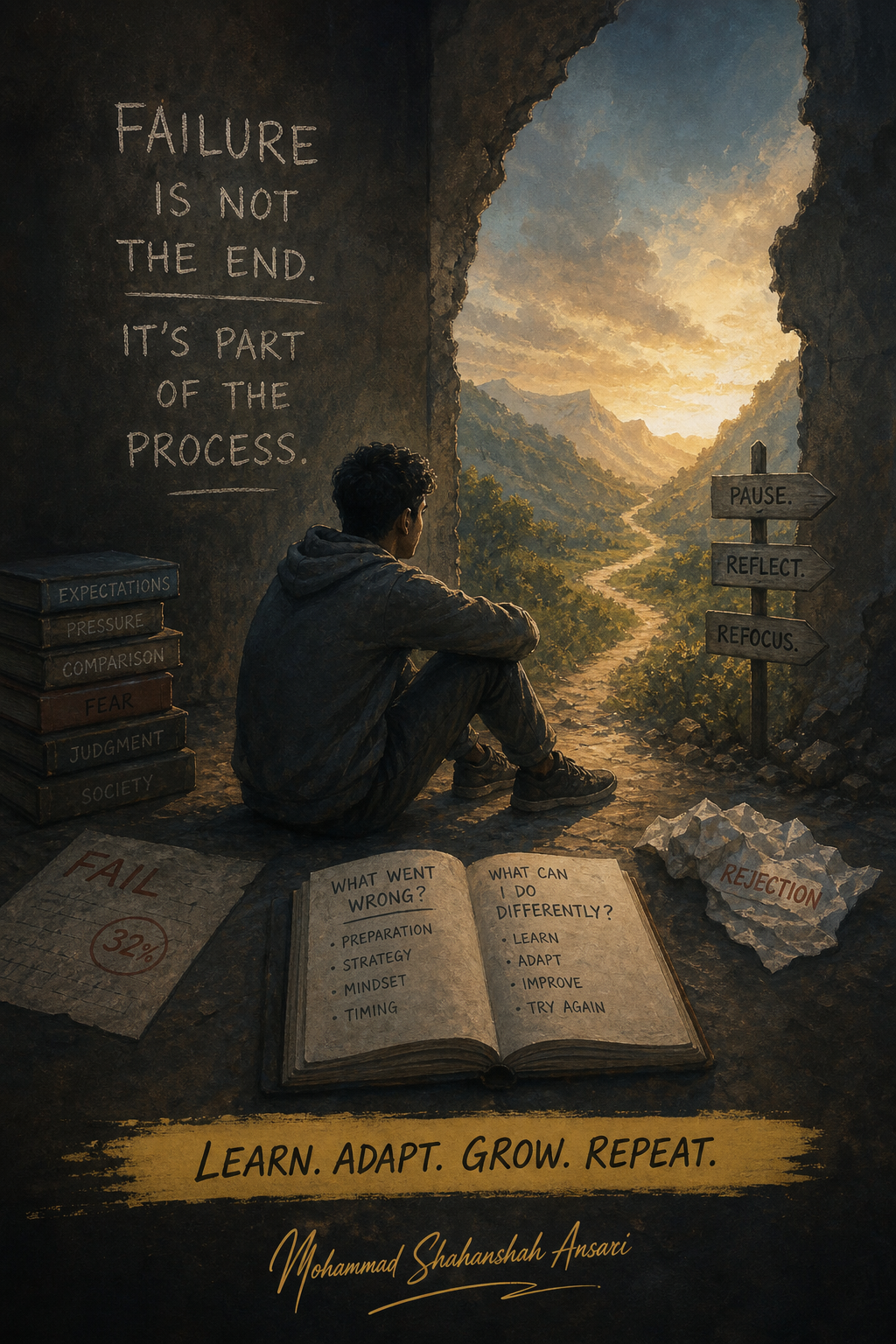
By Mohammad Shahanshah Ansari
Most people have quietly lived through this moment.
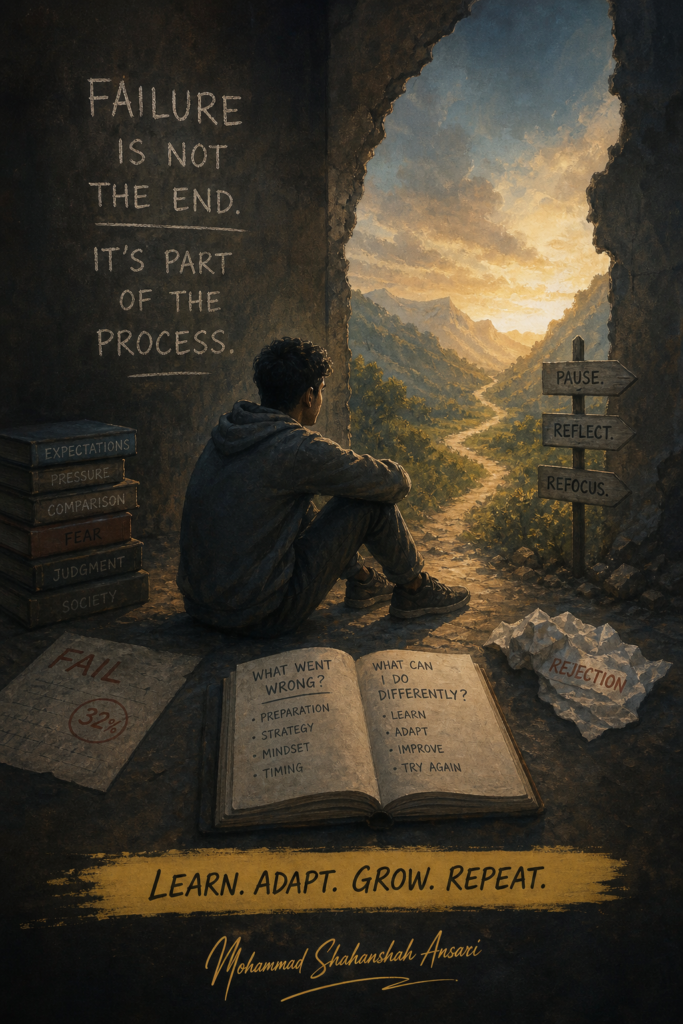 You worked hard—or at least believed you did. You prepared, showed up, and waited. And then it didn’t work out. The result was poor. The job didn’t come through. The promotion went elsewhere. Something you cared about ended.
And you were left standing there, unsure of what to do next—not because the failure was unbearable, but because no one had ever explained how to respond to it.
That silence isn’t accidental.
Modern education was never designed to teach people how to deal with uncertainty or defeat. It was built to produce people who perform, follow instructions, and deliver outcomes. Failure doesn’t fit neatly into that system. It was treated as something to avoid—or correct—not something to understand.
From the first day in school, the message is consistent: get it right.
Right answers. Right marks. Right grades.
The red pen marks mistakes. Rankings show where you stand. Praise follows correctness—not effort, not curiosity, not thoughtful attempts that didn’t work. Over time, the message settles in: failure is something to avoid.
So most of us grew up without ever learning what to do when we fail.
This isn’t about “resilience” in the motivational sense. It’s more basic than that. Many capable, educated adults don’t have a working method for dealing with failure. When things go wrong, they feel embarrassed, avoid the truth, or rush to appear positive. What they rarely do is pause, understand what happened, and move forward without carrying it as a personal weight.
That ability—the ability to process failure—is a skill. And it was never taught.
Think about what schools prepare you for: grammar rules, equations, historical dates, and formal letters. All of it has value. But none of it prepares a teenager for not getting into the college they wanted, or an adult for being told they’re not the right fit for something they worked toward.
The emotional side of growing up was simply left out.
Consider something simple. A student gets a bad grade and quickly hides the paper before anyone sees it. That isn’t just dishonesty. It’s learned behaviour. Failure is something to conceal, something to carry quietly, something that defines you if exposed.
No one showed them another way—to bring it out into the open, talk about it, understand it.
So they hide the paper. And the habit stays.
What makes this more puzzling is that failure is not rare. It’s the more common experience. Most people don’t come first. Most applications don’t succeed. Most plans don’t work the first time.
Failure isn’t the exception. It’s part of the pattern.
And yet, we were taught to treat it like something unusual—something to move past quickly, without really examining it.
That creates a certain kind of adult. Someone is cautious about trying anything that might not work. Because trying increases the risk of visible failure, which feels like exposure.
When things go wrong, it cuts deeper than it should. Not because the event is catastrophic, but because it confirms a quiet fear: that something might be wrong with them.
Take a simple example. Someone applies for a job, gets rejected, and stops applying altogether. Not because they lack ability, but because that one rejection felt like confirmation of something they didn’t know how to challenge.
They step back, call it “timing,” and move on.
But what they were missing wasn’t opportunity. It was a way to handle rejection without losing confidence in themselves.
In India, this is heavier still. Failure isn’t just personal—it’s social. Families invest deeply in education, often with real sacrifice. When things don’t work out, the disappointment isn’t carried alone.
That makes honest conversations about failure even harder.
You can’t easily say, “I failed, and I’m figuring it out,” when failure is seen as a verdict rather than a phase.
And school isn’t the only place this is learned.
At home, many parents rush to fix or soften every setback. The intention is care, but the message is the same: failure is something to escape, not face.
Social media adds another layer. People grow up seeing curated outcomes—admissions, promotions, achievements—without ever seeing the failures behind them. The comparison becomes constant, and the standard keeps rising.
Add financial pressure, limited opportunities, and family expectations, and failure stops feeling like a setback. It starts to feel like a collapse.
So what would it mean to actually teach someone how to fail?
It doesn’t require a new subject or policy. It requires a different response.
Start with something simple: acknowledge failure clearly and calmly.
Not with anger, not with quick reassurance—but with attention.
What actually went wrong? Was it preparation, understanding, timing, or something else?
A short, honest conversation after failure teaches more than any lecture.
Then, separate the outcome from the person.
A result is information. It is not identity.
“You didn’t clear the exam” is a fact.
“You are not good enough” is a judgment.
Most people grow up confusing the two.
Also, make failure visible. Talk about it—openly, without embarrassment. Not just as a lesson, but as a normal part of any meaningful effort. When people only see success, they assume the path is smooth. When their own path isn’t, they assume something is wrong with them.
Visibility changes that.
And perhaps most importantly, teach the difference between quitting and regrouping.
Stopping to reassess is not a weakness. Adjusting your approach is not failure. Starting again with a better understanding is not starting from zero.
It’s how progress actually works.
None of these ideas is complex. They’re what a thoughtful teacher, a patient parent, or an honest mentor might share.
But they’re passed on randomly—not in a way everyone can rely on.
The irony is obvious. The people we admire most—across fields—are almost always those who failed significantly before they succeeded. Yet we celebrate the outcome and edit out the struggle.
So the lesson never reaches those who need it.
And the cost is real.
Every year, there are students who cannot handle a bad result—not because the result is devastating, but because they were never prepared for it. There are young professionals who walk away after one rejection. People who abandon ideas, not because they were impossible, but because the first setback felt final.
The real problem isn’t failure.
It’s that failure is treated like an ending, when it’s usually a question.
Failure isn’t the opposite of success. Often, it’s part of the same path.
But that’s not how we were taught.
We were taught to hide it, move past it, and not speak about it.
So when it shows up—as it always does—we don’t know how to respond.
And maybe that’s what needs to change.
Not whether people will fail—they will.
But whether we finally teach them what to do when they do.