
Every few years, India announces a milestone. Literacy up. Enrollment up. New schools built, new schemes launched, new numbers released at press conferences. And every few years, the same quiet truth sits underneath all of it: millions of Indians are still not learning anything useful.
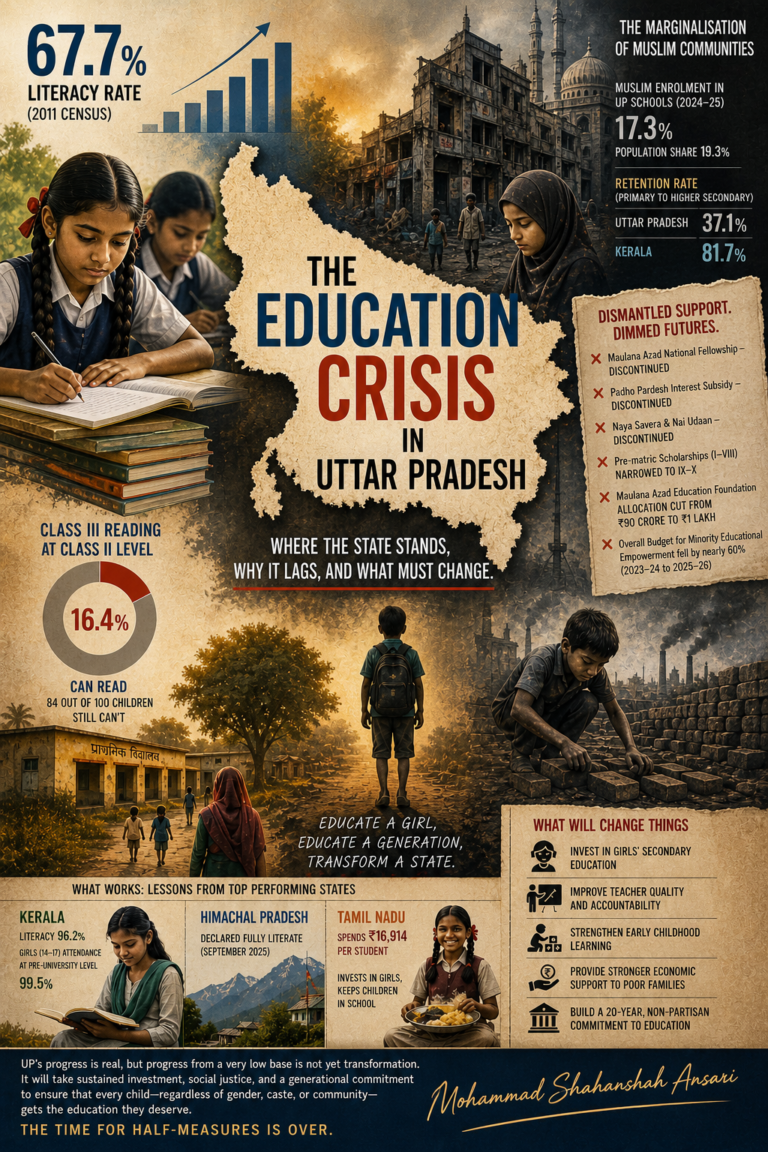
India’s total literacy rate stands at 80.9% today — a number that sounds encouraging until you place it next to what it conceals. Kerala sits at 95.3%, Mizoram at 98.2%. At the other end, Andhra Pradesh records 72.6%, and Bihar 74.3%. Nearly half of all illiterates in India — 48% — are concentrated in just six states: Uttar Pradesh, Bihar, Rajasthan, Madhya Pradesh, Jharkhand and Chhattisgarh. Urban India has a literacy rate of 87.7%, while rural India trails at 73.5%. The gender gap is sharper still — male literacy is at 84.7%, female at 70.3%. In Uttar Pradesh, the female literacy rate is 78.2%, with girls facing obstacles like early marriage that pull them out before they have barely begun.
This is not a story about children who cannot reach schools. That problem, real as it is, has largely been addressed — at least on paper. This is a story about what happens after they arrive.
A child in a government school in rural UP sits in a classroom. She is enrolled. She shows up. She is, by every official measure, part of the education system. But the textbook in her hand was written in a language she half-understood, about a world she did not recognise, preparing her for an exam that would certify her for a job that may not exist in her district. She learns to pass. She does not learn to think. The ASER data is simply putting a number to what her teachers already know and rarely say aloud.
Anjali Sain, a student at a government school in Atrauli, Uttar Pradesh, put it plainly at a UNICEF consultation on digital learning in December 2024: “Technology has opened up a whole new world for us. But we still face challenges — unreliable internet, high costs, limited access to devices.” Her classmate Aditya agreed. Both were teenagers in a small town who knew something was within reach, and knew equally well that it kept slipping away.
This is the design problem India refuses to name. We have spent decades treating education as an infrastructure challenge — build enough schools, hire enough teachers, push enrollment high enough, and the country will educate itself. But infrastructure was never really the core issue. The system was built for a specific kind of person: urban, formally employed, comfortable in Hindi or English, headed toward a desk job in a city — and then handed, in diluted form, to everyone else. Rural women. First-generation learners. Working adults who were written off the moment they crossed eighteen.
India’s Education Illusion
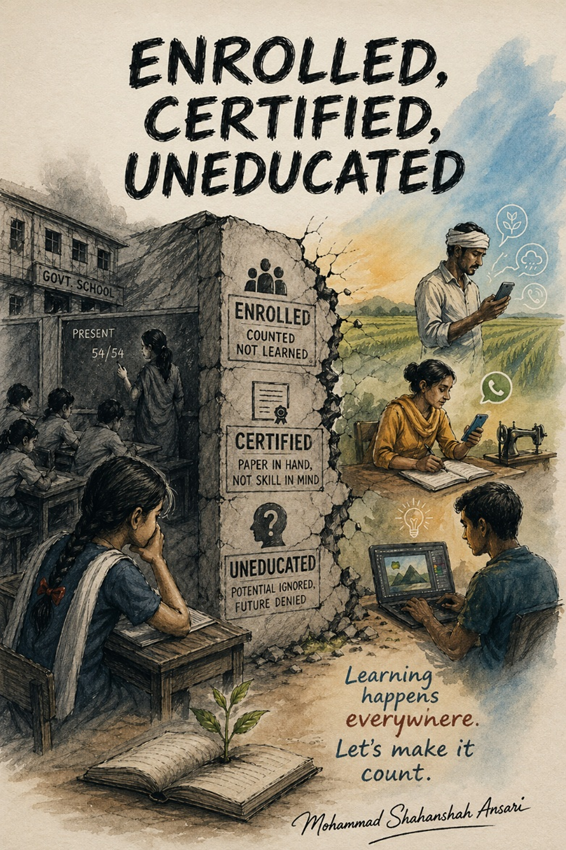
To understand why the system keeps failing, it helps to see what it is actually measuring—and what it is quietly ignoring. There are three distinct things that get routinely confused with one another in Indian education policy, public discourse, and political speechmaking. They are not the same thing. They have never been the same thing.
Schooling is about attendance. A child is in school. She is counted. The state has fulfilled its obligation — on paper. Schooling says nothing about what is happening inside the building, who is teaching, whether the teacher showed up, or whether the child understood a word of what was said. India has become very good at schooling. We have near-universal enrollment at the primary level. We celebrate it. And we have confused it, persistently and consequentially, with education.
Certification is about exams. A student clears a board examination. She receives a document. The document says she has been educated. It says nothing about whether she can reason through an unfamiliar problem, read a contract, understand a newspaper, or hold her own in a negotiation. Certification is the product that the system was designed to deliver. Learning is supposed to be the input that makes certification meaningful. In practice, across large parts of India, the input has been quietly removed, and the product continues to be manufactured regardless.
Learning is about capability. Can a person read and understand? Can she reason from evidence? Can she adapt when circumstances change? Can she ask a good question? These are the outcomes that determine whether education has actually happened — and they are the outcomes that India’s system does not measure, does not reward, and in many cases, does not particularly care about.
This is India’s Education Illusion: the belief that because schooling is widespread and certification is accessible, learning must follow somewhere behind. The ASER data tells us it is not. It has not been for decades. We have been running a system that produces attendance registers and mark sheets, while an entire generation grows up without the capability to use either.
Until we separate these three things clearly in our policy thinking — and start measuring and rewarding the third rather than the first two — every intervention, however well-funded or well-intentioned, will be absorbed into the same machine and produce the same results.
The system is not just misdesigned — it is misincentivised.
And this is the layer that makes the problem so stubborn.
Consider what the system actually rewards. A state government’s education budget is justified by enrollment numbers. A district officer’s performance is measured by how many schools were built, not by what children learned inside them. A teacher’s job is secured by showing up, not by classroom outcomes. And a student’s entire academic fate rests on a single annual examination that tests the ability to reproduce memorised answers under pressure — not to reason, not to apply, not to create. Everyone in this chain is responding rationally to the incentives they face. The tragedy is that none of those incentives points toward learning.
The teacher problem runs deeper than it is usually acknowledged. India has a shortage of roughly 1 million qualified teachers, concentrated most severely in rural areas and in the early grades. But beyond numbers, there is a more corrosive issue: a culture of low accountability that has calcified over decades. In many government schools, a teacher’s posting is a matter of political negotiation. Transfer threats are used as punishment, and transfer requests are used as reward. In this environment, the act of teaching well — differentiating for children at different levels, innovating with limited resources, staying after school — is entirely optional and almost never recognised. The incentive to do the minimum is everywhere. The incentive to do more is almost nowhere.
Then there is the examination system, which sits at the heart of the machine and quietly corrupts everything around it. Indian public examinations, by and large, reward rote memorisation. They test whether a child has absorbed the textbook, not whether she can use what she has learnt. A student who understands fractions intuitively but writes the working in an unfamiliar format loses marks. A student who has memorised every formula without understanding any of them clears the paper. The exam does not measure education — it measures compliance with a format. And since the exam is the only thing that matters, everything above it — teaching, studying, learning — bends in its direction. Curiosity becomes a distraction. Questions become a risk.
The result is a system in perfect equilibrium — stable, self-sustaining, and deeply resistant to change — precisely because everyone inside it is doing exactly what the structure asks of them.
Learning the System Cannot See
While the formal system produces its attendance registers and board results, something vast and largely invisible is happening in parallel.
A farmer in Pratapgarh has never attended an agricultural training programme, but he can diagnose three kinds of fungal infection in his wheat crop by watching YouTube videos in Awadhi. A young woman in Gorakhpur — a school dropout at fourteen — now runs a small tailoring business and manages its accounts, having learnt both skills through a WhatsApp group run by a local NGO. A young man in Moradabad who never cleared his Class 10 boards has taught himself graphic design through free tutorials and earns more freelancing for clients in Bangalore than most of his formally educated peers earn in entry-level jobs.
These are not exceptional stories. They are ordinary ones, repeated in some variation across every district of every state in the country. What makes them remarkable is not that they happened, but that India has built no framework to see them, measure them, or build upon them.
Consider the scale. India has over 700 million smartphone users. YouTube’s largest viewership outside the United States is in India, and a significant and growing portion of that viewership is explicitly educational — farming techniques, vocational skills, language learning, financial literacy, coding tutorials, and legal rights. Tens of millions of Indians are part of WhatsApp learning groups, neighbourhood skill-sharing networks, and informal apprenticeship arrangements that have no official name and no policy recognition. The Pratham Foundation, which conducts the ASER survey, has for years documented the gap between what children learn in school and what they can do — but the gap between what people learn outside school and what the system acknowledges is equally large and almost entirely unmeasured.
The recognition gap matters because it shapes everything downstream. A woman who has informally managed the accounts of a small household business for a decade cannot put that on a job application. A farmer who has developed sophisticated, field-tested knowledge of soil and crop management is still classified as uneducated in every government record that mentions him. A self-taught programmer without a degree will spend years fighting past filters that exist to screen for credentials, not capability. The system does not just fail to reward informal learning — it actively renders it invisible, ensuring that the people who have done the most with the least remain on the wrong side of every opportunity that certification unlocks.
The policy implication of this is both simple and radical. If informal learning is already happening at scale — and the evidence strongly suggests it is — then the first task of education policy is not to create more learning, but to recognise the learning that already exists. Credit frameworks for vocational knowledge. Assessment systems that test capability rather than time spent in classrooms. Formal pathways for self-taught individuals to demonstrate what they know and have it count for something. Other countries have experimented with versions of this. India has not, in any serious way, because doing so would require dismantling the credentialist logic on which the entire formal system rests.
India may already be learning more outside the system than inside it — we just refuse to measure it. And a country that cannot see its own learning cannot build on it.
This is where artificial intelligence enters — not in the way it appears at education summits, with grand talk of disruption and transformation, but in the small, practical, quietly radical way it is already working in some places, amplifying exactly the kind of self-directed, vernacular, need-driven learning that the formal system has always ignored.
DIKSHA — the government’s own Digital Infrastructure for Knowledge Sharing platform — now uses AI for keyword search in educational videos and a read-aloud feature for visually impaired students, and has used AI to translate Class 1 and 2 textbooks into all 22 Indian languages. Bhashini, India’s national language translation platform, allows students and learners to access content in their mother tongue without waiting for a government syllabus to be revised. ConveGenius has deployed AI-driven platforms across government schools in Uttar Pradesh that assess students’ learning levels and provide personalised study material. SwiftChat AI is supporting para-teachers in rural UP schools with lesson plans and real-time doubt resolution. Embibe analyses test responses to generate targeted remedial practice for JEE and NEET aspirants — the kind of personalised coaching that only the richest families could afford before. Google’s Gemini, through a partnership with Atal Tinkering Labs, is being integrated into more than 10,000 Indian schools, reaching 11 million students. Khan Academy’s Khanmigo — an AI tutor that asks guiding questions instead of giving away answers — is now available in Hindi. Voice-based learning models in local languages are on the rise, with companies building datasets in Tamil, Telugu, Hindi and other Indian languages, helping learners navigate dialectal differences that no standardised classroom ever could.
At the policy level, Uttar Pradesh has made moves that, on paper, look significant. The state launched AI-PRAGYA — aiming to train 10 lakh citizens in AI, machine learning, data analytics, and cybersecurity, with a particular focus on Self-Help Groups, village leaders, and marginal farmers. India’s first AI-augmented multidisciplinary university opened in Unnao in July 2025, offering 45 AI-enabled courses and partnerships with Google, Microsoft and IBM. The state has been recognised in India’s national AI Impact report for deploying AI-based assessment systems at scale across government schools.
These are not trivial achievements, and they should not be dismissed. A state that was near the bottom of every education ranking for decades is now inaugurating AI universities and launching rural skilling programmes backed by the World Bank. That is a genuine shift in ambition.
But ambition and outcome are different things, and the history of Indian education policy is littered with well-funded ambitions that quietly reproduced the same system they were meant to replace. The question none of the press releases answer is this: are these programmes measuring capability, or measuring completion? If AI-PRAGYA trains 10 lakh citizens but defines success by the number of certificates issued rather than the skills demonstrably acquired, it will have added a new wing to India’s Education Illusion rather than dismantling it. If the AI university at Unnao operates on the same examination logic — attend, memorise, clear the paper, collect the credential — then its AI-enabled courses are simply a more expensive version of what the system has always done. New infrastructure. Old incentives. Familiar results.
If these programmes remain certification-driven, they risk becoming extensions of the same system they are meant to disrupt. The tools will be newer. The language will be more contemporary. The press photographs will feature more screens and fewer chalkboards. But the underlying transaction — attend, comply, certify — will remain unchanged, and the farmer in Pratapgarh will remain, officially, uneducated.
The test of these initiatives is not whether they scale. It is whether they measure the right thing when they do.
Before we let the list of tools do the work of an argument, three questions deserve to be asked plainly.
Who is actually using these tools — regularly, meaningfully, and without assistance?
Smartphone access has grown rapidly: 84% of rural households now have a phone at home, up from 36% in 2018. But access to a device and active use of a learning platform are separated by a wide, underexamined gap. Most AI education tools assume reliable internet, moderate digital literacy, and a user who already has the confidence and motivation to seek out learning independently. In practice, the children who are thriving on these platforms are largely the same children who were already thriving — those with educated parents at home, a relatively stable environment, and some prior exposure to technology. The 12-year-old in a Lucknow suburb and the 12-year-old in a village in Banda district both technically have a phone at home. They are not having the same experience.
Are these tools improving outcomes — or just improving access to the same inadequate content?
Access and learning are not the same thing, and the education technology sector has a long history of conflating them. An AI platform that delivers a Hindi-language version of the same rote-oriented curriculum, at the same pace, with the same exam-focused framing, has not solved the problem — it has digitised it. Recall India’s Education Illusion: if the underlying system is still optimising for schooling and certification rather than learning, then an AI layer on top will simply make the production of attendance and mark sheets more efficient. The honest question is not whether a child can now reach an app, but whether that app is building capability — the only outcome that actually matters.
Does AI risk replacing thinking — rather than enabling it?
This is the sharpest and most uncomfortable question. A student who asks an AI tutor to explain a concept and receives a clear, patient answer has learned something. A student who asks to solve the problem and copies the result has learned to delegate. The line between the two is thinner than most edtech marketing acknowledges. In a system already oriented around producing correct answers rather than building understanding, AI holds the very real risk of becoming the most efficient shortcut ever invented — not a tutor, but a very sophisticated answer key. If India’s Education Illusion has trained an entire generation to chase certification over capability, AI may simply give them a faster route to the same hollow destination.
None of this is an argument against AI in education. It is an argument against the assumption that availability equals impact, and that a tool distributed at scale is a problem solved at scale.
Five Shifts That Would Actually Matter
Diagnosing a problem well is not the same as solving it. For policymakers, administrators, and anyone who works inside or alongside India’s education system, the argument of this article points toward five concrete changes — not ten-year visions, not mission statements, but real shifts in what gets measured, what gets rewarded, and what gets counted as learning.
Measure learning outcomes, not enrollment. District scorecards, budget allocations, and political accountability should be tied to what children can demonstrably do — read, reason, calculate — not how many of them crossed a school gate. The ASER methodology already exists. The political will to act on it does not.
Recognise informal and skill-based learning. A national credit framework that acknowledges vocational knowledge, self-taught skills, and community-based learning would transform the life chances of tens of millions of Indians currently invisible to the formal economy. This is not charity. It is the correction of a long-running accounting error.
Local language first — not as accommodation, but as a foundation. A child who learns to read in her mother tongue before transitioning to Hindi or English develops stronger comprehension, greater confidence, and deeper retention than one forced into an unfamiliar language from day one. Language should be a bridge into learning, not the first wall a child hits.
AI as an assistant, not a replacement. Every AI education tool deployed in India should be evaluated on one question: Does it make the learner more capable of independent thought, or less? Tools that explain, prompt, and question belong in classrooms. Tools that answer, complete, and shortcut do not — at least not without significant pedagogical guardrails that most implementations currently lack.
Decentralised, community-led learning models. The school as the sole site of education is an industrial-age assumption that India can no longer afford to protect. Learning that happens in gram sabhas, in community libraries, in skill-sharing cooperatives, in neighbourhood WhatsApp groups — this is not informal learning waiting to be formalised. It is education, already functioning, already trusted, already in the right language. It needs recognition and modest resourcing, not replacement by a centralised curriculum it was never designed to deliver.
None of these shifts requires a new scheme or a new budget line. They require a change in what the system decides to see.
Schooling is not education. Certification is not learning. And a country that cannot tell the difference between the three will keep producing the same ASER numbers, year after year, and calling it progress.
The phone is already in their hands. The learning has already begun. The system is the only thing that hasn’t caught up.