Chamari is a village in Jalaun that, until recently, was little known outside Bundelkhand. That changed on a Sunday in late March 2026, when a new library was inaugurated there. Built for over two crore rupees, using the same Dholpur stone as the new Parliament building, the event drew Nobel laureate Kailash Satyarthi, Deputy Chairman of the Rajya Sabha Harivansh Narayan Singh, and others, including Kumar Vishwas, Vikas Divyakirti, Sonali Bendre, and Zakir Khan. Yet the person everyone came to see was not a politician or celebrity, but a journalist from Bundelkhand who had grown up reading in the same quiet he now hoped to change.
Saurabh Dwivedi, the founding editor of Lallantop, a digital news platform that changed how young, Hindi-speaking India consumed journalism, stood at the podium and made an announcement that surprised everyone. He and his wife, Gunjan Sangwan, decided to dedicate all their property to building 100 libraries across Bundelkhand through a trust called Des Raag. Both have also pledged to donate their bodies after death. Saurabh called Gunjan his guru, saying her belief made this commitment possible.
“A man who spent his whole career making sense of the world for others had decided, in the end, that the most important thing he could do was make books reachable for children who had never seen a proper shelf.”
This was not a corporate CSR project, a government scheme, or a matching grant from a big company. It was simply a journalist and his wife deciding that their village deserved the same opportunities the city always had.

Where this idea came from
In interviews, Saurabh Dwivedi has talked about his college years, saying he did more than just attend classes—he was part of political discussions, grassroots meetings, and, most importantly, libraries. For him, a library was never just a building. It was a place where a first-generation learner could sit without feeling out of place, where knowledge was free and open to all, and where the future felt possible. He realised early on that access to books is not just a cultural extra; it is essential infrastructure.
Bundelkhand is one of the most water-stressed and historically underfunded regions in the country. Many young people there are bright and ambitious, but they often lack resources that students in Lucknow or Delhi take for granted, such as a reading table, a quiet room, new books, or exam guides. The first library was not built because of a survey or policy report. It was built because Saurabh Dwivedi understood what it means to need one.
If he can, why can’t others?
Dwivedi’s announcement quietly asks a difficult question to everyone with a public platform. He is not the richest person in the room or a billionaire. Over 12 years, he built a media brand, earned a good living, and then, after careful thought, chose to use it for this purpose. He did not want a building wing named after him or a scholarship in his parents’ name at a top institution. He wanted to build a hundred libraries in a hundred villages where he grew up.
At the same time, actors with huge followings are endorsing soft drinks, cricketers’ own sports teams, and influencers with massive reach are promoting skincare products. This is not a moral judgment—people are free to use their earnings as they wish. Still, Dwivedi’s decision raises an important question: what is public influence for? When does having a platform become a responsibility?
The Mata Prasad Dwivedi Library, Chamari village, Jalaun — built at a cost of ₹2 crore, using Dholpur stone (the same used in the new Parliament). A mobile library truck is also planned to carry books to surrounding villages that can’t travel to Chamari. This is the first of 100.
What a library actually does to a place
A library’s impact on a community is rarely immediate or dramatic. It does not look like a revolution. Instead, it might be a twelve-year-old girl sitting in a clean, quiet room for the first time, reading something other than a textbook. It could be a young man from a farming family who wants to prepare for the UPSC and finally has a place to study, far from home, without paying rent. It can be a village where, for the first time, one generation starts asking questions that the previous generation never could.
At the inauguration, UP Deputy Chief Minister Brijesh Pathak said what many already knew: rural students preparing for exams like the IAS and IPS need more than ambition; they need infrastructure. A library provides that support. It is the most democratic way a society can invest in its young people.
A library truly changes the atmosphere of a place. This is not just a metaphor; it is real. The conversations people have, the dreams they talk about, and the way a town sees itself all shift when there is a building that says knowledge is here, and it belongs to everyone.
What the government should learn — and do
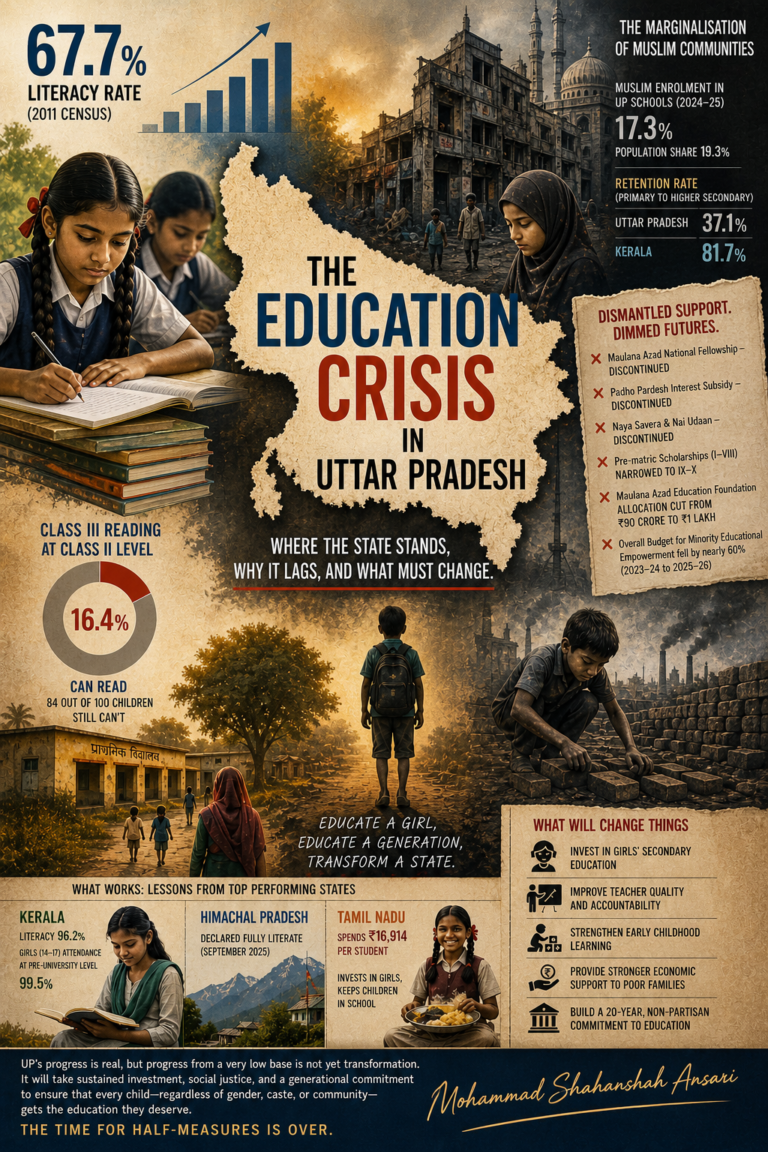
India has more than six lakh villages, but by most estimates, there are fewer than twenty thousand working public libraries. States like Maharashtra and Kerala have long understood that a library network is not a luxury; it boosts literacy, supports public health, and helps fight misinformation. Kerala’s library movement is among the most celebrated in Asia. Still, most Hindi-belt states are waiting for a reason to act.
Now, the signal has come—not from a bureaucrat, but from a journalist in Jalaun. Governments should do more than just applaud; they should pass laws. A Library Access Act that requires one working public library per panchayat, with a set budget and trained librarians, is not unrealistic. In fact, several southern states are already halfway there. The UP Deputy CM’s words at the inauguration were promising, but whether they lead to real policy is yet to be seen.
What the world already knows
In any mid-sized town in the United States, you will find a public library with Wi-Fi, children’s programs, meeting rooms, and digital archives. These are not elite places; they are neighbourhood resources, like water taps. The American public library system began in the 19th century with the idea that democracy works only if everyone, regardless of income, can access information. Andrew Carnegie funded more than two thousand libraries, and this tradition has lasted for over a century.
In Scandinavia, libraries are a key part of growing up. In Japan, even small towns have libraries that are clean, well-stocked, and open late. In the UK, people have fought hard to keep local libraries open because communities deeply understand what is lost when one closes.
India has always had the wisdom to build this kind of culture. What has been missing is political will and, at times, visible private commitment to make public action feel urgent.
Saurabh Dwivedi has shown that commitment. Now, the policy, the funding, and the expansion are up to those with more power than him.
“A library is the most democratic form of public investment a society can make in its young. The atmosphere of a place changes when it has one.”
What we should take from this moment
It is tempting to put Saurabh Dwivedi on a pedestal and treat his story as just a feel-good moment. But that would be the wrong approach. Instead, we should ask what each of us can do, with whatever we have, to follow his example.
A successful businessman in Kanpur could fund a library.
A diaspora community in the UK could support a reading room in their ancestral district.
A company with CSR goals could focus on building shelves instead of auditoriums.
A politician could make the library the symbol of their term, not just a statue.
Dwivedi’s pledge is more than a personal act of generosity. It is a challenge. It shows what can happen when someone decides that the future of children they may never meet is more important than the money their savings could earn. It reminds us that libraries are not just about the past; they are the best investment for the knowledge economy India wants to create.
One hundred libraries in Bundelkhand. A mobile truck bringing books to villages that cannot reach the main library. A man and his wife who chose this as their life’s mission.
The question is no longer whether this can be done. It is already happening, step by step, in a village in Jalaun. Now, the real question is who else will join in.