Why blind hiring matters, and why India can’t ignore it any longer
Researchers at the University of Chicago sent thousands of identical CVs, changing only the name at the top. CVs with “white-sounding” names received 50% more callbacks than those with “Black-sounding” names, even though the qualifications were identical. This shows the impact of human bias.
That study took place in America, but in India, a similar situation happens every day. The difference is that here, no one is tracking it.
An IIM-Ahmedabad study found that Muslim applicants with common Muslim names receive far fewer interview calls than equally qualified Hindu candidates. Oxfam India’s 2022 report reached a key point: discrimination against Muslims lessens when recruitment goes through agencies that hide religious identity. When employers can’t see a candidate’s religion, Muslim candidates stand a better chance. The problem is not with the candidate – it never was.
The Architecture of Unconscious Bias
Hiring decisions are not always rational. Bias often shapes the outcome. Decades of research in behavioural economics show that bias is usually unconscious, not intentional. Details like a name, neighbourhood, or school on a CV can trigger hidden assumptions. Sometimes, a decision is influenced before the CV is even fully read.
This issue affects people worldwide and people of all religions. In India, where 200 million people are part of an economically marginalised minority, unchecked bias leads to serious and lasting harm. The Sachar Committee, in its landmark 2006 report, found that Muslims in India were worse off than the Scheduled Castes and the Scheduled Tribes on many development indicators. Fifteen years later, a post-Sachar report showed no real improvement in formal employment for Muslims. Higher education enrollment for Muslims is only 4.6%, while their population share is 15%. Adivasis, though historically disadvantaged, now have higher college enrollment. When young people from a community stop entering the education pipeline, they soon drop out of the formal economy.
What Blind Hiring Actually Means
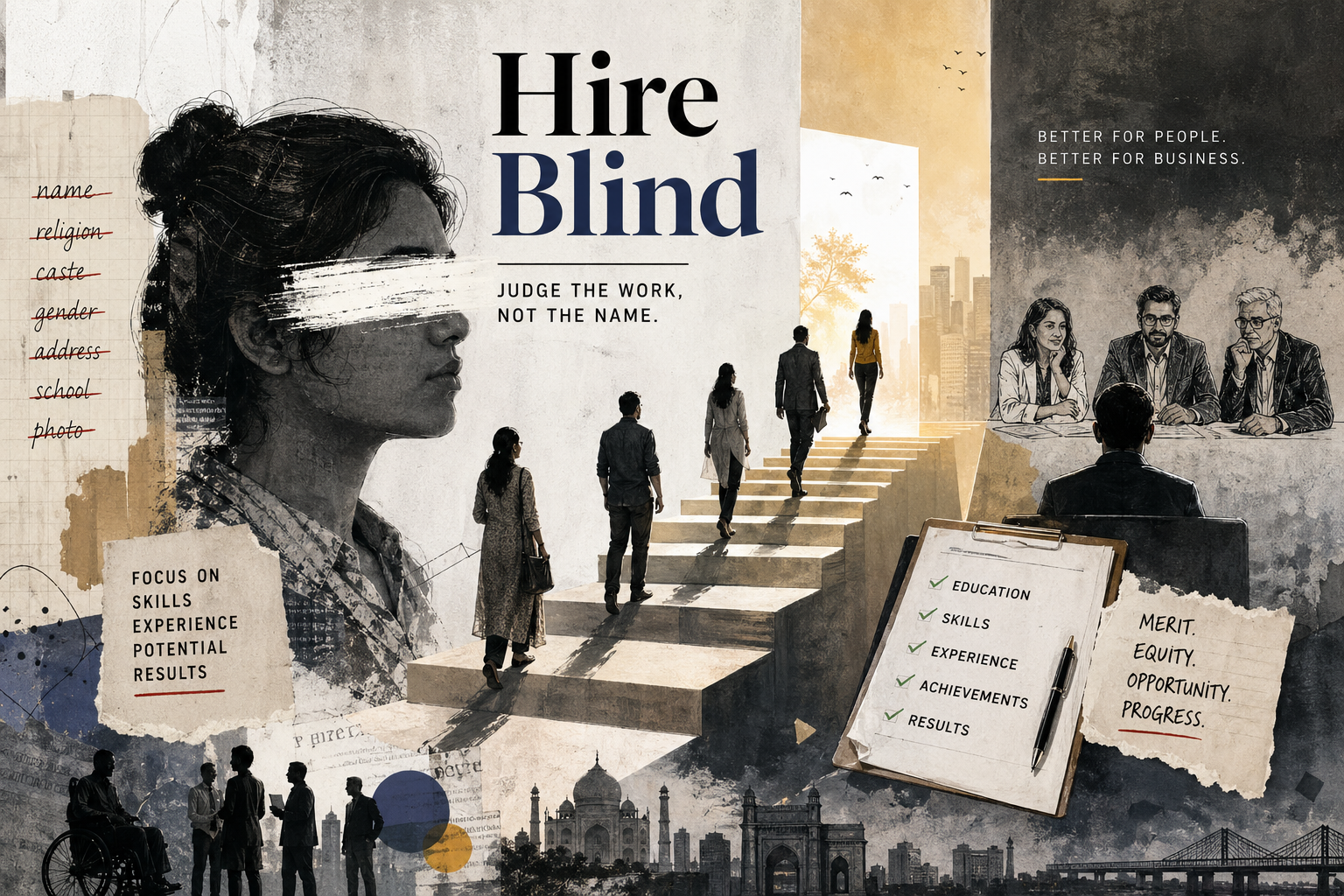
Blind CV screening means removing any information that could lead to bias, such as names, religion, gender, caste, address, school, and photographs. The removal of any information that could lead to bias, such as names, religion, gender, caste, address, school, and photographs, focuses on education, skills, experience, and results.
This is not radical. It honours meritocracy, which Indian industry claims to value.
The UK started using name-blind recruitment for its Civil Service in 2015. This change came after a Cabinet Office report showed that candidates from ethnic minority backgrounds were 28% less likely to get interview calls than white British applicants with the same CV. Now, major British employers like HSBC, KPMG, Deloitte, the BBC, and Virgin Money use blind hiring in at least some of their recruitment processes.
In Australia, a government-run randomised controlled trial found that de-identified applications significantly increased the share of women and people from minority backgrounds advancing to interviews. The Victorian Public Service has since mandated it.
France passed a law in 2006 that required large companies to use anonymous CVs, though enforcement has varied. The Netherlands and Sweden have also tried blind hiring in public institutions. In each country, the results were similar: when names are removed, the people who are called for interviews better reflect the applicant pool.
Why India Has Not Got There Yet
Indian companies do not have to report workforce diversity by religion, caste, or seniority. They also do not file reports like the American EEO-1 or the UK’s Gender Pay Gap disclosures. Without this kind of reporting, discrimination stays hidden.
Companies, researchers, and policymakers cannot say how many Muslims work at any given firm. Wipro and Infosys either do not know or do not share this information. Without data, there is no accountability. Without accountability, nothing changes.
The limited data we have paints a grim picture. Big companies often talk about inclusion and diversity, but their leadership teams show a different reality.
The Business Case, Since That Tends to Land Better
For those unconvinced by the equity argument, there is a practical one. McKinsey’s Diversity Wins report (2020) found that companies in the top quartile for ethnic and cultural diversity are 36% more likely to achieve above-average profitability than those in the bottom quartile. Deloitte research on inclusive teams shows they are 17% more productive and make better decisions 87% of the time compared to non-diverse teams.
India has a large talent pool, but it is not being used fairly. A hiring system that filters out qualified candidates from 15% of the population is not just unfair; it is also discriminatory and wasteful. Blind hiring is not charity for a minority group. It is a smart way to use resources.
What Needs to Happen
These recommendations are not new. What has changed is how urgent they have become.
First, SEBI and the Ministry of Corporate Affairs should mandate disclosure requirements for religion- and caste-based workforce in listed companies. This is similar to how gender diversity is increasingly being tracked on corporate boards. You cannot manage what you do not measure.
Second, large public-sector employers such as banks, railways, and PSUs should adopt blind recruitment for entry-level jobs. The Civil Services exam is already mostly anonymous, so the same idea can be used for PSU hiring., India’s IT industry bodies—NASSCOM in particular—should develop voluntary diversity benchmarks that include religion and caste. Voluntary, yes. But public, tracked, and published. Social pressure is a legitimate lever when legal levers are absent.
Fourth, the Maulana Azad National Fellowship, which was one of the few scholarships for Muslim students in higher education and was recently scrapped, should be brought back. It is not fair to expect a community to compete equally in the formal economy while taking away the only program that helps them enter it.
And fifth, and perhaps most immediately actionable, companies can simply begin. Remove the name and address from CVs. Try a three-month pilot. The results will speak for themselves, often more clearly than any opinion piece.
There is an old saying that meritocracy is a great idea, but we do not truly practice it. Blind hiring does not create a perfect meritocracy, since no tool can do that by itself. However, it does remove one of the most well-known and proven biases in hiring. Now is the time for companies, policymakers, and industry leaders to act. Judge the work, not the name. Start making the change today.
This is not a radical demand. It is the least we owe ourselves and each other. Let’s turn these principles into action and make equal opportunity real.
References & Research Cited
-
- Sachar Committee Report, Government of India (2006)
-
- Post-Sachar Evaluation Committee Report (2014)
-
- IIM-Ahmedabad study on Muslim hiring discrimination in the Indian private sector
-
- Oxfam India Inequality Report (2022)
-
- Bertrand & Mullainathan, Are Emily and Greg More Employable than Lakisha and Jamal?, American Economic Review (2004)
-
- McKinsey & Company, Diversity Wins: How Inclusion Matters (2020)
-
- Deloitte, The Diversity and Inclusion Revolution (2018)
-
- UK Cabinet Office, Diversity in the Civil Service (2015)
- Victorian Government Blind Recruitment Pilot, Australia (2017)
