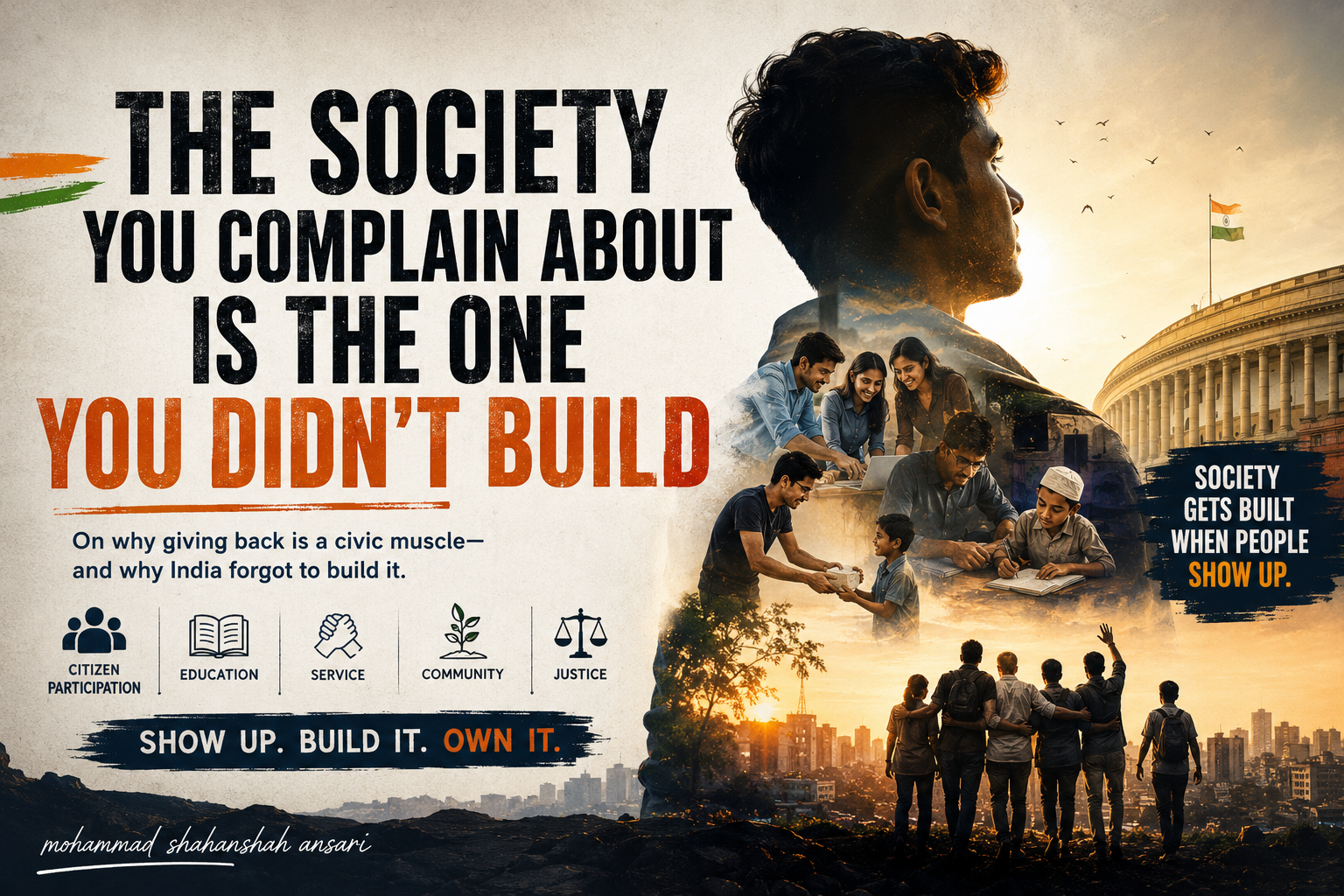
On why giving back is a civic muscle — and why India forgot to build it.
By Mohammad Shahanshah Ansari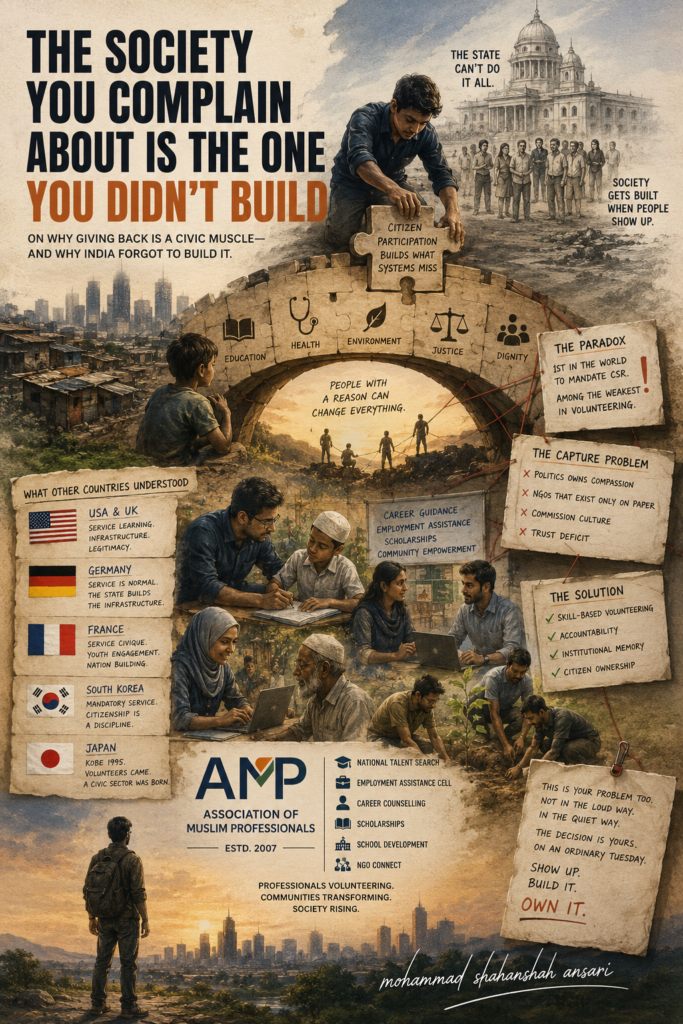 There’s a version of civic life where the government handles everything — roads, schools, hospitals, justice — and individuals just pay taxes and stay out of the way. Most Indians have grown up inside this version. It doesn’t work, and it never really did. The gap between what the state can do and what society actually needs has always been filled — or left unfilled — by ordinary people who chose to get involved. Non-profit organisations are where that choice gets organised.
When you join one, the immediate benefit isn’t to the cause. It’s to you. You develop a kind of situational awareness that no job can give you — an understanding of how things actually fall apart for people, and what it takes to hold something together that nobody is paid to maintain. You meet people outside your professional bubble. You practice disagreeing with someone and still showing up next week. These aren’t soft skills in the corporate sense. They’re the muscle memory of functioning citizenship. And there’s a neurological dimension to this that most people don’t know: researchers have documented what they call the “helper’s high” — a measurable release of oxytocin and endorphins when people engage in acts of service. Consistent volunteering correlates with lower cortisol levels, a reduced risk of depression, and a longer life expectancy. Giving back isn’t just morally correct. It’s biologically rewarding in ways that professional achievement alone doesn’t replicate.
From the field: Over a decade of working with non-profit organisations across sectors — education, livelihoods, public health, social justice — the single most striking pattern I’ve observed isn’t a funding or policy problem. It’s a participation problem. The organisations doing the most meaningful work are almost always led by individuals who came to social work not out of obligation but because they once witnessed a specific injustice up close. That personal encounter — a failed school, a denied medical claim, a community ignored — is what sustains people through years of underfunding and bureaucratic obstruction. Systems don’t transform societies. People with a reason do.
Beyond the individual, the math is straightforward. A society where people only look inward — toward family, income, immediate comfort — becomes one where public goods erode slowly and invisibly until they collapse all at once. Non-profits are the connective tissue. They absorb what the state misses and what the market ignores. Environmental monitoring, adult literacy, economic empowerment of the less privileged, mental health support in smaller cities, legal aid for people who can’t afford it — none of these exists at scale without organised citizen involvement.
What other countries understood
In the United States and the United Kingdom, the non-profit conversation happens at the level of infrastructure, not aspiration. American universities carry service-learning credits. UK schools run the Duke of Edinburgh programme from age fourteen. Governments offer tax deductions for donations and — more significantly — actively fund non-profit delivery through grants and public tenders. The result is a sector that employs millions, performs services the state formally outsources, and produces a generation of civic professionals who understand social problems from the inside. The sector has legitimacy across political, cultural, and economic spheres.
In Germany, the picture is even more instructive. When Germany abolished mandatory military service in 2011, it didn’t simply remove an obligation — it replaced it with the Bundesfreiwilligendienst, the Federal Volunteer Service, a structured twelve-month programme open to people of all ages, offering stipends, health insurance, and pension contributions. Over 35,000 Germans enrol annually. The state essentially said: ” We believe service to society is a normal part of life, and we’ll fund the infrastructure to make it easy. France runs a parallel scheme called Service Civique — 150,000 young people between sixteen and twenty-five take up six to twelve months of civic engagement every year, receive a modest government allowance, and work in organisations that could not otherwise afford full-time staff.
South Korea takes a harder line. Community service hours are mandatory for high school graduation — students who don’t complete them don’t receive their certificates. Singapore embedded civic involvement through its Values in Action programme, wired into the school curriculum as non-negotiable. Neither country treated this as charity or idealism. They treated it as nation-building — the same category as maths or physical education.
“Japan’s civil society didn’t grow from policy. It grew from an earthquake. The Kobe disaster of 1995 exposed something the government couldn’t deny: ordinary citizens organised more quickly, fed more people, and reached more victims than the official relief machinery. The year became known as ‘the first year of volunteering in Japan.'”
The Kobe earthquake of January 1995 killed over six thousand people and left three hundred thousand displaced. What followed was unexpected: within days, over 1.3 million volunteers arrived from across Japan, largely self-organised, with no government coordination. They outperformed official disaster response in speed, reach, and adaptability. The government watched and drew a conclusion. Three years later, Japan passed the NPO Law of 1998, which, before it, required forming a non-profit in Japan to navigate a near-impossible maze of bureaucratic approvals. The law removed those barriers almost entirely. Japan’s registered NPOs went from essentially zero to over fifty thousand within a decade. A disaster created a civic sector. What it really did was surface one that was already there, waiting for permission to exist legally.
India’s strange paradox
India’s relationship with civil society is more complicated and more honest to examine without flattery. The tradition exists — dharmic obligation, the waqf system, community trusts, and Gandhian constructive work. But something happened somewhere between independence and liberalisation. As the middle class grew, it began treating social work as either a government problem or a personal charitable decision. Izzat — reputation — got tied to income and professional rank, not to community contribution. Volunteering became something you did only if you were retired, religious, or had time to spare.
Here is the paradox that almost no one mentions: India was the first country in the world to legally mandate corporate social responsibility. The Companies Act of 2013 requires firms above a certain size to spend 2% of their net profits on social initiatives. First in the world. And yet, India’s culture of volunteering ranks among the weakest globally. The Charities Aid Foundation’s World Giving Index consistently places India in the lower half of its rankings on volunteering time. We legislated corporate giving before we built a culture of personal giving. We put the institutional cart before the citizen horse, and then wondered why the system felt hollow.
From the field: The project culture gap between Indian and Western non-profits is real and consequential. Well-run Western organisations — particularly in Northern Europe — operate on outcomes frameworks: what changed, by how much, verified by whom. Indian organisations, even well-intentioned ones, more often run on relationship frameworks: who trusts whom, who is owed what, which leader’s network this falls under. Neither is entirely wrong, but the relationship model breaks down badly when the patron leaves, the leader changes, or the funding dries up. Sustainability in the non-profit sector requires institutional memory, not personal loyalty. That’s a cultural shift, not just a management fix.
The capture problem
There’s another problem that doesn’t get named often enough. In India, the idea of giving back to society has been so thoroughly captured by political actors that ordinary citizens have stopped seeing it as theirs. Social work gets done around election time. Camps are organised under party banners. Welfare schemes are announced with someone’s face on them. The result is that volunteerism — the unglamorous, unsponsored, unselfconscious kind — has lost its independent identity. People conflate it with political mobilisation and stay away.
Into that gap steps a different kind of operator: the NGO that runs on commission, the trust that exists mainly on paper, the “social worker” whose primary interest is the flow of funds rather than the work itself. This isn’t a fringe problem. Credible estimates suggest that a significant portion of FCRA-registered organisations in India have either never filed annual returns or ceased operations while remaining on paper. The commission culture is structural: government welfare schemes flow through implementing agencies, and each layer in that chain has historically taken its cut before the benefit reaches the intended beneficiary. The non-profit became an extraction mechanism dressed in the language of service.
This is what needs to be separated — firmly and publicly — from what volunteerism actually is. Giving back to society cannot remain the exclusive vocabulary of those who need something in return. And social work cannot stay the preserve of politicians who discover compassion every five years. When those two groups own the narrative, everyone else assumes there’s nothing left for them to do. There is. There always was.
What actually exists — and what it needs
Across India, there are organisations quietly doing what the article above describes — run by professionals, sustained by volunteers, accountable in ways that party-linked “welfare” never is. One of the more substantive examples is the Association of Muslim Professionals (AMP), which has been operating since 2007 across education, employment, and economic empowerment for underserved communities. AMP runs a National Talent Search that identifies and supports meritorious students, an Employment Assistance Cell that connects job-seekers with industry, career counselling cells spread across state chapters, scholarship funds, school development programmes, and an NGO Connect platform that networks grassroots organisations working in the same space and do their capacity building. What makes it worth citing isn’t the scale — it’s the model. AMP is run almost entirely by working professionals who volunteer their time, skills, and networks. A software engineer who conducts mock interviews on weekends. A finance professional who mentors students applying for CA courses. A corporate HR manager who helps a job-seeker in a smaller city navigate the recruitment process. This is exactly the kind of skill-based volunteerism that transforms a community without waiting for a government scheme or a donor cycle to make it possible. Organisations like AMP are what serious civic participation looks like — not a charity event on a company calendar, but a sustained commitment by people who have something to offer and choose to offer it.
AMP India works across education, career guidance, employment, and community empowerment. If you’re a working professional looking to contribute meaningfully, their chapter network is active across most major cities. Visit ampindia.org to learn more or get involved.
What would actually change things?
Overcoming this requires pressure from three directions at once. Governments need to simplify compliance for genuine organisations, extend meaningful tax incentives to salaried individuals — not just corporates — and treat the non-profit sector as a delivery partner, not a surveillance target. FCRA reform that distinguishes legitimate civil society from genuinely suspect foreign influence is long overdue. That’s the policy argument, and it’s been made before without much traction. But it bears repeating until someone listens.
The cultural argument is harder but more urgent. Indians in their thirties and forties who are professionally established need to stop treating social involvement as something they’ll get to later. Skill-based volunteering — a lawyer doing pro bono work, a data analyst helping a health NGO read its numbers, a product manager helping a grassroots organisation build systems that outlast its founders — is worth far more than an annual donation. Most non-profits don’t need money as badly as they need competence, continuity, and the credibility that comes when people with something to lose choose to be present.
And individuals, frankly, need to stop waiting to be asked. The organisations exist. The problems are not abstract. What’s missing, more than funding or policy, is the basic belief that your participation changes something — that it is, in the quieter sense of the word, your problem too. Germany understood this. Japan learned it from an earthquake. South Korea put it on a report card. India keeps waiting for a politician to announce it.
That announcement isn’t coming. The decision is yours, usually in some ordinary moment, when there’s always something easier to do instead.