A Roadmap for Transforming Learning in the Age of Artificial Intelligence
By Mohammad Shahanshah Ansari
Introduction
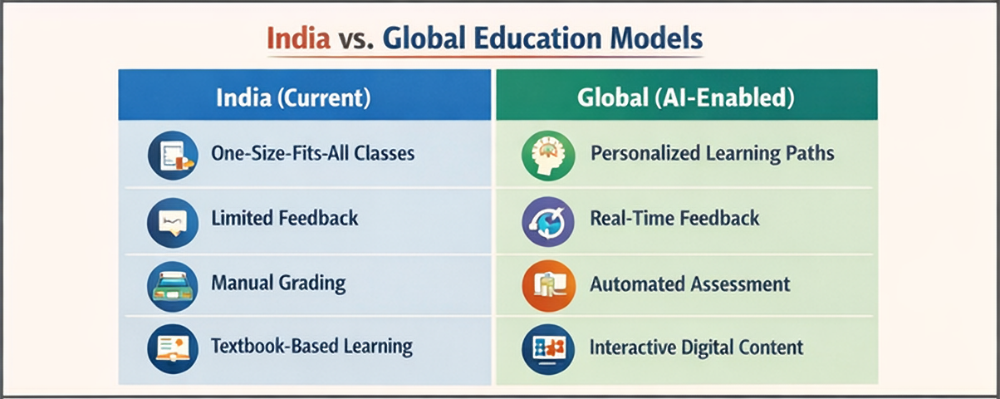
Education systems around the world are undergoing a profound transformation. The rapid emergence of artificial intelligence (AI) has created an opportunity to redesign how knowledge is delivered, assessed, and applied. Traditional education systems—built around uniform curricula and standardized teaching methods—struggle to meet the needs of diverse learners in a fast-changing world.
Artificial intelligence offers a powerful alternative: personalized, adaptive, and data-driven education that adjusts to each learner’s pace and ability.
Countries such as the United States, Estonia, Singapore, and Finland are already experimenting with AI-driven educational models that personalize learning, automate routine teaching tasks, and equip students with digital skills needed for the future economy.
For India, with over 250 million school students, AI-enabled education is not simply a technological upgrade—it is a strategic necessity for national development.
The Problem with the Current Education Model
India’s education system faces several structural challenges.
| Challenge | Impact |
| One-size-fits-all teaching | Students learn at different speeds but receive identical instruction |
| Teacher shortages | Overburdened teachers reduce learning quality |
| Limited feedback | Students often receive delayed feedback on learning gaps |
| Outdated curriculum | Education often focuses on memorization instead of problem solving |
| Inequality in access | Rural and disadvantaged students lack quality resources |
AI can address these problems by individualizing learning and augmenting teachers rather than replacing them.
What is AI-Enabled Education?
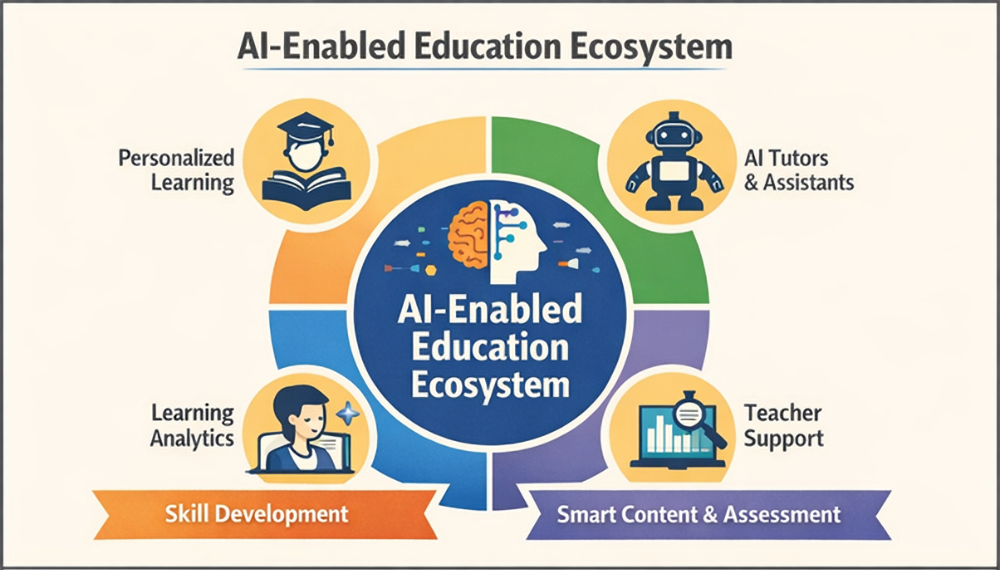
AI-enabled education refers to the use of artificial intelligence technologies to enhance teaching and learning through:
- Personalized learning paths
- Intelligent tutoring systems
- Automated grading and assessment
- Predictive learning analytics
- AI-assisted content generation
Adaptive learning platforms can analyze a student’s performance in real time and adjust lessons accordingly, ensuring that each learner progresses at an appropriate pace. (University of San Diego Online Degrees)
Research also shows that AI systems can increase student engagement and motivation by providing tailored feedback and personalized learning experiences. (ScienceDirect)
Global Models of AI-Driven Education
1. United States: Personalized AI Tutoring
Many American schools are integrating AI-powered tutoring systems to support individualized learning.
Key features include:
- Adaptive learning platforms
- AI teaching assistants
- Automated assessments
- Data-driven insights for teachers
Studies show that AI tutoring systems improve learning performance and engagement, particularly in subjects like mathematics. (PMC)
Some innovative schools even use AI to personalize lessons so effectively that core academic subjects can be mastered more efficiently while freeing time for creativity and life skills. (Chron)
2. Estonia: National AI Education Strategy
Estonia is often considered one of the most digitally advanced education systems in the world.
Key initiatives include:
- National AI education program (“AI Leap”)
- AI literacy for students
- Training teachers to use AI tools
- Personalized learning platforms
The government plans to equip tens of thousands of students and teachers with AI tools to support digital learning. (The Guardian)
Estonia consistently ranks among the top performers in international education assessments.
3. Singapore: Smart Learning Ecosystem
Singapore integrates AI through its Smart Nation education strategy.
Focus areas include:
- AI-driven learning analytics
- digital classrooms
- adaptive educational software
- AI-supported teacher training
The goal is to build a workforce capable of thriving in the digital economy.
Core Components of an AI-Enabled Education Model
An effective AI-driven education system should include five foundational elements.
1. Personalized Learning
Every student learns differently.
AI systems can analyze:
- learning speed
- mistakes
- subject strengths
- engagement patterns
Based on this data, AI platforms can recommend customized lessons.
Example:
| Student | Learning Need | AI Solution |
| Student A | Slow in mathematics | Additional practice modules |
| Student B | Fast learner | Advanced challenges |
| Student C | Visual learner | Interactive simulations |
2. AI Tutors for Every Student
AI tutors can provide 24/7 academic assistance, helping students understand concepts beyond classroom hours.
Benefits include:
- instant feedback
- unlimited practice
- personalized explanations
- continuous evaluation
AI chat-based tutors are already helping millions of students learn independently.
3. Teacher Augmentation, Not Replacement
AI should empower teachers rather than replace them.
Teachers will shift from:
Information deliverers → Learning mentors
AI can automate:
- grading assignments
- generating quizzes
- tracking performance
- administrative tasks
This allows teachers to focus on mentorship, creativity, and critical thinking development.
4. Data-Driven Learning Analytics
AI can analyze large volumes of learning data to identify patterns.
Example insights:
| Data Signal | Insight |
| Repeated mistakes | Concept misunderstanding |
| Slow progress | Need for personalized support |
| Low engagement | Need for different teaching method |
This allows early intervention before students fall behind.
5. AI Literacy for Students
Students must learn how AI works, not just how to use it.
Core AI literacy topics include:
- algorithmic thinking
- data ethics
- machine learning basics
- responsible AI usage
Countries integrating AI education are preparing students for a workforce increasingly shaped by automation.
Potential Benefits for India
Implementing AI-enabled education could transform India’s education system.
| Area | Impact |
| Learning outcomes | Improved comprehension and retention |
| Teacher productivity | Reduced administrative burden |
| Education equity | Access to quality tutoring anywhere |
| Skill development | AI literacy and digital skills |
| Economic growth | Future-ready workforce |
A survey of U.S. educators found that over half believe AI improves learning outcomes in classrooms. (Southern Methodist University)
A Proposed AI Education Model for India
A national AI education framework could include the following structure.
Phase 1: Digital Infrastructure
- High-speed internet in schools
- affordable student devices
- national digital learning platform
Phase 2: AI Learning Platform
A government-supported AI learning system providing:
- adaptive courses
- virtual tutors
- assessment tools
- multilingual support
Phase 3: Teacher Training
Train teachers to:
- use AI tools effectively
- analyze learning data
- mentor students
Phase 4: AI Curriculum
Introduce AI concepts from middle school.
Subjects could include:
- computational thinking
- data science
- ethical AI
- robotics
Challenges and Ethical Considerations
While AI offers enormous potential, responsible implementation is essential.
Key concerns include:
| Risk | Solution |
| Over-reliance on technology | Balanced human-AI teaching |
| Data privacy | strong data protection policies |
| AI bias | transparent algorithms |
| cheating and misuse | ethical AI education |
Experts emphasize that safeguards are needed to ensure AI supports learning rather than enabling shortcuts or academic dishonesty. (College of Education)
The Way Forward
India has a historic opportunity to leapfrog traditional education systems by integrating artificial intelligence into learning.
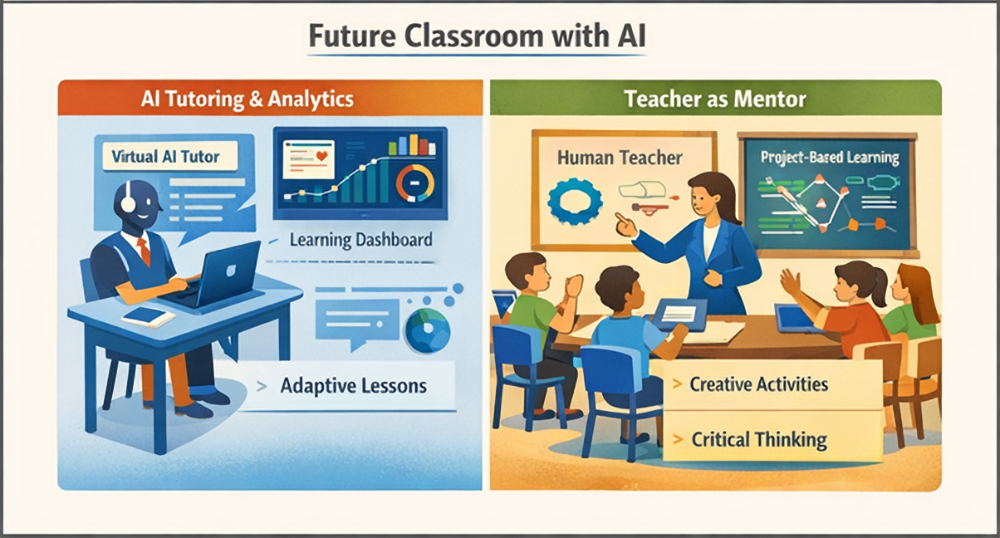
The future classroom will likely combine:
- human teachers
- AI tutors
- digital simulations
- project-based learning
Such a system would shift education away from memorization toward creativity, critical thinking, and problem solving.
Conclusion
Artificial intelligence is not merely a technological tool—it is a transformative force capable of redefining education itself.
Countries investing early in AI-driven learning are preparing their citizens for a future shaped by automation, digital economies, and knowledge-driven industries.
For India, adopting an AI-enabled education model could unlock the potential of millions of young minds and accelerate national development.
The question is no longer whether AI will reshape education.
The real question is whether we will lead this transformation—or follow it.