Where the State Stands, Why It Lags, and What Must Change
By Mohammad Shahanshah Ansari
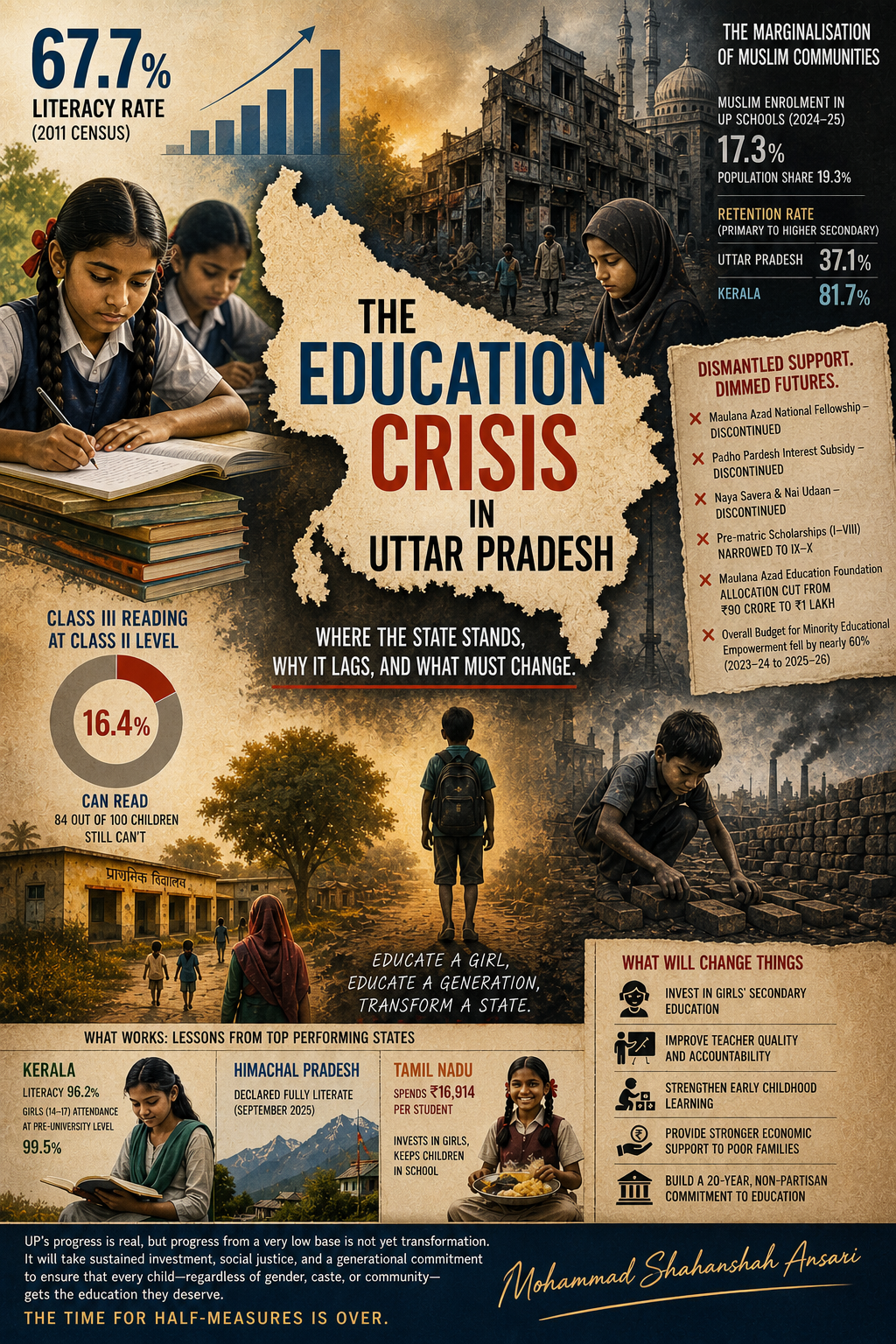
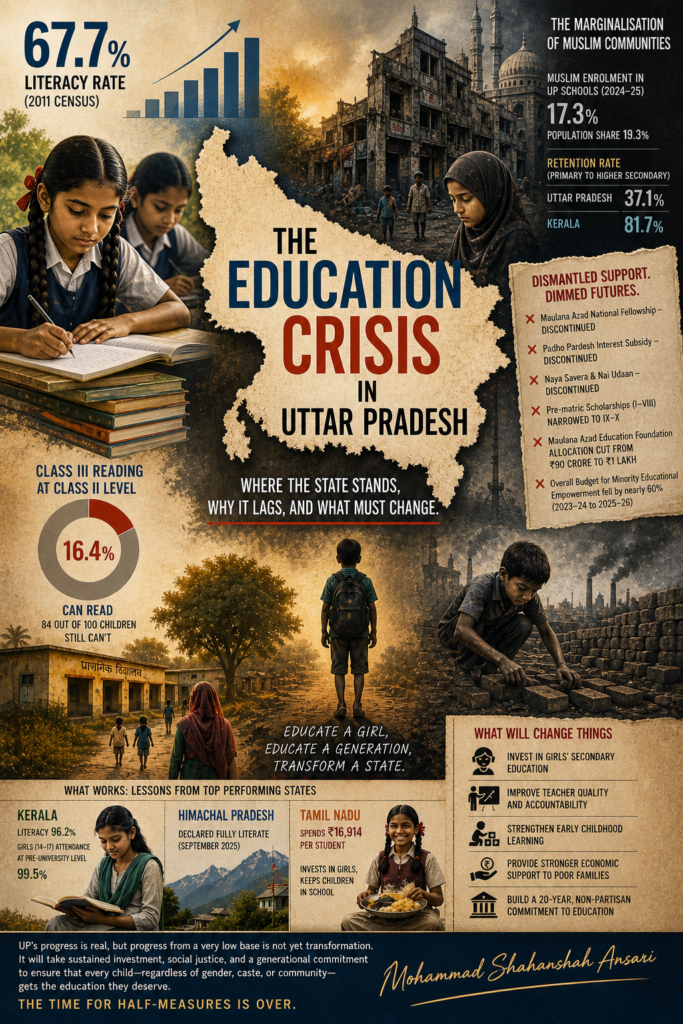
One number sums up UP’s education challenge: 67.7 per cent literacy in the 2011 Census. The national average was 73 per cent. That six-point gap may look small, but with over 200 million people, it means millions lack basic literacy. Even 67.7 per cent is misleading because it masks significant differences between men and women, rural and urban areas, regions, and communities.
NSO survey data show that UP’s female literacy rate is much lower than in Kerala and Mizoram. The gap is huge, almost as if you were looking back in time. There has been some progress, but UP seems stuck, unable to catch up as the challenge grows.
What the Enrolment Numbers Are Actually Telling Us
 UP has raised school enrolment. According to ASER 2024, more than 95 per cent of children aged 6 to 14 are now in school. This is positive, but enrolment by itself does not guarantee education. The real question is what happens once children are in school.
According to UDISe+ 2023–24, UP’s secondary-level Gross Enrolment Ratio is 82.9 per cent, but the Net Enrolment Ratio, which measures age-appropriate attendance, is only 67 per cent. This 15-point difference shows that many students are older than expected for their grade or started school late. They are not moving through the system as they should.
The situation in pre-school is also worrying. More than half of UP’s three-year-olds are not in any early childhood program. This matters because the brain is most adaptable in the first six years. Language, math, and social skills develop during this time and are hard to build later. Children who miss this stage start Class I behind and often struggle to catch up.
The learning crisis highlights how serious the situation is. In 2022, only 16.4 per cent of Class III children in UP could read a Class II-level text. This number reveals the true state of education. It is not that 16 per cent are struggling—only 16 per cent can read at all. After three years in school, 84 out of 100 children are still unable to read properly. This is not just a gap; it is a deep, structural problem.
Girls in UP attend school at lower rates than in other states. At the pre-primary level, only 22.7 per cent attend, and at the pre-university level, the rate is 64.5 per cent. Both are the lowest in the country.
The Muslim Community: Left Even Further Behind
A true look at UP’s education crisis must address one of its biggest issues: the educational marginalisation of Muslims, who make up almost 19.3 per cent of the state’s population, or over 38 million people.
Muslims in UP make up a disproportionately large share of illiterate people. The 2006 Sachar Committee Report, the most comprehensive official study of Muslims in India, found that Muslims in Uttar Pradesh had lower literacy, higher dropout rates, and less access to higher education. In some cases, their educational outcomes were worse than those of the Scheduled Castes and the Scheduled Tribes. This means a religious community is more marginalised in education than groups with a constitutional history of discrimination.
Recent UDISE+ 2024–25 data shows Muslim enrolment in UP schools is 17.3 per cent, below the community’s population share of 19.3 per cent. The retention rate is 37.1 per cent from primary to higher secondary. By comparison, in Kerala, the retention rate is 81.7 per cent.
Districts with large Muslim populations, such as Rampur, Moradabad, Bijnor, and Azamgarh, often rank lowest on human development indicators. The decline of traditional crafts like weaving, brasswork, and leatherwork has made these areas more economically vulnerable, and formal jobs have not replaced these losses. For girls, challenges are even greater: social customs, early marriage, distant schools, and family finances all make education harder to access. In poor families, a daughter’s education is often seen as the least affordable cost.
UP has more than 16,000 registered madrasas, with many more unregistered. These schools are important because they serve millions of the poorest children and are often the only educational option when government schools are absent or not functioning. Most madrasas focus on theology, Arabic, and law, so their graduates have limited opportunities in the formal economy or higher education. The madrasa is not the reason for Muslim educational challenges; it is a symptom, filling the gap left by the state’s lack of support for these communities.
The deprivation has worsened as the targeted support infrastructure built after the Sachar Committee’s recommendations was dismantled. From 2022–23, the central government discontinued the Maulana Azad National Fellowship. This fellowship funded Muslim students pursuing MPhil and PhD degrees. Padho Pardesh interest subsidy for overseas education was also discontinued. The free coaching schemes Naya Savera and Nai Udaan, which supported minority candidates in clearing the UPSC preliminary exams, were also ended. Pre-matric scholarships were narrowed from Classes I–VIII to only Classes IX–X. This decision is troubling, as most dropouts happen long before Class IX. The Maulana Azad Education Foundation has funded scholarships for minority girl students since 1989. Its allocation was cut from Rs 90 crore in 2021–22 to Rs 1 lakh in 2022–23. The Foundation was formally ordered shut in February 2024. The overall budget for minority educational empowerment under the Ministry of Minority Affairs fell from Rs 1,689 crore in 2023–24 to Rs 678 crore in 2025–26. This is a collapse of nearly 60 per cent in two years. Budget utilisation, which had been close to 100 per cent, dropped to 5 per cent in 2023–24 because the schemes were neither approved nor implemented. A parliamentary standing committee noted in early 2025 that scholarship schemes had not been approved beyond 2021–22. It urged the government to at least implement them in states where irregularities were minimal, so that students were not penalised for no fault of theirs.
The community that needed steady, focused support to close a long-standing gap is now getting less help each year.
Why the Top-Performing States Pulled Ahead
To understand why UP is struggling, we need to look at what successful states have done differently.
Kerala’s literacy rate today is 96.2 per cent. The male-female gap is just 2.2 percentage points—the smallest in the country. Kerala led the nation in literacy since the 19th century and maintained that lead through sustained investment for over 150 years. This is the key distinction. Not any programme or any government, but generational continuity of intent. Kerala educated its women first and longest. Educated women produced children who stayed in school, demanded better schools, and educated their own children. The positive cycle sustained itself and became self-sustaining. At the pre-university level, Kerala’s attendance ratio for girls aged 14–17 is 99.5 per cent. UP’s is 64.5 per cent.
Himachal Pradesh’s story is, in some ways, even more instructive. The state started out much like UP. Between 1961 and 2001, it went through a ‘Schooling Revolution’ and was declared fully literate in September 2025. This change was not driven by wealth, but by a social structure without strict hierarchies. The government made literacy a top priority and mobilised the entire administration to achieve this goal. Officials identified people who could not read and worked with community leaders. They ensured that every level of the bureaucracy was accountable for results. The mechanics are worth studying. The government identified illiterates by name. It assigned “animators” to teach five people each. It established 360 continuing education centres to catch school dropouts before they left the system completely. Mizoram went from 31 per cent literacy in 1951 to over 88 per cent by 2001. This was not due to money, but to a focused mission.
Tamil Nadu linked industrial growth with education spending in ways UP has not. Tamil Nadu spends Rs 16,914 per student, while UP spends much less. The midday meal scheme, which started in Tamil Nadu before becoming a national program, helped keep children in school. For poor families, sending children to school made financial sense. Tamil Nadu also invested heavily in girls’ secondary education through self-help groups and incentive programs. This helped break the cycle where uneducated mothers have children who leave school early.
The lesson from all these examples is clear. States that improved literacy treated it as a long-term project, focused first on women’s education, made school attendance affordable for poor families, and kept their efforts going across different governments. UP has not done these things consistently or for long enough.
Here is a striking fact: 43.6 per cent of all school-age children in India, aged 5 to 14, live in the four BIMARU states. Improving education in UP would have a bigger effect on India’s overall human capital than similar progress in almost any other state.
The Structural Reasons UP Remains Behind
The most basic problem is the cycle that passes from one generation to the next. In Kerala, 99.1 per cent of mothers have gone to school. In UP, the number is much lower, at 30.3 per cent, close to Rajasthan’s, according to the ASER survey. Mothers who have not been to school are much less likely to ensure their children attend school, help them learn at home, or resist the financial pressures that lead to dropping out. This gap keeps repeating itself. Caste exclusion is another major problem. The secondary Gross Enrolment Ratio for Scheduled Tribes in UP is 55 per cent, much lower than the state’s already low average. Children from the lowest social groups face not only poverty but also discouragement: schools are often far from Dalit communities, teachers are absent more often in rural and lower-caste areas, and the social system has not valued their presence in schools.ms.
Poverty also pushes children out of school. In eastern UP, a child who can earn Rs 200 a day in a brick kiln or on a farm brings in money that many families need. No education program has fully solved this problem, because it is not just about education—it is an economic issue that affects school attendance.
Teacher quality is another serious problem. ASER 2024 found that student attendance in UP government schools is 71.4 per cent—better than before, but still low. In rural UP, it is common for one teacher to handle two or three grades at once. In these settings, focused teaching is almost impossible, and basic learning rarely occurs. The pipeline breaks down entirely. UP’s Gross Enrolment Ratio at the higher education level is 23.2 per cent — below the national average. Children who survive the system through secondary school often have neither the quality of learning to compete for seats nor the financial resources to afford the journey if they get one.
What the State Government Has Done
It is important to recognise what the current government has done, and some of these steps are truly significant.
The NIPUN Bharat mission, implemented in UP as Mission Prerna, is the most serious foundational literacy intervention the state has run. It targets 1.8 crore students across 1.59 lakh schools. Nearly 4.76 lakh teachers have been trained through face-to-face modules across all 75 districts. One DIET mentor and five Academic Resource Persons per block now conduct a lakh school visits every month. Over 40,000 Shikshak Sankuls — peer learning groups for teachers — have been established for monthly meetings.
The results are showing up in hard-to-dismiss data. Between 2022 and 2024, reading proficiency in UP’s government school Class III students rose by 12 percentage points and subtraction ability by 14 points. ASER 2024 placed UP among the small group of states — alongside Kerala, Himachal Pradesh, and Maharashtra — that improved Class III reading levels by more than 10 percentage points in government schools in just two years. For a state that started at 16.4 per cent, this is not a small achievement.
The School Chalo Abhiyan brought 13.22 lakh out-of-school children into the system in 2024–25 and 15.84 lakh more in 2025–26. The NIPUN Vidyalaya Assessment evaluated over 64,000 schools in early 2025, certifying 48,061 of them as meeting foundational literacy and numeracy benchmarks — a measure that did not exist five years ago.
These are real improvements, starting from a very low point. They have not yet changed the overall structure, but they are taking steps in the right direction.
What Will Actually Change Things
Schemes alone are not solutions; they are just starting points. Real change needs a different kind of commitment, one that lasts for decades instead of just until the next election.
The most important investment UP can make is in girls’ secondary education, not just primary enrolment, which is already high. The goal should be to keep girls in school until Class XII. Each extra year of secondary school for a woman is associated with later marriage, fewer children, higher family income, and a much greater chance that her children will stay in school. Kerala became literate not because of a single program, but because it educated women for generations. UP needs to begin this long-term effort.
Improving teachers is more important than building more schools. UP already has schools, but it needs teachers who are present, can teach mixed classes, and are responsible for what students learn, not just for attendance. NIPUN has started to create this culture, but it needs to go further, stay free from political influence, and reach higher grades.
Early childhood education gives the longest-lasting benefits. Turning the Anganwadi system from just a nutrition program into a real learning environment is not a small change. It decides whether a child starts Class I ready to learn or already behind, which can affect their whole school life.
Economic help for poor families needs to be stronger. Midday meals and uniforms help a little, but for families where sending a child to school means losing income, larger conditional cash transfers are needed. For Muslim students, it is especially important to restore pre-matric scholarships from Class I, not just Class IX. Since most dropouts happen early, support must start early, too.
Another key issue is institutional memory. Himachal Pradesh and Mizoram show that states succeed when they treat literacy as a long-term, non-partisan goal. UP’s main problem is not a lack of effort, but that when governments change, priorities shift, and important programs are renamed or stopped, progress is lost. What is needed is not just another five-year plan, but a true twenty-year commitment that is protected from election cycles, measured independently, and cannot be easily undone by the next government.
This applies with particular force to the Muslim community. The support infrastructure built in the wake of the Sachar Committee’s findings took years — and considerable political will — to assemble. It can be, and has been, dismantled in a single budget cycle. A Muslim student from Azamgarh who loses a pre-matric scholarship in Class V does not simply defer her education. She leaves it. A young researcher from Moradabad who cannot fund a PhD without a fellowship has no other option. He finds another life. These are not statistics waiting to be recovered in the next survey round. They are people. And the governments — state and central — that have quietly stepped back from their obligations to this community should be held to account for what that stepping back actually costs.
UP’s education story in 2025 sits in an uncomfortable place. The progress is real — earned slowly, inside a broken system, by teachers who showed up, administrators who pushed, and communities that refused to stop trying. But progress from a very low base, moving at the current pace, does not yet constitute transformation. The structural conditions are still there: the poverty that pulls children out of classrooms, the caste that keeps certain children out altogether, the political culture that treats education as a manifesto line rather than a fifty-year project. The numbers have moved. The ground beneath them has not shifted enough. That gap — between what is being measured and what is actually changing — is where UP’s future is still being decided.
References
- Census of India 2011 — Literacy Rate Data, Office of the Registrar General and Census Commissioner, Ministry of Home Affairs https://censusindia.gov.in
- ASER 2024 (Annual Status of Education Report), ASER Centre / Pratham https://asercentre.org/aser-2024/
- UDISE+ 2023–24 and 2024–25 Reports, Department of School Education and Literacy, Ministry of Education, Government of India https://www.education.gov.in/sites/upload_files/mhrd/files/statistics-new/UDISE+Report%202024-25%20-%20Existing%20Structure.pdf
- Muslim Education in India: Analysis Based on UDISEPlus 2024–25 Data, Education for All in India (Prof. Arun C. Mehta) https://educationforallinindia.com/muslim-education-in-india-analysis-based-on-udiseplus-2024-25-data/
- Summary Report for the State of Uttar Pradesh, NITI Aayog, 2025 https://niti.gov.in/sites/default/files/2025-07/Summary-Report-Uttar-Pradesh%20(1).pdf
- Macro and Fiscal Landscape of the State of Uttar Pradesh, NITI Aayog https://www.niti.gov.in/sites/default/files/2025-07/Macro-and-Fiscal-Landscape-of-the-State-of-Uttar-Pradesh-1.pdf
- School Education Quality Index, NITI Aayog (quoted in The Print, December 2019) https://theprint.in/india/education/kerala-is-best-performing-state-for-education-of-girls-uttar-pradesh-the-worst/335646/
- Comparing UDISE+ 2024–25 with ASER 2024, Education for All in India https://educationforallinindia.com/comparing-udise-2024-25-with-aser-2024/
- Secondary Education in India: Analysis of UDISE+ 2024–25 Data, Education for All in India https://educationforallinindia.com/secondary-education-in-india-where-do-we-stand-an-analysis-of-udise-2024-25-data/
- Understanding UDISE+ 2023–24 Enrolment Ratios under Samagra Shiksha, Education for All in India https://educationforallinindia.com/wp-content/uploads/2025/02/decoding-enrolment-ratio-2023-24.pdf
- Literacy in India, Wikipedia (with references to Census and PLFS data) https://en.wikipedia.org/wiki/Literacy_in_India
- Indian States by Literacy Rate 2026, National Statistical Office Survey https://www.findeasy.in/indian-states-by-literacy-rate/
- Bihar, Uttar Pradesh, Rajasthan and Madhya Pradesh have the worst literacy rates, Scroll.in (citing ASER Trends Over Time and Economic and Political Weekly) https://scroll.in/article/825780/bihar-uttar-pradesh-rajasthan-and-madhya-pradesh-have-worst-literacy-rates-school-outcomes
- India’s Progress Engine: The Groundwork Behind NIPUN Bharat Mission, Central Square Foundation https://www.centralsquarefoundation.org/articles/indias-progress-engine-the-groundwork-behind-nipun-bharat-mission
- NIPUN Bharat (Mission Prerna), Official Website, Department of Basic Education, Government of Uttar Pradesh https://basiceducation.up.gov.in/en/page/nipun-bharat-(mission-prerna)
- NIPUN Bharat Mission Improves Foundational Learning Outcomes, ForumIAS (citing Indian Express, February 2025) https://forumias.com/blog/nipun-bharat-mission-improves-foundational-learning-outcomes/
- UP Yogi Government: NIPUN Bharat Mission — Over 32,000 Schools Attain NIPUN Status, Women Express https://www.womenexpress.in/state-news/uttar-pradesh/up-yogi-government-nipun-bharat-mission-over-32000-schools-attain-nipun-status/40667/
- ASER 2024 Report: Education Trends, Digital Literacy and NEP Impact, Tarun IAS https://tarunias.com/exams/upsc-notes/aser-2024-report/
- Justice Rajinder Sachar Committee Report, 2006, Prime Minister’s High Level Committee, Government of India https://minorityaffairs.gov.in/sites/default/files/sachar_comm.pdf
- Muslim Education in Uttar Pradesh: Pathways to Inclusion and Reform, Countercurrents / SabrangIndia https://countercurrents.org/2025/08/muslim-education-in-uttar-pradesh-pathways-to-inclusion-and-reform/
- 18 Years After the Sachar Report: Lot More Needed on Education of Muslims, Clarion India https://clarionindia.net/18-years-after-the-sachar-report-lot-more-needed-on-education-of-muslims/
- Minority Welfare in Decline: Budget Allocations, Utilisation, and the SDG Paradox, Sabar Institute, 2025 https://sabarinstitute.org/minority-welfare-in-decline-budget-allocations-utilisation-and-the-sdg-paradox/
- Maulana Azad Scholarship for Minority Communities Discontinued by Union Government, National Herald India https://www.nationalheraldindia.com/national/maulana-azad-scholarship-for-minority-communities-discontinued-by-union-government
- Controversial Closure of Maulana Azad Foundation Sparks Outrage, The Mooknayak https://en.themooknayak.com/minority-news/closure-of-maulana-azad-education-foundation-a-retrogressive-step-an-agenda-against-minorities
- Minority Scholarship Schemes Frozen for Over 3 Years Due to Irregularities, Parliamentary Panel Flags Concern, Dailyhunt / The Wire https://m.dailyhunt.in/news/india/english/the+wire+english-epaper-wireng/minority+scholarship+schemes+frozen+for+over+3+years+due+to+irregularities+parliamentary+panel+flags+concern-newsid-n704550102
- Funding for Minority Students Plummets, Govt Figures Show, The Federal https://thefederal.com/category/education/govt-data-sharp-drop-fund-allocation-minority-students-202664
- Minority Budget Utilisation Hits Record Low, Kashmir Times https://kashmirtimes.com/news/minority-budget-utilisation-falls-to-alarming-levels
- Madrasa Programme, Tata Trusts https://www.tatatrusts.org/our-work/education/broadening-access/madrasa-programme
- Muslim Education in India 2023, Education for All in India https://educationforallinindia.com/muslim-education-in-india/