By Mohammad Shahanshah Ansari
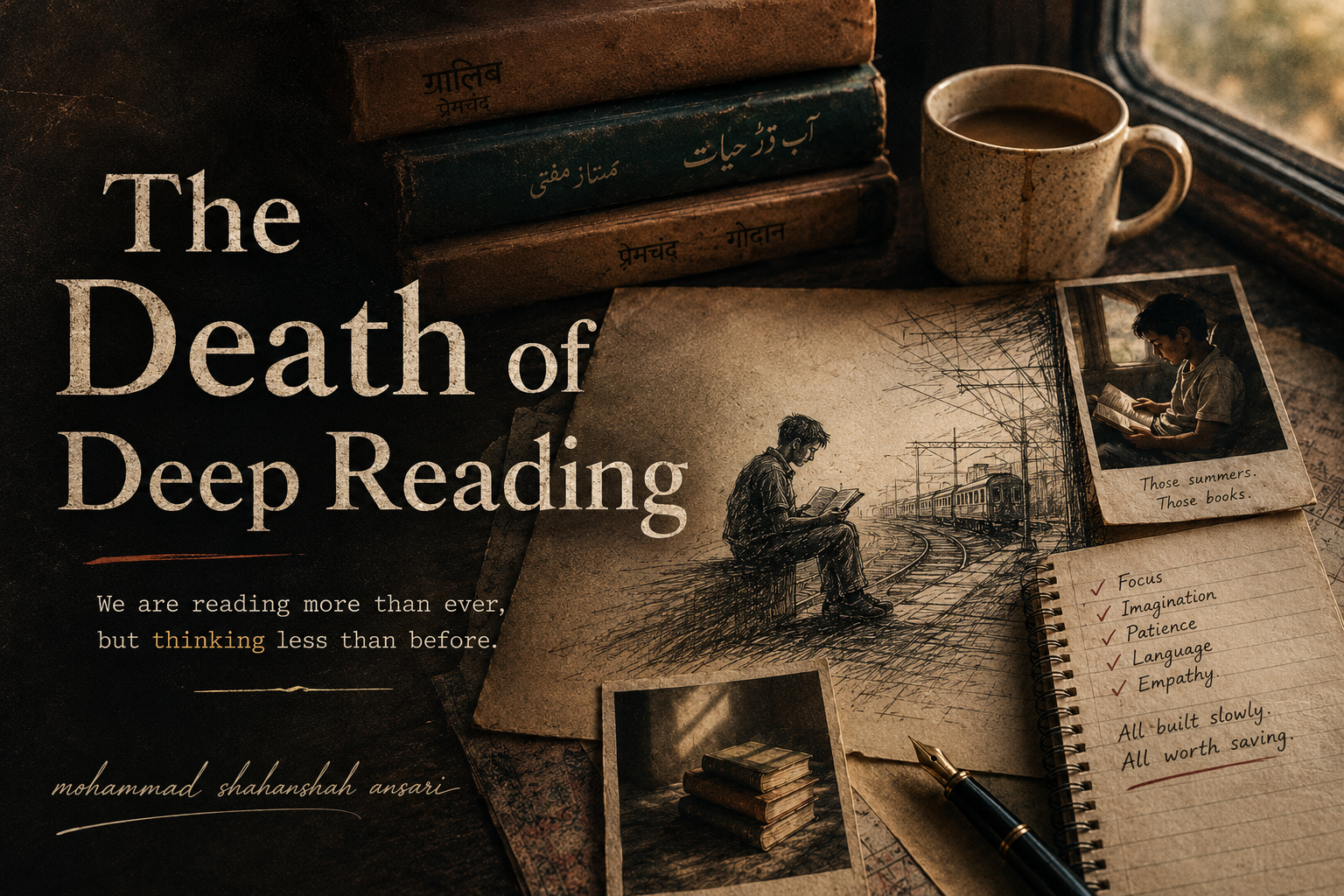
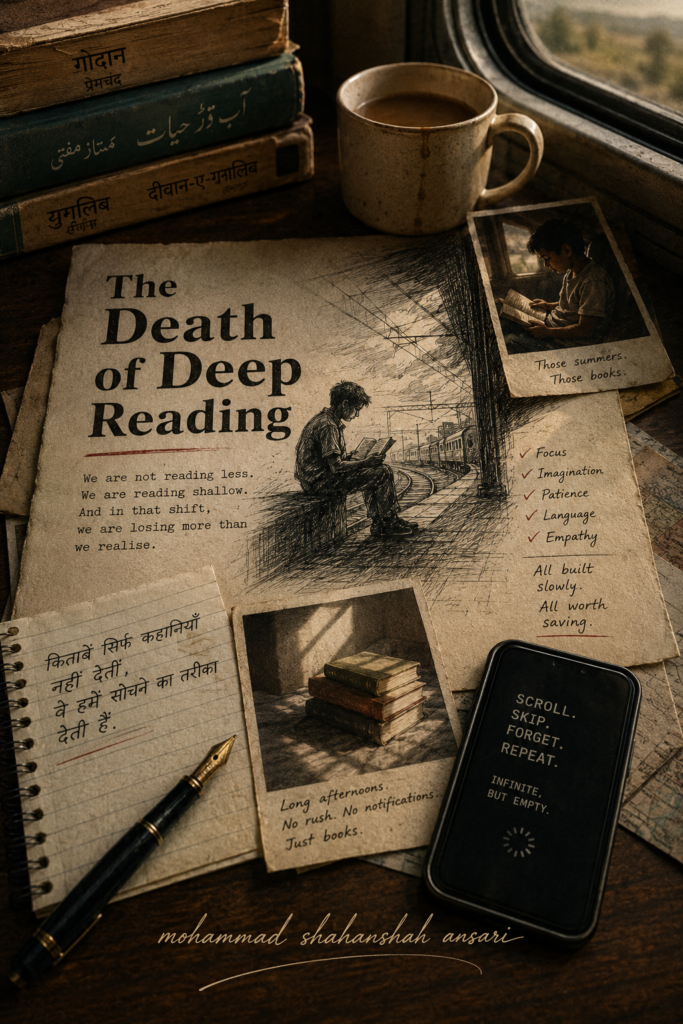 I used to read on long train journeys. The landscape outside would change slowly. With nothing but time and a book, I could finish three hundred pages between stations—completely lost in a world not my own. I would arrive at the platform slightly disoriented, like after leaving a cinema in daylight. That feeling of being elsewhere—fully, willingly—felt ordinary then. I didn’t know it was something you could lose.
Now, that loss aches inside me.
Last month, I picked up a book I’d meant to read for a year. I sat down on Sunday, genuinely intending to read. I made it through eleven pages before grabbing my phone. Not because of anything urgent. Nothing urgent happened. My hand reached for it—just as your tongue finds a loose tooth. Twenty minutes vanished into nothing I can name. I put the phone down, read three more pages, and picked it up again. What should have taken an hour took four sittings. Worse, this now feels completely normal.
That quiet normalisation is terrifying. Not that it happened, but that we barely flinch when it does.
But let me go further back. To the summers of my school days, which, if I am being honest, were the best reading years of my life.
Those vacations had a particular rhythm. School closed, the heat settled in, and the long, unscheduled days became the perfect conditions for reading. I went through stacks of storybooks, Hindi literature, and Urdu novels—whatever was at home, borrowed, or found. There was no plan. No reading list or curriculum. Just a boy, books, and long afternoons with nowhere to go.
I didn’t realise what was happening inside those hours. My Hindi deepened, not through grammar drills, but by living in the language. I learned how sentences were built, how writers shifted thoughts, and what a well-placed word could do. My Urdu—a different inheritance, a different perspective—grew in ways no classroom could manage. You can’t learn a language’s soul from a textbook. You learn it through its literature, by feeling the weight of words in a story and sensing a mood before you consciously know why.
That kind of reading gave me something I have been drawing on ever since. A feel for language. A sense of how thought moves when it is written with care. I didn’t know it was an education. It felt like pleasure. That is, I think, the mark of the best kind of learning.
Those summers are gone—not just for me, but as a cultural practice. I see it in the next generation: bright, curious, and quick. But they have never spent an afternoon lost in a book or experienced the time suspension that deep reading brings. Storybooks are now YouTube videos. Urdu novels show up in Instagram reels. Long afternoons are replaced by screens, which never allow boredom long enough for reading to begin.
This is a specific loss—not a sentimental one, but a linguistic and cognitive loss. Hindi and Urdu, so rich and precise, are being hollowed out. A generation now meets them only in conversation or film dialogue. The deep vocabulary, the literary register, and the ability to write—and think—well in either language are fading. The languages have not failed. Reading has stopped. A language you only speak is one you are slowly forgetting.
We are reading more than any generation before—countless texts, messages, and comments every day. But the central issue is not the sheer quantity of reading. The core problem is a shift in what reading actually means: we have lost the kind of reading that fosters depth, focus, and sustained thought, replacing it with fast, superficial, fragmented reading.
Skimming and scanning have survived. We assemble information from headlines, intros, and bolded summaries. We’re efficient at getting the gist without deeply engaging. This feels productive—and in a narrow way, it is. But it is very different from following an argument over twenty pages, losing the thread and returning, or stopping for a sentence that demands attention. That kind of slow, demanding reading is disappearing—not from books, but from us.
The mechanism is simple. Every scroll brings novelty: a new face, an opinion, something funny or outrageous, something agreeable, something that quickens your pulse. Then comes another, right away. The brain—always seeking novelty—recalibrates to the quickest hits. Compared to that, sitting with one difficult idea for thirty seconds feels punishing. The mind grows restless. Something in you wants to reach for more.
This is not a moral failure. It is conditioning—very effective, very deliberate. People who understand attention have designed these apps better than most of us know our habits. The apps are not passive; they are engineered. Every scrolling feature was put there by someone who studied attention and where it breaks. We entered this world with no defences, because nothing before suggested we’d need them.
But here is what concerns me beyond the personal inconvenience of not finishing books — what this is doing to thought itself.
Deep reading was never just about gathering information. It was a place for a certain kind of thinking. You followed a mind working through a problem and learned how to work through problems yourself. Arguments were built slowly enough that you could sense their structure and challenge them. A novelist showed you a vastly different life, and you emerged with a larger sense of what a person could be.
This reading produces what scrolling cannot: the ability to hold complexity without rushing to resolution. It teaches sitting with contradiction and changing your mind, not by command, but by slow rearrangement over many pages. This is a mental skill. Like most skills, it weakens when neglected.
I notice this in myself—and I doubt I’m unique. Sustained thought is harder now. Not impossible, but harder. My mind wants to move on before the idea is finished. It has learned to be impatient on a structural level. I now must work against what once came effortlessly.
I don’t think the answer is to perform some kind of dramatic digital detox, treat screens as the enemy, or develop a nostalgic relationship with the printed page. The technology is here. It is not going anywhere. But I think something important is at stake that we are not being honest about.
A culture that cannot read deeply turns fluent reaction into uneasy reflection. People can have endless opinions, but struggle to sustain a thought. Such a culture does not just read fewer books. It loses the mental infrastructure that difficult books quietly built. In a country where Hindi and Urdu hold centuries of thought, feeling, and beauty, the loss is more than cognitive. It is civilisational.
I want that back. I crave it. The warm hush of the summer afternoon, the bedside stack of borrowed books, the hours that slipped by so guiltlessly, the deep, bone-deep pleasure of arriving at a station winded by story and not quite ready for real life.
I don’t think I am the only one.