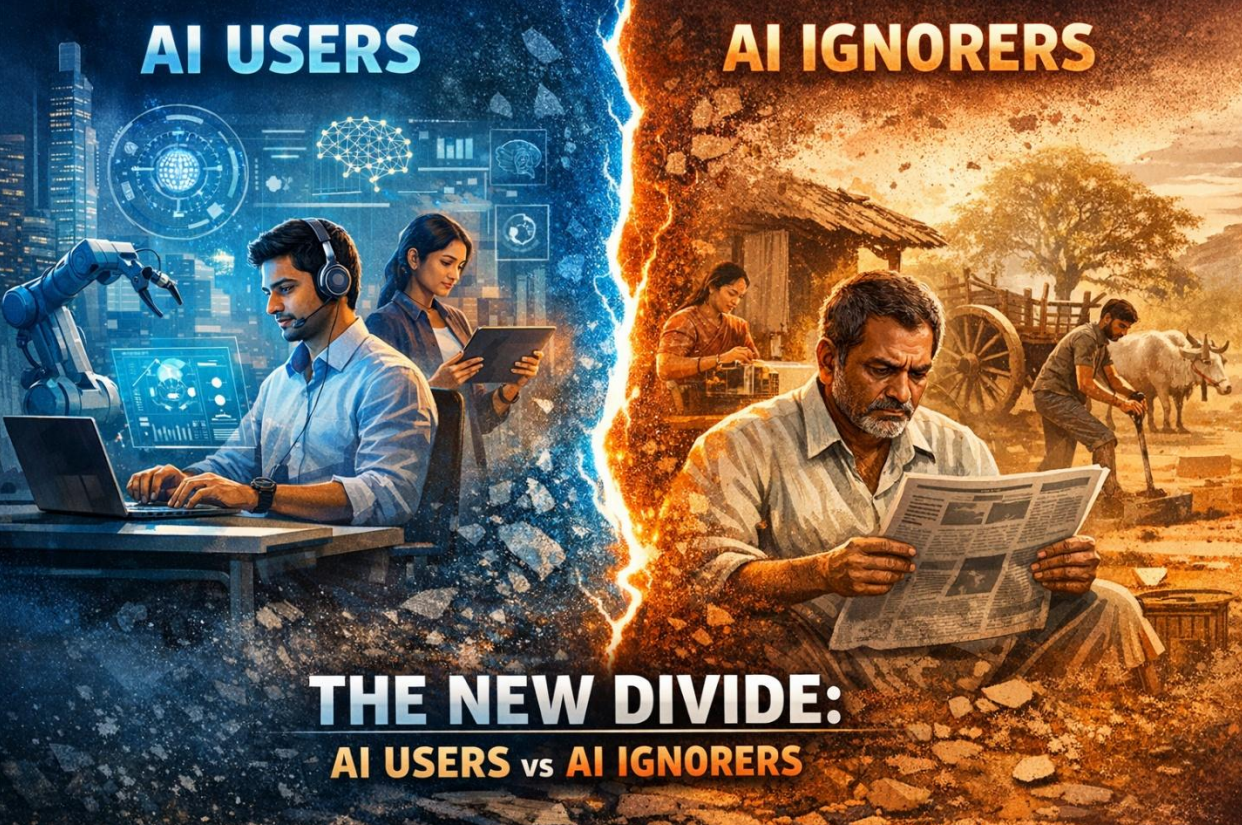
This division is not simply economic.
Nor is it urban versus rural.
It is not determined solely by education.
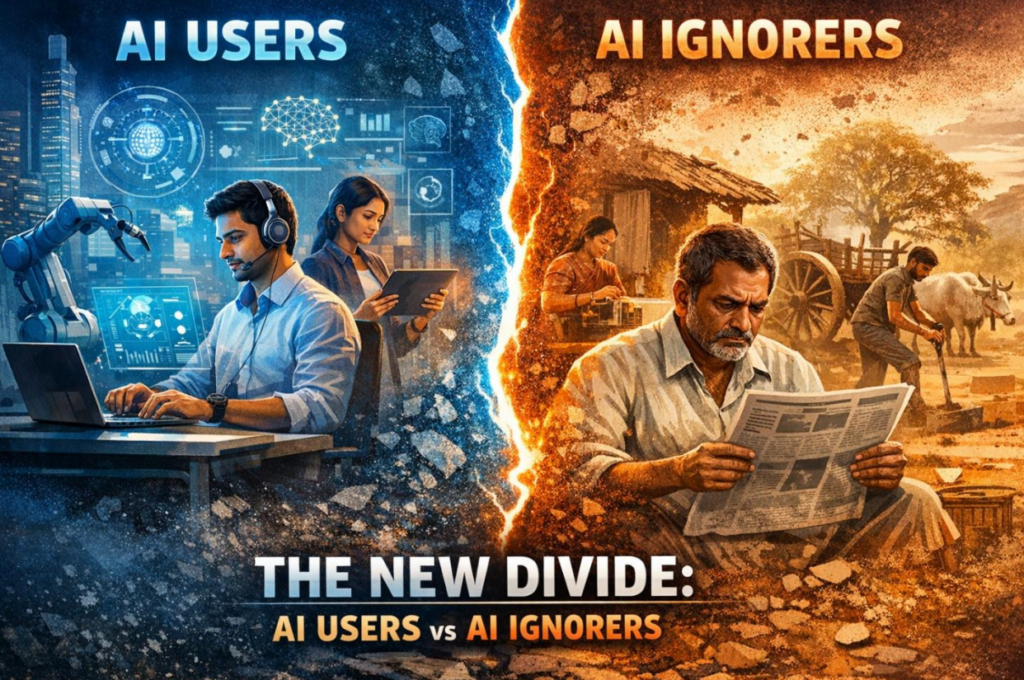
Rather, it separates those who use AI from those who do not.
Though subtle, this emerging divide could redefine employability, productivity, and mobility nationwide.
Beyond Degrees: Redefining Skills in the AI Era
For decades, education has been regarded as the primary pathway to success in India. A degree has symbolised opportunity, stability, and upward mobility. However, the nature of work is evolving more rapidly than traditional education systems can accommodate.
Currently, possessing knowledge alone is insufficient. The ability to apply that knowledge, especially when enhanced by AI tools, is becoming the new benchmark for professional relevance. A recent graduate proficient in using AI to analyse data, draft content, automate workflows, or improve decision-making has a distinct advantage over peers with similar qualifications who lack these skills. This advantage depends not on years of experience but on awareness and adaptability.
In this context, AI functions not merely as a technological innovation but as a force multiplier.
The Illusion of Digital Preparedness
India has made remarkable strides in digital adoption. With widespread smartphone use, affordable internet access, and initiatives promoting digital inclusion, the country appears well-positioned for the future.
However, a critical distinction exists between being digitally connected and being digitally empowered.
Engaging with social media, messaging applications, or basic software does not equate to understanding how AI can enhance productivity or generate new opportunities. Many individuals, including professionals, remain unaware of effective ways to integrate AI tools into their daily work.
This situation creates an illusion of preparedness that may lead to high costs in the coming years.
An Expanding Risk Across Sectors
The implications of this divide are not limited to any one sector. From corporate offices to small businesses, from students to experienced professionals, the impact is widespread.
Expectations in corporate environments are shifting. Employees must deliver more output in less time, often using AI tools. Those who adopt these technologies become more efficient and valuable, while those who do not risk obsolescence.
In the informal sector, which employs a large part of India’s workforce, the challenge is even greater. Routine tasks such as data entry, basic analysis, and customer support are especially well-suited to automation or augmentation. Without proactive upskilling, millions may face shrinking opportunities over time.
Simultaneously, AI is generating new opportunities, with roles emerging that did not exist a decade ago. The central question is whether India’s workforce is adequately prepared to capitalise on these opportunities.
The Core Challenge: Prioritising Awareness Over Access
Unlike past technological revolutions, access is no longer the main barrier. Many advanced AI tools are free or low-cost. The primary gap is awareness, especially a practical understanding of how to use these tools effectively.
In many regions of India, AI is still perceived as a complex and distant concept, often regarded as relevant only to engineers or specialists. This perception must be addressed.
AI is not exclusively for developers; it is relevant for teachers, students, entrepreneurs, administrators, and workers across all sectors. It serves as a tool to enhance human capability, rather than replace it, provided it is properly understood and adopted.
Bridging the Divide: A Strategic Roadmap
Addressing this emerging divide requires deliberate and coordinated action. The objective should extend beyond technological advancement to encompass inclusive empowerment.
1. Mainstreaming AI Literacy
AI literacy should become a fundamental component of education. Educational institutions should provide practical exposure to AI tools, emphasising real-world applications over theoretical complexity. Students must learn to use AI for problem-solving, productivity enhancement, and critical thinking.
2. Upskilling the Existing Workforce
For individuals already in the workforce, continuous learning is essential. Short-term, accessible training programs delivered through online platforms, corporate initiatives, and professional networks can help bridge the skills gap. Employers should regard AI upskilling as a necessity rather than an option.
3. Reaching Beyond Urban Centres
Efforts must go beyond metropolitan areas. Tier-2 and tier-3 cities, as well as rural regions, need targeted awareness campaigns. Community organisations, local institutions, and non-profits can play a key role in promoting AI literacy among underserved populations.
4. Strengthening Public–Private Collaboration
Government initiatives aimed at digital inclusion must evolve to incorporate AI awareness and training. Collaboration with the private sector can accelerate implementation, ensuring that programs are scalable, relevant, and effective.
5. Fostering a Culture of Adaptability
Ultimately, the biggest transformation is cultural. Individuals must shift from a static learning mindset to a continuous-adaptation mindset. In an AI-driven environment, the ability to learn, unlearn, and relearn will outweigh the value of any single qualification.
A Defining Moment for India
India’s story has always been one of resilience and reinvention. The country has navigated economic transitions, technological shifts, and social transformations with remarkable agility.
The emergence of AI represents another pivotal moment.
The gap between AI users and non-users is not inevitable. It can be addressed with foresight, commitment, and collective action.
If India succeeds in bridging this gap, the nation can unlock unprecedented levels of productivity, innovation, and inclusive growth. Failure to do so may deepen the divide, thereby limiting opportunities for millions.
The future will be shaped not by those who resist change, but by those who comprehend and act upon it.
Take action now. Learn AI skills, inform your community, and demand decisive support from leaders. Only with immediate, united effort can we close this divide and ensure India’s inclusive growth.