If you visit an office, check a college WhatsApp group, or watch a teenager do homework, you’ll see a pattern. People aren’t working through problems themselves. Instead, they type questions into chat boxes, wait for answers, and copy the results, letting machines decide what to say or do next.
Most people don’t see this as a problem. But that’s exactly what makes it a real issue.
We’ve been so busy celebrating what AI can do that we haven’t stopped to consider what we might be giving up. It’s not just data or jobs. It’s something more personal: our habit of thinking for ourselves.
How Dependency Sneaks In
No one suddenly chooses to stop thinking for themselves. It happens gradually, through small moments that seem reasonable at the time.
Maybe you’re tired, facing a deadline, and need to write an email, so you use AI. The next day, you do it again. Six months later, you find it hard to write even a simple message without turning to AI first. You might not notice it happening, but it does.
That’s how dependency develops. It’s not a sudden change, but a series of small conveniences that slowly build up over time.
Consider what we really lose in these everyday situations.
If someone relies on AI to write every work email, they stop practicing how to communicate under pressure. That pressure—finding the right words for something difficult, sensitive, or precise—isn’t just a hassle. It’s what helps you improve. If you avoid it all the time, you don’t just save time; you lose an important skill.
When a student turns in an essay written by AI, they aren’t just cheating the professor—they’re cheating themselves. The frustration of facing a blank page, working through your argument, and finally writing a paragraph that says what you mean, all help you grow.
There’s no shortcut for that. The brain gets stronger through effort, and using AI carelessly takes away that effort before you can build real ability.
If a manager relies only on AI to summarise meetings, find patterns, and suggest decisions, what’s left for them to do? They end up just reviewing what the machine produces instead of thinking for themselves. Their instincts, judgment, and ability to read the room—all the things that made them effective—start to fade. And when you stop using those skills, they get weaker.
What This Looks Like Twenty Years from Now
Imagine a workplace in the future where most people have always relied on AI to do their thinking. They’re quick, productive, and good at using prompts, but they struggle with tough problems on their own. They can’t always spot when AI is wrong, because that takes independent thinking—the very thing they’ve given up.
This isn’t science fiction. We can already see the early signs. If you ask someone to explain their work in their own words, they often struggle. If you ask for their opinion before they look it up, there’s an awkward pause.
On a bigger scale, the real risk is sameness. AI systems learn from what people have already written, so they naturally lean toward the average—the common view, the expected answer, the safe middle. If more thinking goes through these systems, fewer people will come up with ideas that break the mold. The truly original ideas—the ones that change a field, a company, or a conversation—almost always come from people who think differently. AI can’t create those people. They have to be developed the traditional way.
The Real Question
The solution isn’t to delete AI. AI is a real tool for speeding things up. It saves time, finds information, catches mistakes, and lets you focus on bigger decisions.
The real question isn’t whether to use AI. It’s what kind of person you are when you use it.
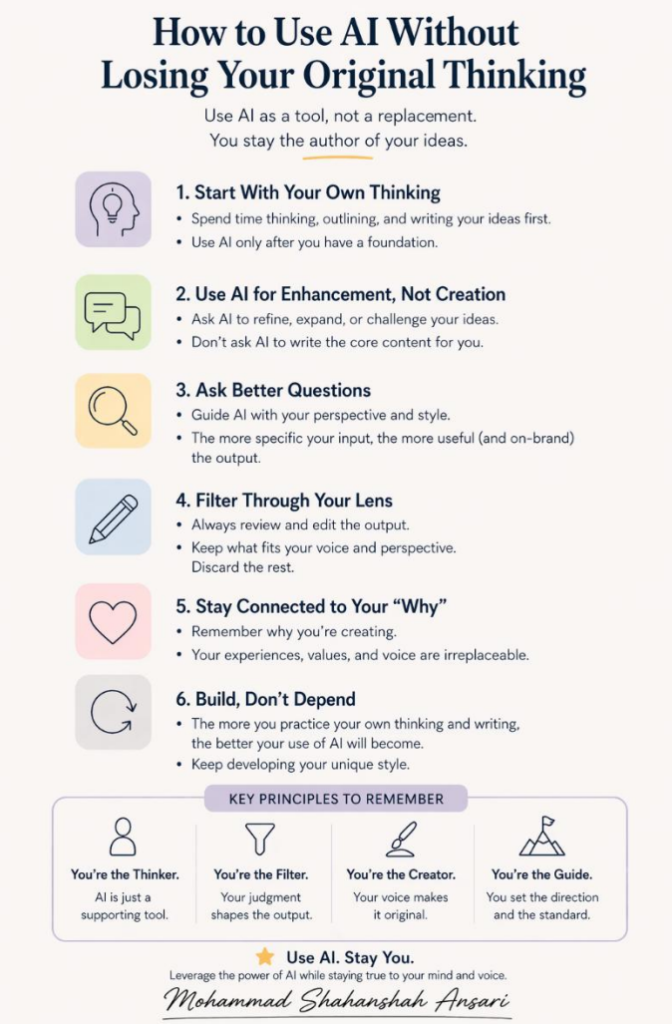
Build the habit of thinking for yourself before turning to AI.
Before you ask AI to write something, try writing your own version first.
Before using AI to analyze something, try to understand it yourself first.
Make a point to keep practicing skills that AI can make optional, like writing, reading carefully, and working through tough problems on your own.