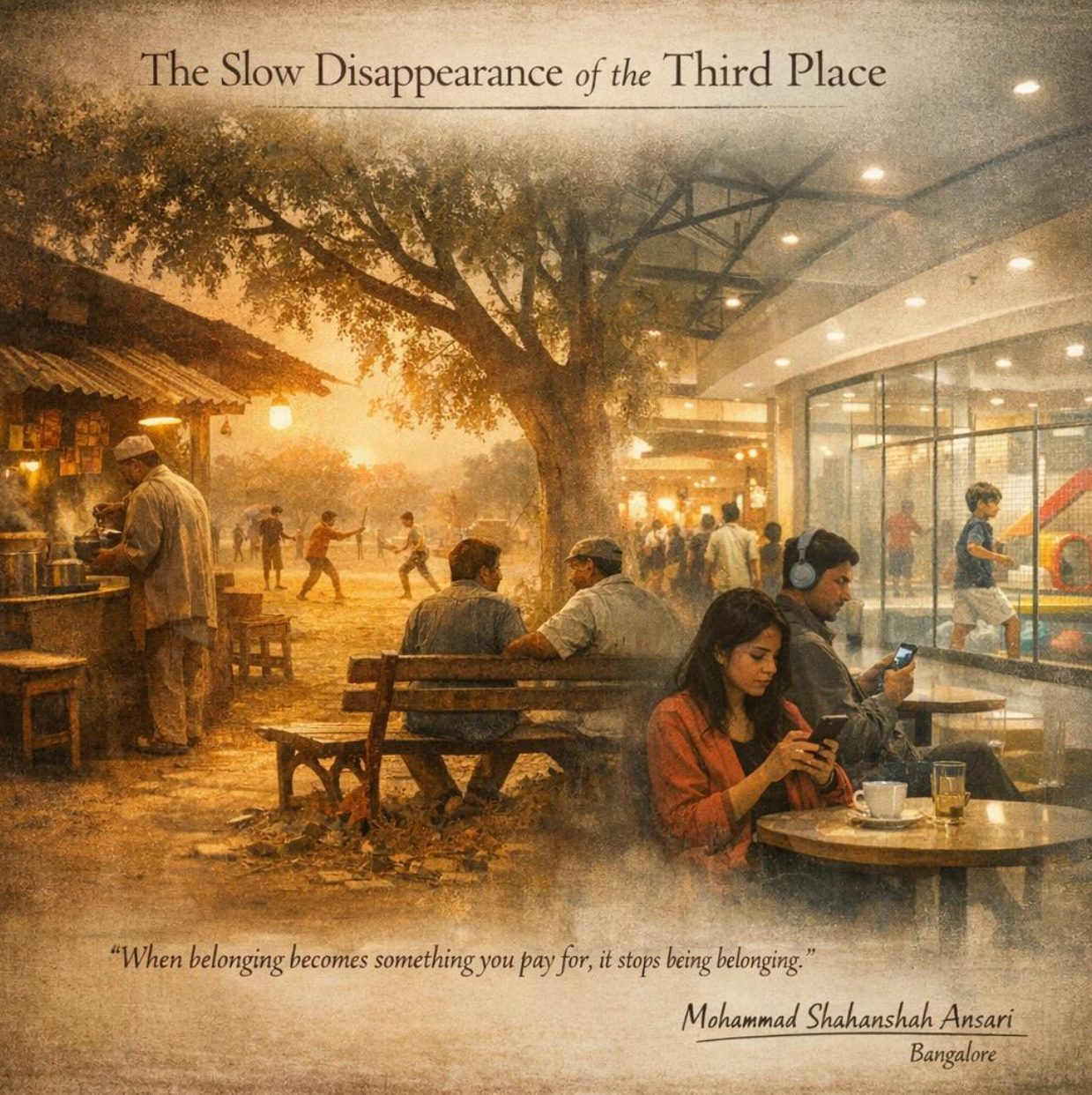
If you grew up in a village or a small town like me, you already understand this instinctively — because your entire childhood was, in some sense, one long third place. The street in front of the house. The chabutra where the elders sat every evening. The open maidan where cricket, football, bollyball, etc. happened without any scheduling, without coaches, without fees — just whoever showed up. Nobody owned those spaces, and everybody did. You wandered in, you wandered out. There was no entry, no exit, no transaction. The village didn’t need to invent community because the physical layout of life made community unavoidable. Then people moved to cities, and they discovered that cities don’t do this automatically. Cities have to be designed for it. And mostly, they aren’t.
What is a “Third Place”?
Sociologist Ray Oldenburg gave a name to what that tea stall was. He called it a “third place” — distinct from the first place (home) and the second place (work). A third place is where you go when you don’t need to be anywhere in particular. The neighbourhood dhaba. The old Iranian café. The public park with the broken bench that everyone still uses. The barber’s shop where haircuts take forty minutes because no one is in a hurry. Oldenburg argued that these spaces were not luxuries. They were, he said, the informal heart of community life — the places where civic identity forms, where strangers become familiar, where people feel, in the most uncomplicated way, that they belong somewhere.
We are losing them. Quietly, steadily, without any single announcement.
What Changed?
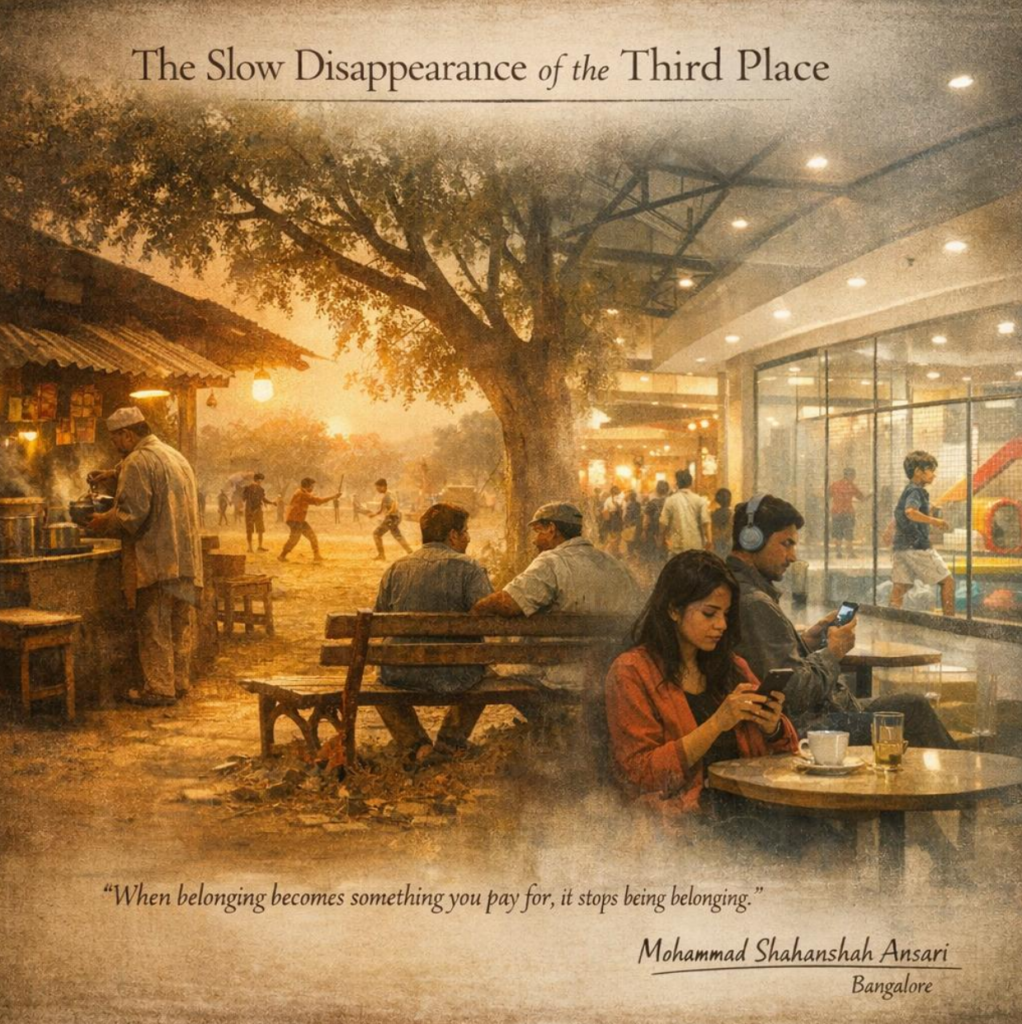
Think about what has happened to the spaces in your own city in the last ten years. The old Irani cafés of Mumbai and Hyderabad, once anchors of entire neighbourhoods, are dying out — not because people stopped loving them, but because the people who ran them aged and their children moved into IT. The roadside addas of Calcutta still exist, but feel more like nostalgia tourism than living, breathing spaces. The maidan, the chowk, the neighbourhood library — all are slowly being absorbed by the city’s need to be productive with every square foot.
What replaced them? Malls, mostly. And then, once the mall era began to fade, apps.
Take two cities that could not feel more different from each other — Lucknow and Bangalore. Lucknow still carries the memory of its tehzeeb in its bones. The old tea houses of Hazratganj, the corners of Aminabad where people lingered without purpose, the mohalla culture where the lane itself was a living room — all of it quietly shrinking under the pressure of real estate prices and changing habits. What remains often feels preserved rather than living, a city performing its own nostalgia.
Bangalore, on the other hand, grew so fast that it never had the chance to develop third places at all. It imported people from everywhere and gave them apartments, tech parks, and flyovers — but no chowk, no common ground, no place to simply be. The result is a city of enormous population and surprisingly thin community. People in Bangalore often say they have lived in the same building for five years and don’t know their neighbours’ names. That is not a personal failing. That is what happens when a city is designed entirely around productivity and has no architecture for belonging.
The Illusion of Modern Spaces
Here is what a third place actually requires: that you not be obligated to spend money, that you not be there for a specific purpose, and that anyone can walk in. A mall fails all three. A café that charges two hundred and fifty rupees for a cappuccino — where the wifi password is printed on the receipt, and you feel a mild guilt if you sit for more than an hour without ordering again — fails all three. What looks like a third place is often just a commercial space dressed up to look like one.
What This Means for Children
Nowhere is this more visible than in what has happened to children. A generation ago, kids played in parks, streets, and open grounds because those spaces existed and were free. Today, in most Indian cities, those spaces are either gone, gated, or unsafe. So, parents drive their children to the mall, where there is an air-conditioned play zone, a trampoline park, a bowling alley, and a “kids’ sports zone” on the third floor.
It is nothing. Children still play, still run, still laugh. But they do it inside a commercial space that requires an entry ticket, a time slot, and a parent’s credit card. Sport has become a service. Play has become a product. And the most important thing a street or a park gave children — the ability to just show up, unplanned, and figure it out — is now something you book in advance on an app.
The child who grew up kicking a ball on an open maidan did not just learn football. He learned negotiation, conflict, self-organisation, and how to exist among strangers. The child in the mall’s football arena learns football. That is a real difference, even if it is hard to measure.
The difference matters more than it sounds. When you have to pay for belonging, belonging becomes a transaction. And transactions are not the same as community.
The Role of Phones
The other thing that replaced third places is, of course, the phone. This is where it gets complicated, because the argument is usually made too simply — that digital connection is fake and physical connection is real, and we chose the fake one. But that is not quite right. Most people didn’t choose screens over places. They chose screens after the places were already gone, too expensive, too far, too unsafe, or simply no longer there. The phone fills a vacuum. It was not the thing that created the vacuum.
And yet, there is something the phone cannot replicate. When you sit in a shared space with no particular agenda, you encounter people you did not select. The neighbour you would never have followed on Instagram. The old man has opinions you disagree with entirely. The stranger is going through something you recognise. The internet’s great flaw is that it is too good at giving you what you already want. A third place gave you what you didn’t know you needed — the unpredictable, unoptimised friction of other people.
The Loss We Don’t Notice
There is also something about what a third place does to time. It suspends the sense of urgency. You are not being productive. You are not networking. You are not optimising anything. You are just — there. In a culture that has made busyness into a virtue and rest into a guilty pleasure, this is more radical than it sounds. To sit in a place that expects nothing from you, surrounded by people who are also expecting nothing from each other, is a kind of freedom we have stopped allowing ourselves.
I used to know a man who spent every Sunday morning at the same park bench for twenty years. He said he didn’t do anything there — just watched people, drank his thermos of tea, and sometimes talked to whoever sat down next to him. His children thought it was a waste of time. After he retired, it was the one thing he kept. “It makes me feel,” he once said, trying to find the words, “that I am part of something.” Not a club or a cause or a building. Just something.
That is not a small thing to lose.
Conclusion
The disappearance of third places is not dramatic. No one protests the closing of a chai stall. No headlines are written when a neighbourhood park starts charging an entry fee. It happens the way most slow losses happen — one unremarkable thing at a time, until you look up one day and realise that the part of your life that was unscheduled, unmonetized, and free has become very small.
What we are left with are the two places. Home and work. Work and home. The toggling between obligation and rest, with very little in between that belongs to no one in particular, which means it belongs to everyone.
Think of the spaces in your own city that existed ten years ago but no longer do. The addas, the chai stalls, the park where people actually sat. Somewhere in that list is the third place you didn’t know you were losing until it was already gone.