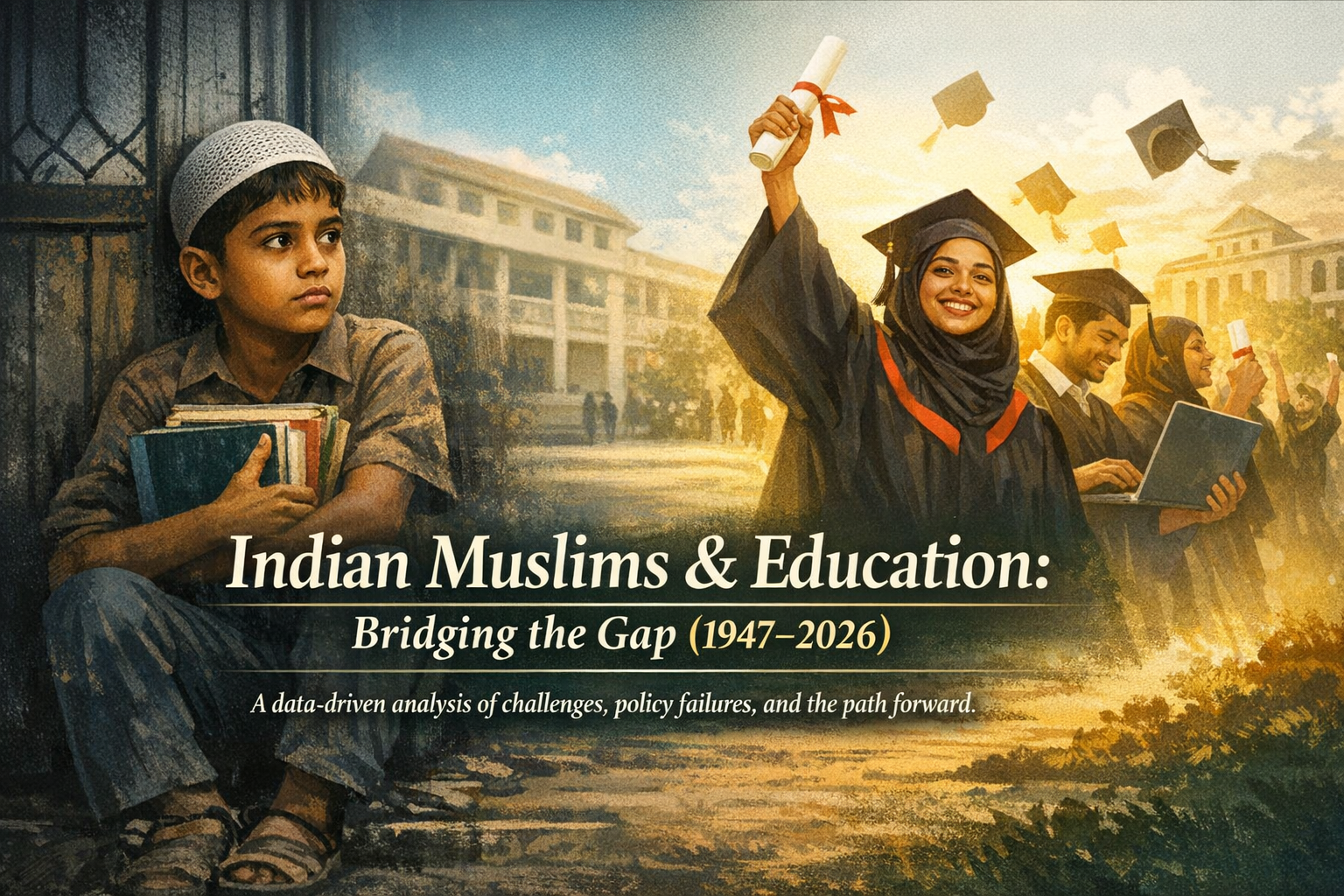
The developmental journey of the Indian Muslim community since the inception of the Republic in 1947 presents a paradox of demographic resilience and persistent socio-educational marginalization. As of March 2026, the community finds itself at a critical intersection where historical legacies of the Partition, decades of socio-economic stagnation, and recent significant shifts in state policy regarding minority empowerment coalesce to define a new and challenging reality.1 Understanding the current educational status of Indian Muslims requires a multi-dimensional lens that accounts for geographic disparities, economic vulnerabilities, and the systemic barriers that have hindered the community’s transition from foundational literacy to high-order professional attainment.3
Demographic Landscape and Geographic Distribution in 2026
The demographic profile of Indian Muslims in 2026 underscores their status as the largest religious minority in the nation and one of the most significant Muslim populations globally. Estimates as of March 2026 project the Muslim population at approximately 215 million, representing roughly 15% of India’s total population of 1.46 billion.2 This marks a steady increase from the 172.2 million (14.2%) recorded during the 2011 Census.6 India remains the home of the world’s third-largest Muslim population, following Indonesia and Pakistan, and constitutes nearly 11% of the global Muslim populace.6
The growth of the community, while often a subject of intense political debate, is increasingly characterized by a trend toward demographic convergence. While the Total Fertility Rate (TFR) for Muslims was recorded at 2.36 in the 2019-21 National Family Health Survey (NFHS-5)—the highest among religious groups—it has also experienced the most significant decadal decline.8 Projections for 2026 suggest that as education and urbanization levels rise, particularly among Muslim women, these fertility rates will align more closely with national averages.2
Regional Concentrations and State-Wise Dynamics
The geographic distribution of the community is highly uneven, shaped by centuries of historical settlement, medieval administrative centers, and coastal trade routes. Nearly half of all Indian Muslims reside in the three states of Uttar Pradesh, West Bengal, and Bihar.6
| State/Union Territory | Total Population (Est. 2025/26) | Muslim Population (Est. 2025/26) | Muslim Percentage | Significance/Status |
| Lakshadweep | ~66,000 | ~64,000 | 96.58% | Majority |
| Jammu and Kashmir | ~13.5 Million | ~9.2 Million | 68.31% | Majority |
| Assam | ~35.2 Million | ~12.1 Million | 34.22% | Significant |
| West Bengal | ~101 Million | ~27.5 Million | 27.01% | Significant |
| Kerala | ~35.1 Million | ~9.5 Million | 26.56% | Significant |
| Uttar Pradesh | ~235 Million | ~42.1 Million | 20.10% | Highest absolute count |
| Bihar | ~128 Million | ~19.2 Million | 17.50% | Significant |
| Jharkhand | ~39.4 Million | ~5.8 Million | 15.20% | Minority |
| Karnataka | ~68.1 Million | ~8.4 Million | 13.80% | Minority |
| Telangana | ~39.2 Million | ~5.1 Million | 13.20% | Minority |
| Maharashtra | ~125 Million | ~14.1 Million | 12.20% | Minority |
| Delhi (NCT) | ~19.5 Million | ~2.5 Million | 12.86% | Minority |
| Gujarat | ~67.2 Million | ~6.5 Million | 10.10% | Minority |
Data Source:.2
In addition to these major states, high concentrations of Muslims are found in 110 minority-concentrated districts where they constitute at least a fifth of the population.6 The historical roots of these populations vary; for instance, the 96.6% Muslim population in Lakshadweep is attributed to centuries of trade with Arab merchants, whereas the high percentage in Jammu and Kashmir is a legacy of medieval Sufi missionary work.2 Conversely, states like Punjab (2.2%) and Chhattisgarh (2.02%) maintain negligible Muslim populations, largely due to the demographic shifts during the 1947 Partition.2
Educational Trajectory Since Independence: 1947 to 2026
The educational status of Indian Muslims since 1947 is a narrative of slow progress punctuated by periods of relative stagnation. At the time of Independence, India faced a monumental task of nation-building with a national literacy rate of only 12.2%.12 The Muslim community was uniquely disadvantaged by the Partition, which saw a significant portion of the Muslim elite, professionals, and middle class migrate to Pakistan.6 This migration created an institutional and leadership vacuum within the community that stayed in India, leaving behind a population that was predominantly rural and economically fragile.14
The Literacy Gap: Historical and Modern Perspectives
While the 1947 census data did not provide a religious sub-classification for literacy, historical studies from the colonial era provide a baseline. In 1911, the literacy rate among Muslims was recorded at a mere 5%, reaching 6.4% by 1931.15 After independence, the community struggled to keep pace with the national average. By the 2001 Census, Muslim literacy had reached 59.1%, which was lower than the national average of 64.8% and significantly trailing other minorities like Jains (94.1%) and Christians (80.3%).16
As of March 2026, the estimated literacy rate for Indian Muslims stands at approximately 68.5%, compared to a projected national average of 77.7%.18 While the community has shown progress, especially in urban areas, the “relative gap” has remained stubbornly persistent. The phenomenon of “maximally maintained inequality” suggests that as educational opportunities expand, the privileged sections of society appropriate the benefits first, leaving marginalized groups like Muslims as the “last in the queue” to attain universal literacy.14
Comparative Educational Attainment Across Religious Communities
The disparity in educational outcomes becomes more pronounced as one moves from basic literacy to higher levels of schooling and university graduation. The following table illustrates the comparative educational attainment of Muslims against other religious groups based on the most comprehensive disaggregated data (scaled to 2011/2021 baselines).
| Religion | Illiterate | Primary Only | Middle (Class 8) | Matric (Class 10) | Higher Sec (Class 12) | Graduate & Above |
| Muslim | 42.72% | 16.08% | 9.73% | 6.33% | 4.44% | 2.76% |
| Hindu | 36.40% | 15.11% | 11.27% | 9.00% | 6.62% | 5.98% |
| Christian | 25.66% | 14.17% | – | 10.72% | 10.24% | 8.85% |
| Sikh | 32.49% | 15.80% | – | 12.71% | 7.55% | 6.40% |
| Buddhist | 28.17% | 14.39% | – | 9.51% | 7.15% | 6.18% |
| Jain | 13.57% | 12.04% | – | 14.81% | 12.90% | 25.65% |
| All India | 36.90% | 15.00% | – | – | – | 5.63% |
Data Source:.3
The data reveals a stark reality: Muslims are the only community with an illiteracy rate (42.7%) higher than the national average (36.9%).21 At the highest levels of achievement, the gap is most alarming. Only 2.76% of Muslims are graduates, less than half the national average and nearly ten times lower than the rate among the Jain community.22
The Crisis of Retention: School Dropout Rates
One of the most concerning features of Muslim education in 2026 is the exceptionally high dropout rate at the secondary level. While primary enrollment for Muslim children has reached near-parity with their population share (15.6% enrollment against ~15% population), the representation drops sharply after Class 8.24
Recent reports from the Ministry of Education and independent researchers indicate that the dropout rate for Muslim students at the secondary level (Class 9-10) is approximately 18.64%, which is significantly higher than the national average of 12.6%.26 In specific states like Assam and West Bengal, the dropout rates for Muslim students have surged to 29.5% and 23.2%, respectively.25
Comparative Dropout and Enrollment Metrics
| Group | Never Enrolled (Age 3-35) | Dropout Rate (Secondary Level) | Enrolled in Higher Education |
| Muslim | 17.0% (M) / 21.9% (F) | 18.64% | 4.87% |
| SC (Dalit) | 13.4% (M) | 12.6% (Approx) | 15.30% |
| ST (Tribal) | 14.7% (M) / 22.4% (F) | – | 6.30% |
| OBC | – | – | 37.80% |
| National Avg | – | 12.60% | 28.4% (GER) |
Data Source:.27
The analysis of these trends suggests that the “representation of Muslim students starts declining gradually from Class 6 and is the lowest in Class 11 and 12”.25 This is attributed to a combination of economic factors—where poverty forces young boys into the informal labor market (such as mechanics and embroidery)—and social factors that limit the mobility of girls as they reach puberty.4 Unlike SC and ST students, who have witnessed double-digit increases in enrollment due to robust affirmative action policies, Muslims have seen a decline in their share of higher education enrollment from 5.45% in 2019-20 to 4.87% in recent years.31
Institutional Ownership: Secular and Religious Domains
The educational infrastructure owned and managed by the Muslim community is disproportionately small relative to its population size. This deficiency exists in both the secular higher education sector and the primary schooling network.
Secular Higher Education Institutions
As of 2026, the Muslim community manages only a tiny fraction of India’s expansive higher education system. Out of nearly 44,000 colleges in India, only 1,155 (2.6%) are Muslim-managed.33 Of the approximately 1,113 universities in the country, only 23 (2.1%) are Muslim minority institutions.33
| Metric | National Total | Muslim Managed | Community Share |
| Universities | 1,113 | 23 | 2.1% |
| Colleges | 43,796 | 1,155 | 2.6% |
| Technical Colleges | 851 (Minority) | 141 | 16.6% (of Minority total) |
Data Source:.33
Despite constituting 73.4% of all minority groups in India, Muslims hold only a 16.6% share of colleges run by minority communities, while other minority groups (Christians, Sikhs, etc.) manage the remaining 83.4%.33 Furthermore, 83.1% of Muslim-managed colleges are private unaided institutions, which lack the government funding necessary to scale infrastructure or provide low-cost education.33 Interestingly, these institutions serve as hubs for pluralism; over 55% of students enrolled in Muslim-run colleges are non-Muslims, primarily Hindus.34
The Role of Madrasas in 2026
The popular perception that madrasas are the primary vehicle for Muslim education is not supported by empirical evidence. Statistics indicate that only about 4% of Muslim school-aged children actually study in madrasas.36 Most Muslim families prefer mainstream secular schools, using madrasas primarily for part-time religious instruction (Maktabs).
As of 2026, the madrasa landscape in India is characterized by the following statistics:
- Total Number: There are approximately 38,000 madrasas across India.36
- Recognition Status: About 28,107 of these are officially recognized by state governments, while roughly 10,039 remain unrecognized.36
- Student Strength: Approximately 2 million (20 lakh) students were enrolled in these institutions as of the 2022-23 academic year.36
- Distribution: Uttar Pradesh accounts for nearly 60% of the total madrasas in India, with 13,329 recognized institutions in that state alone.37
While recognized madrasas (Darse Aliya) often follow the NCERT curriculum and teach subjects like Mathematics, Science, and English, the unrecognized ones (Darse Nizami) focus almost exclusively on theology and jurisprudence.37 In recent years, madrasa education has faced severe administrative and financial pressures. In states like Uttar Pradesh, the number of students appearing for madrasa board exams has declined from over 4 lakh in 2016 to just 88,082 in 2025, reflecting a significant shift in the educational priorities of parents or a response to tightening state regulations.38
Key Contributors to Educational Backwardness
The stagnation of Muslim education in India is a multi-causal phenomenon rooted in socio-economic, historical, and systemic factors.
Socio-Economic Poverty and the Survival Priority
Poverty remains the single greatest impediment to educational progress. NFHS data reveals that Muslims have one of the lowest per capita consumption levels among all religious groups.4 This economic fragility creates a high opportunity cost for schooling; poor families often view education as a “risky investment” with uncertain returns in the job market, leading them to withdraw children from school to assist in traditional crafts or unskilled labor.4
Historical Neglect and Policy Failure
Post-independence, the community has largely been excluded from the “compensatory discrimination” (reservation) frameworks that have empowered SC and ST groups. While some Muslims are categorized as OBCs, the community as a whole lacks the systemic “push” that quotas provide in higher education and government employment.4 Furthermore, schools in Muslim-majority localities are often fewer, poorly staffed, and lack essential infrastructure like toilets and libraries, which discourages retention, especially for female students.4
The “Appeasement” Narrative and Budgetary Cuts
A significant hurdle in the 21st century has been the politicization of minority welfare. Schemes specifically aimed at bridging the Muslim educational gap are often labeled as “minority appeasement,” leading to administrative reluctance and budget cuts.4
The Union Budget for 2026-27 highlights a worrying trend of “quiet dismantling” of educational support for minorities. While the overall allocation for the Ministry of Minority Affairs saw a token increase, the actual funding for targeted scholarships has been slashed.43
| Educational Scheme | 2024-25 Allocation | 2025-26 Allocation | 2026-27 Allocation | % Decline (2 to 3 years) |
| Merit-cum-Means (Professional) | ₹33.80 Cr | ₹7.34 Cr | ₹0.06 Cr | ~99% Cut |
| Pre-Matric Scholarship | ₹326.16 Cr | ₹195.70 Cr | ₹198.00 Cr | ~39% from 2024 |
| Post-Matric Scholarship | ₹1,145.38 Cr | ₹413.99 Cr | ₹581.00 Cr | ~49% from 2024 |
| Maulana Azad Fellowship (MANF) | ₹45.00 Cr | ₹42.84 Cr | ₹36.14 Cr | Discontinued for new applicants |
Data Source:.43
The discontinuation of the Maulana Azad National Fellowship (MANF) and the drastic reduction in merit-cum-means scholarships have been described as a “consequential blow” to the aspirations of millions of young people.43 Without these fellowships, many Muslim PhD and professional degree aspirants are forced to abandon their studies, further widening the gap at the higher tiers of education.42
Systemic Deprivation: Is it Deliberate?
The question of whether Indian Muslims are being “systematically deprived” of their educational needs is a subject of scholarly and social debate. The evidence points to a pattern of “benign neglect” and “administrative exclusion” rather than explicit legal prohibition. The Sachar Committee Report (2006) was the first to officially document that Muslims had fallen behind even the SC/ST communities in several development indicators.28
In 2026, this deprivation manifests through:
- Budgetary Under-spending: Even when funds are allocated for minority education, they often remain unspent. For instance, in 2024-25, out of ₹1,145 crore allocated for post-matric scholarships, actual expenditure was only ₹5.31 crore.43
- Institutional Absence: Schools in Muslim-majority urban neighborhoods are often missing or under-resourced, forcing children to attend low-quality private schools or drop out entirely.4
- Cultural “Othering”: Reports have highlighted a growing sense of alienation among Muslim students in some school environments, where their identity is marginalized, contributing to a “withdrawal” from mainstream public institutions.42
Strategies for Mainstreaming and Educational Advancement
Bringing Indian Muslims into the educational mainstream is not merely a task of social justice but a demographic imperative for India’s national development. An uneducated 15% of the population acts as a drag on the nation’s human development index (HDI).4
Practical Solutions and Community Reform
The transformation of the community must involve a synergy of state action, non-profit intervention, and community leadership.
- Restoration of Targeted Funding: The government must reinstate the Maulana Azad National Fellowship and scale up merit-cum-means scholarships. Evidence shows that these scholarships “raised demand for school education and reduced the financial burden of poor parents,” directly discouraging dropouts.42
- Integrated Vocational-Academic Stream: For students in economically vulnerable districts, high schools should offer “dual certification” in academic and vocational skills (e.g., IT, digital marketing, advanced carpentry). This reduces the perceived opportunity cost of remaining in school.40
- Community-Led Educational Trusts: Civil society should prioritize the establishment of “District Educational Endowments” funded through community contributions (Zakat/Sadaqah) and CSR (Corporate Social Responsibility) to provide interest-free loans for professional education, bypassing the hurdles of declining government aid.49
- The Kerala Model of Decentralization: States like Uttar Pradesh and Bihar can learn from Kerala, where Muslim educational trusts and community organizations built a vast network of secular colleges and schools, achieving high levels of literacy and professional representation through proactive social reform.34
The Role of Muslim Professionals
The burgeoning class of Muslim professionals—doctors, engineers, lawyers, and tech workers—has a critical role in bridging the gap.
- Adoption of Schools: Professionals can form associations to “adopt” local government schools in minority districts, ensuring quality control, teacher accountability, and infrastructure upgrades.49
- Mentorship and Visibility: Success stories and role models are essential to break the cycle of defeatism. Professionals must engage in active mentorship programs, especially for girls, to demonstrate the tangible benefits of higher education.4
- Career Counseling Networks: Establishing standardized career guidance hubs in every district can help students navigate competitive exams (UGC-NET, GATE, UPSC) and awareness of existing schemes.48
Immediate Action Items
- Universal Primary Enrollment Drive: A community-wide campaign to ensure every child aged 6-14 is enrolled in a school, leveraging the RTE Act’s provisions for free education.27
- Digital Literacy Camps in Madrasas: Immediate deployment of computer labs and digital training modules in recognized madrasas to equip students with basic IT skills.40
- Scholarship Awareness Portals: Creation of localized digital portals by non-profits to help parents apply for the limited remaining government scholarships and find alternative private funding.40
Timeline for Systematic Transformation
Achieving educational parity is a long-term project that requires a “generation-shift” approach. A systematic 25-year roadmap can be envisioned:
- Years 1–5 (Foundational Stabilization): Focus on 100% primary enrollment and the restoration of a community-funded scholarship pool to replace cut government programs. Establishment of district-level vocational hubs.
- Years 5–15 (Retention and Middle-Tier Growth): Drastic reduction of the secondary dropout rate from 18.6% to below 8%. Scaling up of community-owned secondary schools and junior colleges.
- Years 15–25 (Attainment and Parity): Achieving parity with the national Gross Enrollment Ratio (GER) in higher education. Increasing the graduate rate from the current 2.76% to at least 10%.1
By 2050, the Indian Muslim population is estimated to reach 310 million.1 Whether this population becomes a “demographic dividend” or a “demographic disaster” depends entirely on the educational interventions made between now and 2030. The upliftment of this community is not just a minority concern; it is a prerequisite for India’s inclusive national development and its goal of becoming a developed nation by 2047.1
Works cited
- Purpose of Report, accessed March 6, 2026, http://educationofmuslimsindia.org/uploads/Report-With-Tables-on-Education-of-Indian-Muslims.pdf
- India’s 2026 Demographic Outlook: New Projections for the Muslim Population Growth, accessed March 6, 2026, https://indiadatamap.com/2025/12/31/projections-for-indias-muslim-population/
- Status of Indian Muslims with special consideration to their Educational Attainment Dr. Gunjan Dubey, Professor, Dept. of Educat, accessed March 6, 2026, https://papers.ssrn.com/sol3/Delivery.cfm/SSRN_ID3923817_code3306829.pdf?abstractid=3923817&mirid=1&type=2
- (PDF) EDUCATIONAL BACKWARDNESS OF INDIAN MUSLIMS: CAUSES AND REMEDIES, accessed March 6, 2026, https://www.researchgate.net/publication/399465768_EDUCATIONAL_BACKWARDNESS_OF_INDIAN_MUSLIMS_CAUSES_AND_REMEDIES
- Population growth and religious composition in India – Pew Research Center, accessed March 6, 2026, https://www.pewresearch.org/religion/2021/09/21/population-growth-and-religious-composition/
- Islam in India – Wikipedia, accessed March 6, 2026, https://en.wikipedia.org/wiki/Islam_in_India
- Muslim Population in India, History and Trend in Growth – StudyIQ, accessed March 6, 2026, https://www.studyiq.com/articles/muslim-population-in-india/
- Key findings about the religious composition of India – Pew Research Center, accessed March 6, 2026, https://www.pewresearch.org/short-reads/2021/09/21/key-findings-about-the-religious-composition-of-india/
- Hindu-Muslim fertility differentials in India: An update, accessed March 6, 2026, https://www.ideasforindia.in/topics/social-identity/hindu-muslim-fertility-differentials-in-india-an-update
- Muslim Population in India – State wise Population, accessed March 6, 2026, https://www.census2011.co.in/data/religion/2-muslims.html
- Muslim Population in India, Check States with Highest Muslim Population – Adda247, accessed March 6, 2026, https://www.adda247.com/upsc-exam/muslim-population/
- From Independence to Now: A Comprehensive Analysis of the Journey of Literacy Rates in India – The Academic, accessed March 6, 2026, https://theacademic.in/wp-content/uploads/2024/11/78.pdf
- TIL India’s Literacy rate was just 12.2% in 1947. – Reddit, accessed March 6, 2026, https://www.reddit.com/r/india/comments/5kp3ib/til_indias_literacy_rate_was_just_122_in_1947/
- Changing Educational Inequalities in India in the Context of Affirmative Action – PMC, accessed March 6, 2026, https://pmc.ncbi.nlm.nih.gov/articles/PMC2474466/
- Education among Muslims in the Post-Independence India … – ijhsss, accessed March 6, 2026, https://www.ijhsss.com/files/14.-Mohammad-Suhail-11-08-19.pdf
- (PDF) Educational Backwardness of Indian Muslims: Causes and Solutions – Academia.edu, accessed March 6, 2026, https://www.academia.edu/94904401/Educational_Backwardness_of_Indian_Muslims_Causes_and_Solutions
- Education and Exclusion of Muslims – CSDS |, accessed March 6, 2026, https://www.csds.in/uploads/custom_files_new/1526551833_Education%20and%20Exclusion%20of%20Muslims.pdf
- Explore the Literacy Rate in India & Key Stats by 2025 – 21K School, accessed March 6, 2026, https://www.21kschool.com/us/blog/literacy-rate-in-india/
- (PDF) Educational Status of Muslim Women in India: A Comparative …, accessed March 6, 2026, https://www.researchgate.net/publication/368395839_Educational_Status_of_Muslim_Women_in_India_A_Comparative_Study
- Brief About the Yearbook 2021 “Educational Status of Muslims in India, accessed March 6, 2026, https://www.iosworld.org/ContentPdf/Brief_About_the_Yearbook2021.pdf
- 42.7% of Muslims Illiterate, Reveals Census Data – The Wire, accessed March 6, 2026, https://m.thewire.in/article/society/education/census-literacy-religion
- At nearly 43%, Muslims have highest percentage of illiterates: Census, accessed March 6, 2026, https://m.economictimes.com/news/politics-and-nation/at-nearly-43-muslims-have-highest-percentage-of-illiterates-census/articleshow/53949959.cms
- At nearly 43%, Muslims have highest percentage of illiterates: Census – Hindustan Times, accessed March 6, 2026, https://www.hindustantimes.com/india-news/at-nearly-43-muslims-have-highest-percentage-of-illiterates-census/story-oV2eqLTrJ4JcDjk4yEuMKI.html
- EDUCATIONAL STATUS OF MUSLIMS IN INDIA : PROBLEMS AND PROSPECTS – IJSP.IN, accessed March 6, 2026, https://ijsp.in/admin/mvc/upload/Vol%2011_02_2.pdf
- Muslims’ Enrolment in Higher Education Dropped by Over 8.5% In 2021: Report – The Wire, accessed March 6, 2026, https://m.thewire.in/article/education/muslims-enrolment-in-higher-education-dropped-by-over-8-5-in-2021-report
- Muslim student strength in higher education fell by 1.79 lakh in 2020-21 – The Hindu, accessed March 6, 2026, https://www.thehindu.com/news/national/over-179-lakh-fewer-muslim-students-pursued-higher-education-in-2020-21-says-report/article67583855.ece
- Muslim students’ strength in higher education dropped by 8.5% in 2020-21, says a news report on state of Muslim education in India – IndiaTomorrow.net, accessed March 6, 2026, https://indiatomorrow.net/2023/12/02/muslim-students-strength-in-higher-education-dropped-by-8-5-in-2020-21-says-a-news-report-on-state-of-muslim-education-in-india/
- Literacy rate for Muslims worse than SC/STs – The Times of India, accessed March 6, 2026, https://timesofindia.indiatimes.com/india/literacy-rate-for-muslims-worse-than-sc/sts/articleshow/77514868.cms
- AISHE survey shows enrolment of Muslim students in higher studies falls significantly compared to other communities | SabrangIndia, accessed March 6, 2026, https://sabrangindia.in/aishe-survey-shows-enrolment-muslim-students-higher-studies-falls-significantly-compared/
- AISHE 2021-22 – Ministry of Education, accessed March 6, 2026, https://www.education.gov.in/sites/upload_files/mhrd/files/statistics-new/AISHE%20Book_2021-22_4.pdf
- Muslim representation in higher education in India drops to 4.87%, report reveals, accessed March 6, 2026, https://shiawaves.com/english/news/115861-muslim-representation-in-higher-education-in-india-drops-to-4-87-report-reveals/
- Declining Enrollment of Indian Muslims in Colleges and Universities, accessed March 6, 2026, https://www.southasiainvestor.com/2023/06/declining-enrollment-of-indian-muslims.html
- Empowerment through Education: A Comprehensive Analysis of …, accessed March 6, 2026, https://www.nousnetwork.org/empowerment-through-education-a-comprehensive-analysis-of-muslim-managed-higher-education-institutions-in-india/
- Non-Muslim students form majority in India’s Muslim minority institutions: CSR study – IndiaTomorrow.net, accessed March 6, 2026, https://indiatomorrow.net/2024/02/07/non-muslim-students-form-majority-in-indias-muslim-minority-institutions-csr-study/
- Muslim-Managed Higher Education Institutions in India: A Status Report – Nous Network, accessed March 6, 2026, https://www.nousnetwork.org/muslim-managed-higher-education-institutions-in-india-a-status-report/
- What are the odds? More than 20 lakh students study in madrasas, yet remain unemployed, accessed March 6, 2026, https://www.financialexpress.com/jobs-career/education/what-are-the-odds-more-than-20-lakh-studentsnbsp-study-in-madrasas-yet-remain-unemployed/3420606/
- About Madrasa education under RTE Act: UPSC Current Affairs, accessed March 6, 2026, https://www.iasgyan.in/daily-current-affairs/madrasas
- Uttar Pradesh planning to overhaul madarsa education. Here is how – The Week, accessed March 6, 2026, https://www.theweek.in/news/india/2025/04/25/uttar-pradesh-planning-to-overhaul-madarsa-education-here-is-how.html
- status of muslim education in india: problems and concerns – Aarhat Publication, accessed March 6, 2026, https://www.aarhat.com/download-article/525/
- Bridging the gap: Muslim educational challenges and opportunities in Uttar Pradesh, accessed March 6, 2026, https://www.counterview.net/2025/09/bridging-gap-muslim-educational.html
- Dropout Rate Among Muslim Secondary School Students in Maharashtra Alarming, accessed March 6, 2026, https://clarionindia.net/dropout-rate-among-muslim-secondary-school-students-in-maharashtra-alarming/
- Maulana Azad National Fellowship: Cutting Corners in Education, accessed March 6, 2026, https://www.nationalheraldindia.com/national/maulana-azad-national-fellowship-cutting-corners-in-education
- This Year’s Budget and India’s Minorities: What Did They Really Get? – The Wire, accessed March 6, 2026, https://m.thewire.in/article/economy/this-years-budget-and-indias-minorities-what-did-they-really-get
- Minority Education Faces Deep Funding Cuts in Union Budget 2026–27, Warns SPECT Report – IndiaTomorrow.net, accessed March 6, 2026, https://indiatomorrow.net/2026/02/15/minority-education-faces-deep-funding-cuts-in-union-budget-2026-27-warns-spect-report/
- Educational deficits and social identity in India; Background paper for the Education for all global monitoring report 2010 – GOV.UK, accessed March 6, 2026, https://assets.publishing.service.gov.uk/media/57a08b70ed915d3cfd000d06/60430-186612e.pdf
- Under-representation of Muslims in Higher Education in India, accessed March 6, 2026, https://www.vikasanvesh.in/wp-content/uploads/2019/12/Secondary-analysis-of-educational-institutional-supply-for-education-of-Muslims.pdf
- “They Say We’re Dirty”: Denying an Education to India’s Marginalized | HRW, accessed March 6, 2026, https://www.hrw.org/report/2014/04/22/they-say-were-dirty/denying-education-indias-marginalized
- Towards Inclusive and Holistic Reform of the Madrasa in India – New Age Islam, accessed March 6, 2026, https://www.newageislam.com/islamic-society/grace-mubashir-new-age-islam/towards-inclusive-holistic-reform-madrasa-india/d/133686
- Muslim Education and Social Reform in Uttar Pradesh: Challenges, Legacies, and Pathways to Empowerment – IndiaTomorrow.net, accessed March 6, 2026, https://indiatomorrow.net/2025/08/23/muslim-education-and-social-reform-in-uttar-pradesh-challenges-legacies-and-pathways-to-empowerment/
- From Religious to Secular Education: How Kerala Muslims Adopted Modern Education – Part 2 | Grace Mubashir, New Age Islam, accessed March 6, 2026, https://www.newageislam.com/islamic-society/grace-mubashir-new-age-islam/from-religious-secular-education-how-kerala-muslims-adopted-modern-education-part-2/d/130042
- REFORMS in ISLAMIC EDUCATION, accessed March 6, 2026, https://www.cis.cam.ac.uk/wp-content/uploads/2016/01/Reforms-in-Islamic-Education.pdf
- 4. Minority Education | A study of Indian Muslims – Dialnet, accessed March 6, 2026, https://dialnet.unirioja.es/descarga/articulo/5575833.pdf