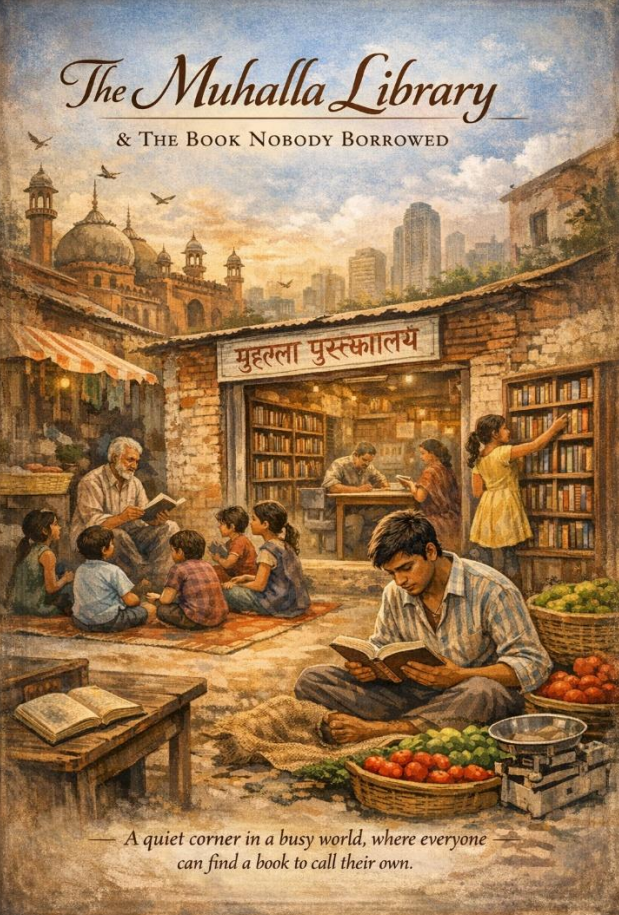
The idea behind the Muhalla library is simple: a community reading space set up right in the neighbourhood, whether in a park, on a rooftop, or in a community hall, instead of a grand civic building. Pratham, an education NGO, has been doing this for years. Each library offers 50 to 60 carefully chosen books, storytelling sessions led by local volunteers, and aims to make reading feel accessible to everyone, not just those who have passed their SSC exams. It is small, local, and truly democratic because all it asks is that you show up.
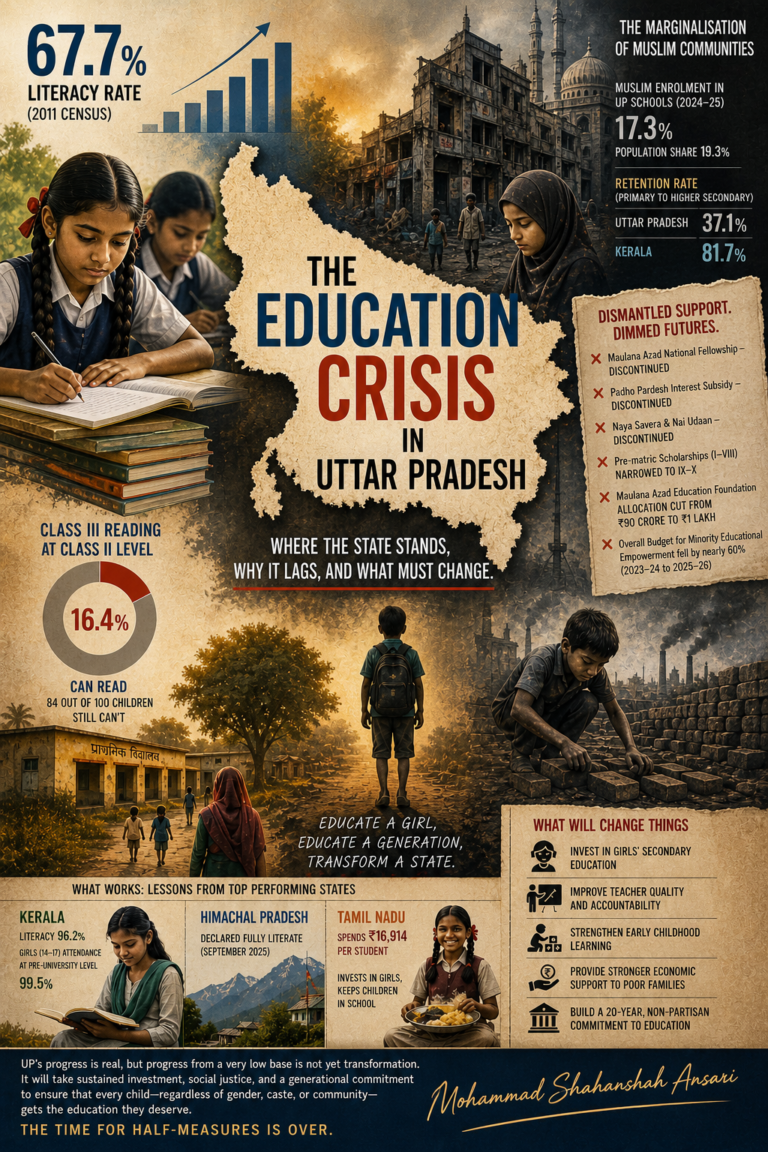
The numbers tell a sad story. Uttar Pradesh, with almost 98,000 villages and over 200 million people, has only about 200 public libraries. That means there is just one library for every 490 villages. Bihar is in an even worse position—only 51 libraries remain out of the 540 that existed in the 1950s. For 70 years, we have slowly dismantled the system that supported public reading, and then we wonder why young people feel lost. Only 19 states in India have laws about how public libraries should work and be funded. The rest have not addressed the issue at all.
Still, those of us living in cities once known for learning see the irony. Take Lucknow, for example. The city has a long literary history shaped by Nawabi culture, Urdu poetry, and a tradition that values both spoken and written words. The Amir-ud-Daula Public Library in Kaiserbagh has nearly two lakh books in Hindi, English, Urdu, Arabic, Persian, Bengali, and Sanskrit, plus 75,000 digitised books, thousands of e-journals, and rare manuscripts. It is one of the best public libraries in India. But how many people from the inner neighbourhoods of Ameenabad or Husainabad actually visit? The library is there, but the reading culture outside its walls is not as strong as it should be. A city that gave us Mir and Premchand deserves more than just one major library—it needs Muhalla libraries in every ward, with books in the languages spoken by local people.
Now, let’s travel a thousand kilometres south to Bangalore. The city is known as the Silicon Valley of India, famous for its coders, startups, and fast-paced life. But beneath this energy lies a long-standing reading culture in Bangalore. The State Central Library in Cubbon Park, with its red brick building and over 2.65 lakh books, is one of the city’s oldest and most popular libraries. The Mythic Society library, founded in 1909, has more than 46,000 books and journals on history, archaeology, anthropology, and philosophy. Its shelves include an 1887 edition of Karl Marx’s Das Kapital and an 1812 edition of Adam Smith’s Wealth of Nations. These are not just tourist spots—they are places where people still come to read and think. The city’s café culture also supports this tradition: Dialogues Café in Koramangala serves as a reading room, while DYU Art Café and Atta Galatta mix literature, art, and coffee. Still, Bangalore’s libraries do not reach far into the city’s growing outskirts, where many migrant workers and first-generation city residents live. A Muhalla library in Whitefield or Yelahanka is not a luxury; it is something the city needs.
Now, look at Kerala—a state that made a different choice. With 34 million people, Kerala has 7,648 rural libraries. The state has the highest literacy rate in India, and its public discussions are among the most active and engaged. This is no accident. When people read, they think. When they think, they debate. When they debate, they hold others accountable. A library is not just a building; it is the foundation of a thoughtful society.
Now look at the United States. Now consider the United States. There are more than 17,468 public libraries across the country, with over 174 million registered borrowers—more than half the population. These libraries had 1.25 billion visits in one year, which is almost four visits per person. Studies show that public libraries help improve reading and literacy and can even reduce crime in communities. American libraries are not just places to store books; they are active parts of civic life. They offer meeting rooms, computer access, children’s programs, spaces for remote workers, and, of course, books. Between 2022 and 2023, room reservations in American libraries went up by 52 percent, showing that people use these spaces to think, work together, and spend time away from home and their phones. Their libraries too face challenges — funding disparities between states are sharp, and post-pandemic security incidents have risen. But the foundational commitment remains: that a citizen has the right to walk into a public space, pick up a book, sit quietly, and belong there. No membership form, no fee, no recommendation from a government official. Just a person and a book.
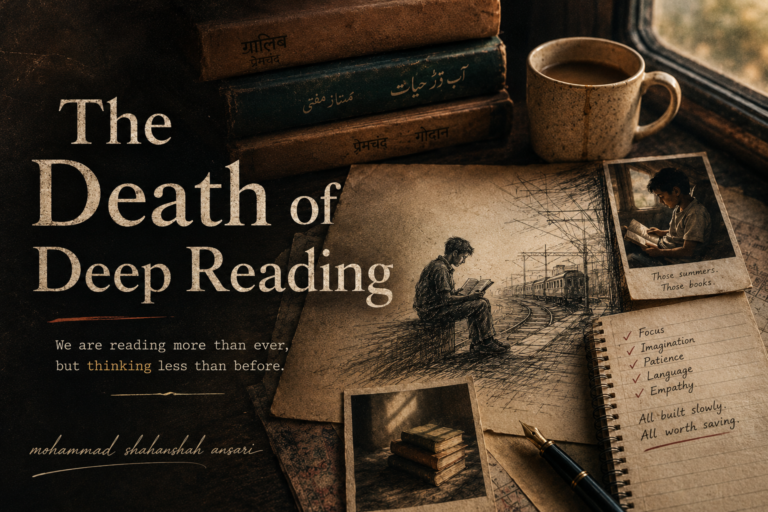
This brings us to the importance of physical books, which is becoming more relevant now. Research shows that reading on paper leads to better understanding than reading on screens. The brain handles a physical book differently—it remembers where things are, the feel of the pages, and the act of turning them. Reading a printed book requires a kind of focus that a phone, with its constant notifications and videos, cannot provide. This is not just nostalgia; it is backed by neuroscience. For a child in a UP village who has mostly seen reels and WhatsApp messages, spending even thirty minutes with a real book is a completely different experience for the mind.
The Muhalla library model understands this need. It does not make children earn the right to read. Instead, it puts books on the street, in parks, and at bus stops, simply saying: here. It makes reading a normal part of daily life, not just something for exams. Punjab has taken steps in this direction—114 rural libraries are now open, with 179 more being built. The Sangrur district library, renovated at a modest cost, now attracts readers from distant villages every day. It is open all week, from 8 in the morning to 9 at night. This kind of access—seven days a week, thirteen hours a day—should be the rule, not the exception.
The solution is simple. Every Indian state should pass a strong Public Libraries Act—not just a law on paper, but one that guarantees funding, staff, and, most importantly, local control. District libraries are good, but they do not help someone who lives fourteen kilometres away without transport. The Muhalla library should be the main way to deliver library services: small, locally managed, and filled with books that match the language and lives of local people. Panchayats should have the power and money to run them. Local teachers, retired government workers, and young volunteers can all help bring these libraries to life.
The connection to anti-social behaviour is not incidental — it is direct. An idle teenager with a phone and no civic space is not a moral failure; he is a policy failure. The research on American libraries. The link between a lack of libraries and anti-social behaviour is clear. When a teenager has only a phone and nowhere else to go, it is not their fault—it is a failure of policy. Research from the US shows that access to libraries and community spaces is linked to lower crime rates. India’s data show the opposite: states with fewer libraries often have more restless youth, poorer educational outcomes, and more social problems. A Muhalla library will not end poverty, but it does give young people a place to be calm, read beyond their daily struggles, and slowly start to imagine new possibilities. Muhalla library is precisely the institution that makes that kind of pleasure possible — ordinary, unhurried, uncertified. It asks nothing of you. And that, quietly, is how it gives everything back.