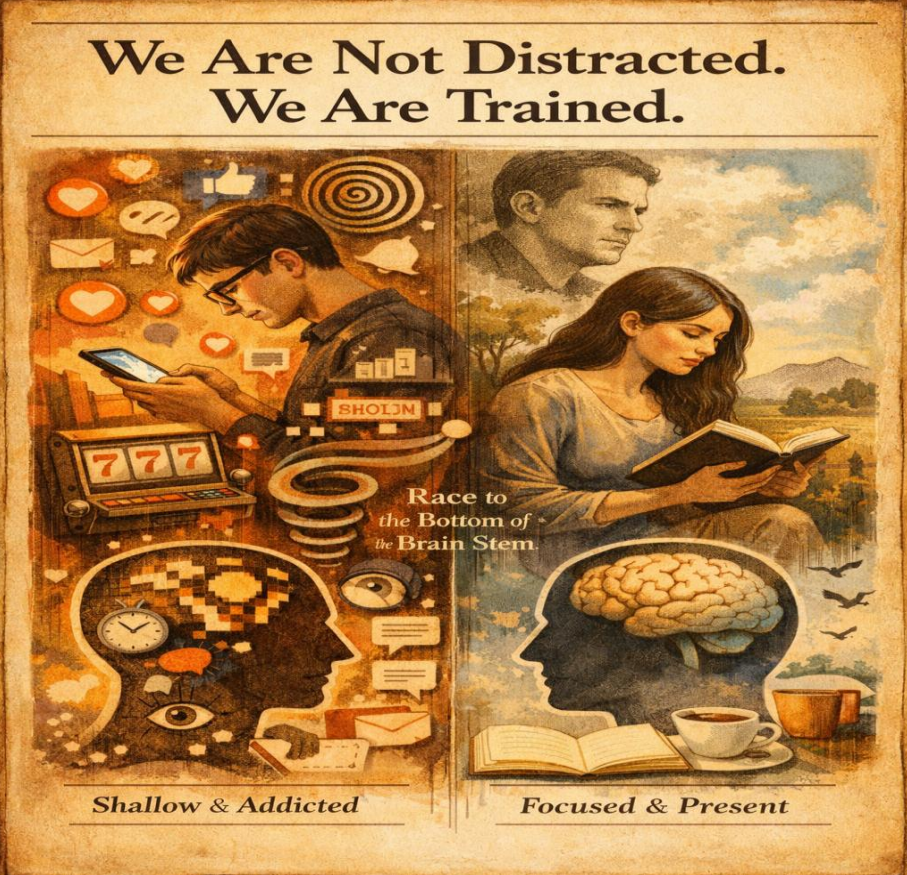
Tristan Harris, who worked as a Design Ethicist at Google and later co-founded the Center for Humane Technology, was one of the first in the industry to speak openly about this. While at Google in the early 2010s, he noticed how product design was steadily eroding our focus, harming relationships, and affecting mental health. He saw a system driven by a harsh logic: the competition for attention and engagement led to what he called a race to the bottom of the brain stem, turning our world into one that is addicted, distracted, and divided.
The phrase ‘race to the bottom of the brain stem’ is worth thinking about. In the fight for your attention, the most effective approach was not to appeal to your best instincts, but to skip past them completely.
Every major platform was built on one principle: keep users engaged for as long as possible. This isn’t to help the user, but because your attention is what’s being sold to advertisers.
They use something called variable reward scheduling. Since you never know when the next interesting thing will show up, you keep scrolling. That uncertainty is what keeps you hooked. It’s the same idea that makes slot machines so hard to walk away from.
“Nothing can feel more luxurious than paying attention.” A generation ago, that sentence would have made no sense. Paying attention was the default. Today, it requires deliberate resistance against a very well-funded current pulling in the opposite direction.
The biggest loss isn’t just productivity, though that is affected too. The real loss is depth.
Depth of thought matters. To truly understand a complex idea, you need to focus on it for a while. When your attention is broken into short bursts, your thinking becomes shallow. You end up with opinions, but not real understanding.
Depth of memory is also important. We remember things when we engage with them slowly and often. Scrolling gives a false sense of knowing—you feel informed, but you haven’t really learned anything. The information just passes by without sticking.
Depth of feeling matters too. Emotions need time and quiet to develop fully. If we always distract ourselves at the first sign of discomfort, feelings build up without being resolved. This may help explain why anxiety has increased so much with more screen time. We’ve removed the natural ways our minds calm down.
Vivienne Westwood put it simply:
“The age in which we live, this non-stop distraction, is making it more impossible for the young generation to ever have the curiosity or discipline — because you need to be alone to find out anything.”
Solitude isn’t just a luxury. It’s something our minds need, and we’ve quietly taken it away.
In India, the scale of this deserves its own reckoning
There are 700 million smartphone users in India, and mobile data is among the cheapest in the world. The country skipped desktop internet and went straight to mobile, which is the most addictive form of technology and also the most affordable. Short videos have spread to towns and cities where reading was never a strong habit, taking over before slower activities could become common.
There’s also the work side of things. Always-on WhatsApp groups, late-night messages that expect a reply by morning, and the loss of any boundary between work and personal time. We’ve all accepted a situation where our attention is available to everyone except ourselves, and we call it dedication.
But in reality, this is the lasting breakup of the one thing we can’t get back: our attention. You can make more time, but once your attention is scattered, it’s very hard to put it back together.
A deeper perspective
There’s a deeper, philosophical side to this that productivity hacks and digital detox weekends often overlook.
Philosopher Simone Weil called attention the rarest and purest form of generosity. To truly focus on something—a problem, a person, or a page—is to give it your real presence, not just be physically there. When a culture loses its ability to pay attention for long periods, it also loses the chance for real thinking, real relationships, and real self-understanding.
Cal Newport puts it simply:
“Technology should empower us, not overwhelm us. Digital wellness is about reclaiming control over our attention and time in a world full of distractions.”
The word ‘reclaiming’ is important. You can’t reclaim something unless it was taken from you. And something has been taken—not stolen, but given up bit by bit, in return for convenience and entertainment.
A quiet counter-movement is growing, without a flashy name, in the small choices people make when they realise what they’re losing. Some protect their mornings from social media, read printed books, leave their phones away during meals, or discover that walking without earphones isn’t wasted time—it’s a way to think.
Greg McKeown said it well:
“In the age of distraction, single-tasking is a superpower.”
What used to be called concentration—the basic human skill of focusing on one thing—is now so rare it’s seen as a superpower. That shows just how much things have changed from what was once normal.
The Real Question
The real question isn’t how much time you spend on your phone.
It’s about what you can no longer do because of your phone. What kinds of thinking have become more difficult? How present are you with the people and work that matter most? Is the version of yourself from before the endless feed—curious, patient, able to get lost in something—still there?
For most of us, that version still exists. It hasn’t been destroyed, just buried under habits, design choices, and the weight of many small compromises.
The real question is whether you want to uncover it.