On the language we were taught to be ashamed of
Indian parents often take pride when their child speaks English without an accent. It’s not just speaking but performing—rattling off sentences like a news anchor, rolling R’s, hiding any regional tone. In living rooms, this feels like a small victory, as if the child has moved up to something better.
No one ever admits it aloud. Still, the air in the room thickens; you feel it in every glance and quiet nod. It is an unspoken rule that shapes our behaviours without being spoken.
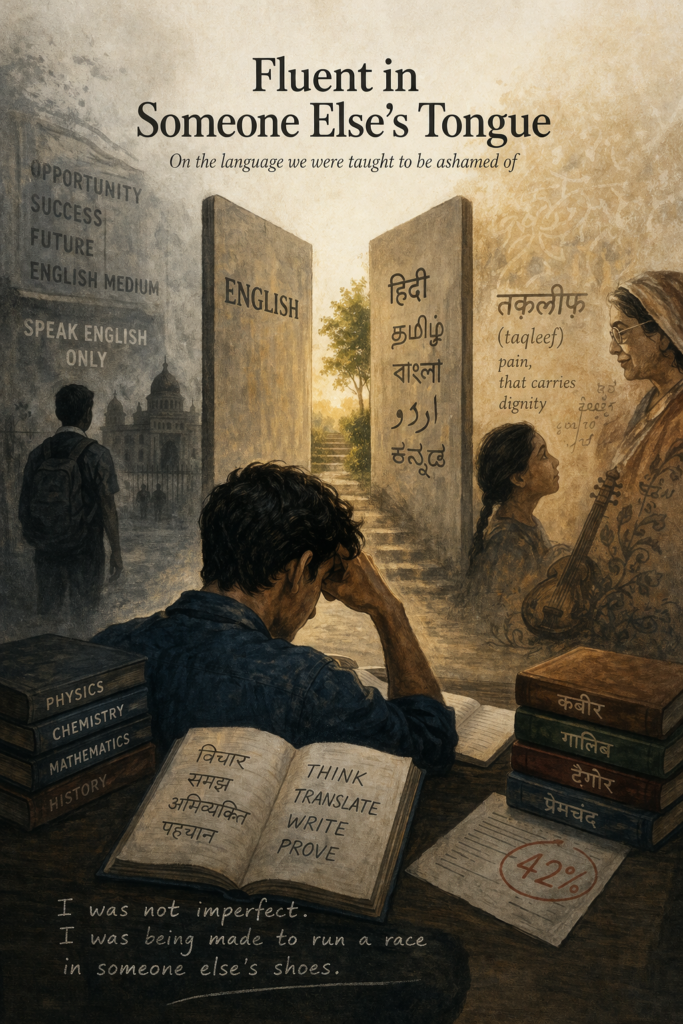
Growing up, I watched children pulled in two directions: toward English, seen as an opportunity and the future, and away from their home language, seen as backward or limited. This message was unwritten but clear. You saw it when a teacher corrected Hindi in class, when English-medium schools fined students for speaking their mother tongue, or when families with convent-educated children were quietly seen as successful.
What we inherited from the British was not just a language. We inherited the belief that their language was the measure of intelligence itself.
Research is clear: children learn best in the language they already think in. UNESCO said this in 1953. Linguistics, psychology, and education experts have repeated it for decades. A child who learns about gravity in their mother tongue can later explain it in many languages. But if a child learns gravity in a foreign language, they juggle the idea and the words. Usually, something is lost.
This is more than a minor detail. In fact, it shapes how a mind develops from the ground up.
Early childhood, especially the first eight years, is when language shapes the brain. Here, a child builds not only vocabulary but also deep structures of thought—how to sort ideas, ask questions, and sense meaning. If this happens in a language not spoken at home, something is lost. The child must navigate life in translation, and that experience never truly leaves.
This isn’t just something I’ve read in a research paper. I know it from my own life experience, which mirrors what the research suggests.
Until Class 10, I was a consistent topper, the kind of student teachers remembered. I understood lessons the first time and never doubted my ability. Learning was what I did well, all in Hindi medium—the only one I knew. My thinking, dreaming, and reasoning were all in Hindi.
That changed suddenly when I joined Aligarh Muslims University (AMU) in 1996 for my 10+2.
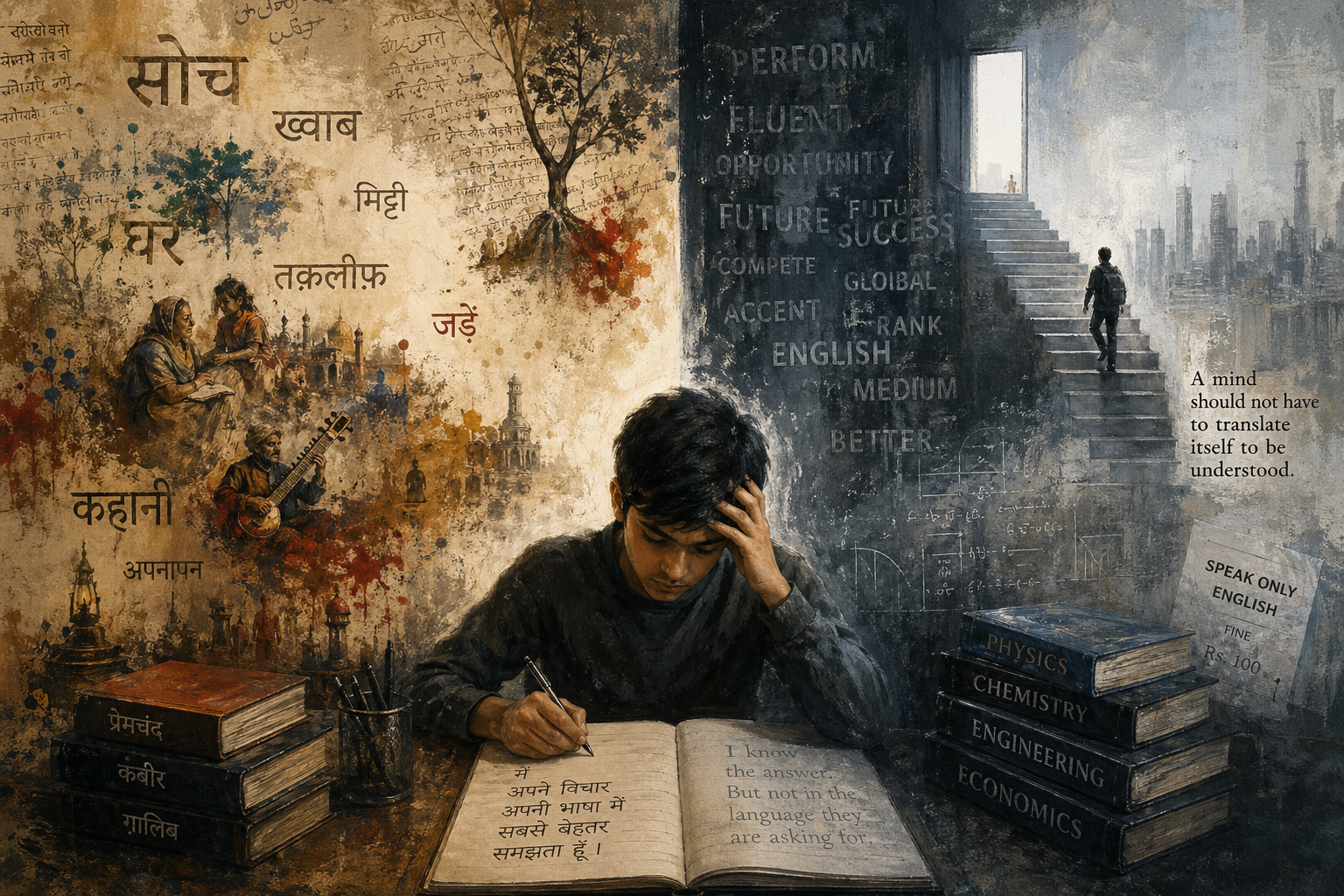
At AMU in 1996, instruction switched to English overnight. The subjects I understood easily became hidden behind a language I was still learning. I didn’t struggle with concepts, but with translating them. Each explanation had to be turned into Hindi in my mind, then back to English for writing—two steps for every idea. I was tired before reaching the answer, unable to express myself well, not for lack of knowledge but for lack of words.
My scores collapsed. I, who had never performed below expectations, found myself at the bottom. The worst part wasn’t the marks, but the start of believing they were true. Maybe my achievements in the Hindi medium meant less. In English, I felt average.
It took years to understand the real problem—the gap between what I knew and the language I had to use. I was tested in a language I was still learning, though my knowledge of another was strong. The exam saw only my English, and since it wasn’t perfect, it judged me as less than I was.
I wasn’t lacking. I was just being asked to compete in a way that didn’t fit me.
For contrast, consider China.
China has the world’s second-largest economy and produces more STEM graduates each year than any other country. Its technology sector has grown so quickly that it worries the West. All of this has happened almost entirely in Mandarin. Unlike in India, where English is a marker of success, Chinese students aren’t told that English fluency is needed to be smart. They learn and are tested in their own language, building a strong base. When English is introduced, it’s added on, not used to replace their own language.
Japan, South Korea, Germany, and France are similar. France has laws protecting the French in public life. These countries are innovative, not backwards. They don’t confuse language and intelligence. Yet in India, we—descendants of rich literary traditions—decided our own languages were lesser. This began as policy, became culture, then instinct.
The problem isn’t that Indians learn English—far from it. English is truly useful. It connects people and creates opportunities. However, the real issue is the hierarchy—the deep, unspoken belief that a child taught in Hindi, Urdu, Tamil, or Kannada is getting a lesser education than one taught in English.
In many middle-class Indian homes, there’s anxiety about language. Parents often speak only English to their children, not because it’s their native language but because they see it as a gift. Grandparents feel left out of conversations. Cousins from different schools must choose a language when they meet. There’s a divide in families that is now so normal that no one notices it as a divide.
Children are pushed to excel in one language, losing touch with the jokes, idioms, and emotions of their first language. For example, Urdu’s taqleef means pain, but with dignity—no English word matches it. Losing such words means losing ways of feeling. When taught in a foreign language too soon, children become surface learners. They can repeat and perform, but deep, creative thinking grows in the language closest to the self. English drills may yield better-speaking children, but core reasoning and imagination are built in the mother tongue. If that language is treated as embarrassing, the foundation cracks.
What happened to me at AMU is common. Every year, thousands of Indian students move from local-language schools to English-medium colleges. Once confident, they suddenly feel lost. They understand their subjects but can’t express their ideas in exam English. After exams, they doubt if they failed the subject or just the translation. Privately, they begin to question their intelligence. This is what we have done to generations of children, calling it aspiration.
Many Indian professionals are fluent in English and skilled in their field, but cut off from their own language’s literature, music, and philosophy. They can’t read Kabir or Ghalib in the original and know Tagore won the Nobel, but not his work in Bengali. They are market-educated yet disconnected from heritage. What should we do—practically, not as a slogan or nostalgia—to rethink children’s education in India?
The answer isn’t complicated, just inconvenient for a system based on the opposite idea. Early years matter—not because English is bad, but those are when the mind builds concepts, reasoning, and inner language. Mathematics in Hindi is still mathematics. Science in Tamil is still science. Knowledge doesn’t diminish because the language is regional—only the colonial hierarchy does.
English should be introduced early, but as a subject, not as the main language of instruction. From Class 1, teach English as a language—its grammar, literature, and sounds. Let children become comfortable and curious about it, without fear. But don’t make it the only way to access all other knowledge. A child can learn to speak a language well without having to learn every subject through it at the same time. These are two separate things, and we’ve mixed them up for seventy years.
And here is something schools rarely think about, but perhaps should — enrol children in spoken English classes early. Not grammar drills. Not rote exercises. Actual spoken practice, in a room where the only agenda is to open the mouth, form the thought, and say it out loud in English without fear. This sounds small. It is not small. Confidence in a language is not the same thing as knowledge of it. You can know every grammatical rule and still freeze when asked to speak. You can have a full vocabulary and still feel like an imposter when writing formally. What spoken coaching gives a child is authority — the felt sense that this language is also mine to use, not just to survive in.
I know this because I experienced the opposite. I spent my school and undergraduate years translating—thinking in Hindi, performing in English, and never fully owning either language the way I wanted. It was only during my master’s, when I joined a spoken English program, that things changed. My grammar and vocabulary didn’t shift, but my confidence did. Suddenly, I could read in English without anxiety, write without second-guessing, and speak in a room with confidence. The ease and presence I had in Hindi, I finally felt in English, too. It took over twenty years of education and a few months of spoken English class to get there, which says a lot about what our system is missing.
The switch to English-medium teaching should be gradual and only happen when the foundation is strong—around Class 9, when a child’s thinking skills are well developed. At that stage, English is like a coat you put on over clothes you already have, not your skin. A child who reaches Class 9 with eight years of solid mother tongue education and some spoken English practice will adapt to English more quickly and confidently, with less harm to their sense of self, than a child who has been translating and performing since early childhood.
This isn’t a radical idea. It’s what many countries already do. Finland, which is often ranked among the best education systems, teaches children in their home language and adds foreign languages later. Germany teaches medicine, engineering, and law in German. Japan has Nobel Prize winners, top engineers, and global companies, and most university students there speak English only functionally, not perfectly. No one told them this meant they couldn’t think deeply.
The transition to English also needs to be taught, not just expected. Right now, when Indian students move from local-language schools to English-medium colleges, they’re supposed to adjust as if switching languages is easy. No one teaches them how to think in a new language or recognises how hard this is. If their grades drop, people assume they weren’t good enough, rather than recognising that the system didn’t help them with a real, well-known challenge.
What if schools spent Classes 9 and 10 explicitly building that bridge? English language skills, reading comprehension, academic writing — not as an afterthought but as a dedicated, respected part of the curriculum. Not English literature from colonial syllabuses that feel distant and alien, but English as a living tool — journalism, essays, contemporary writing, things that feel relevant to a young person’s actual world. The language does not have to arrive with condescension attached. That was always a choice, not a requirement.
And parents — this part matters too. The pressure that middle-class Indian families put on children to perform English fluency from toddlerhood is not giving them a head start. It often gives them a shaky one. A child who grows up hearing their grandmother’s stories in Urdu, their bedtime conversations in Hindi, and their school lessons in their mother tongue is not being left behind. They are being given roots. The English will come. It always comes. What does not always come back, once it is taken away, is the texture and the depth of a language that was yours from the beginning.
The countries that are thriving now — technologically, economically, culturally — are the ones that trusted their own languages—that built knowledge in them rather than constantly translating knowledge from somewhere else. China did not build its tech industry by teaching its engineers to think in English. It built it by teaching them to think, period, in the language they were born into. The output speaks for itself.
India has everything required to do the same. The intellectual tradition is there. The languages are rich, complex, and ancient enough. What is missing is confidence. The willingness to stop treating our own languages as waiting rooms we sit in until we are fluent enough to leave.
A child taught to love their mother tongue does not become less capable of learning other languages. They become more capable. The research on this is also settled — multilingualism is cognitively advantageous, and a strong foundation in one language accelerates acquisition of others. The child who is rooted has better reach, not less.
The child who is taught to be ashamed of where they come from, on the other hand, spends a great deal of energy trying to belong to a place they were never fully let into.
I was that child once. Standing in an examination hall, knowing the answer in a language nobody was asking for.
We have produced generations of us. It might be worth asking what we lost in the process — and whether we still have time to stop.
Some things are not a step down. They were never a step down. We just believed someone who told us they were.