By Mohammad Shahanshah Ansari
There’s a number that India’s AI cheerleaders love to quote. India is the second-largest AI consumer market in the world. Weekly ChatGPT users are second only to the United States. Number one globally in AI skill penetration. Third most competitive AI nation, per Stanford’s Global AI Vibrancy Tool — behind the US and China, ahead of the UK, Japan, Germany, and South Korea.
It sounds like a story of arrival.
Then there’s the other number, the one that rarely makes it into the press releases. Of the world’s top 100 AI companies, 20 have an Indian co-founder. Only one of those 20 is India-domiciled.
This is the heart of India’s AI story: we are engines powering global AI, yet we do not shape it for our own future.
The gap between India’s global AI contribution and its lack of ownership defines the real challenge. It’s a gap of sovereignty, value, and agency—far deeper than what metrics or rankings suggest. Rankings showcase activity, not control; they count talent and usage, not who benefits.
India is an extraordinary place to consume AI. It is still a poor place to build it.
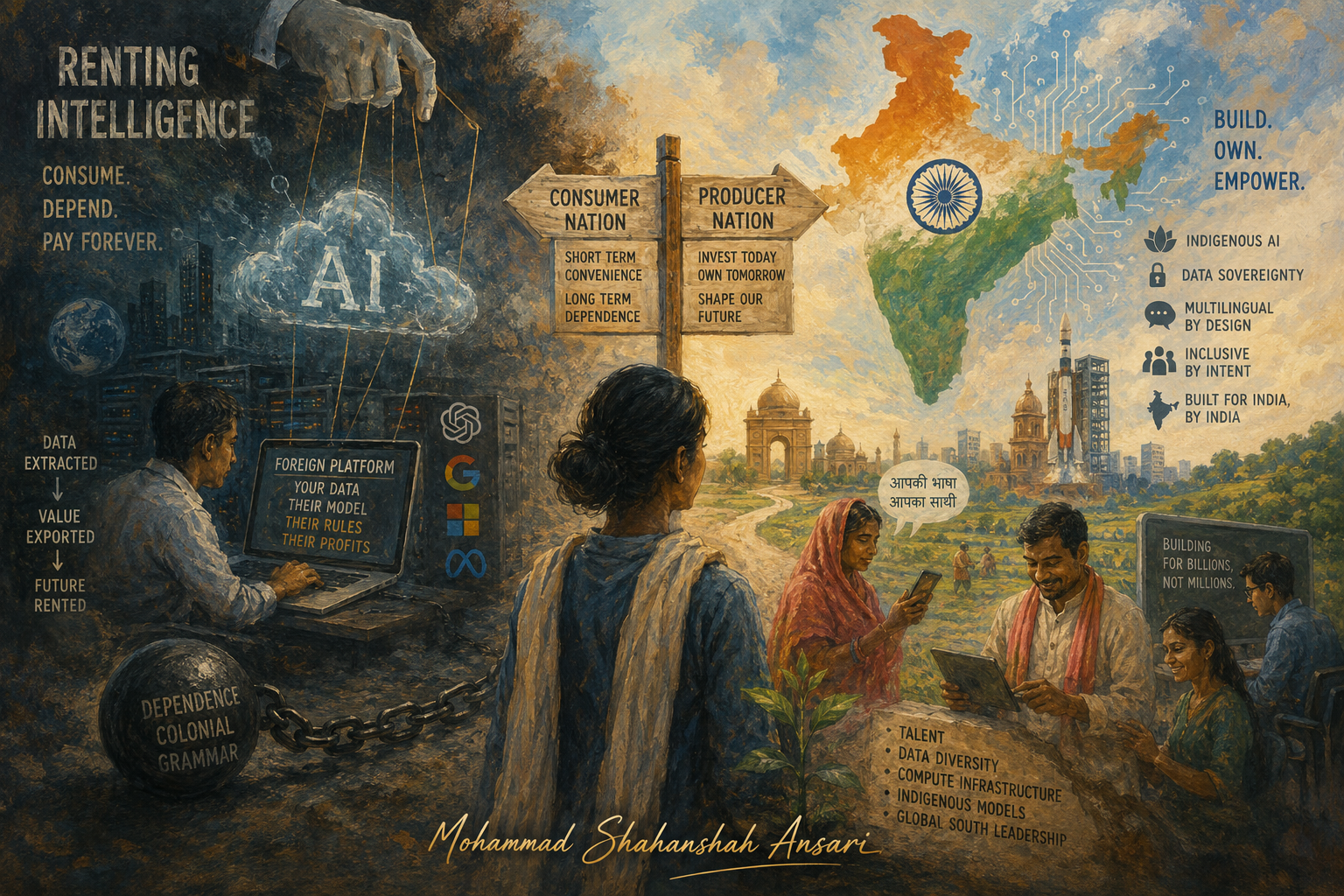
India must decide whether to accept a consumer role or invest seriously to become an AI producer—and consider the cost of inaction.
Let’s be honest about what “consumer nation” actually means in practice.
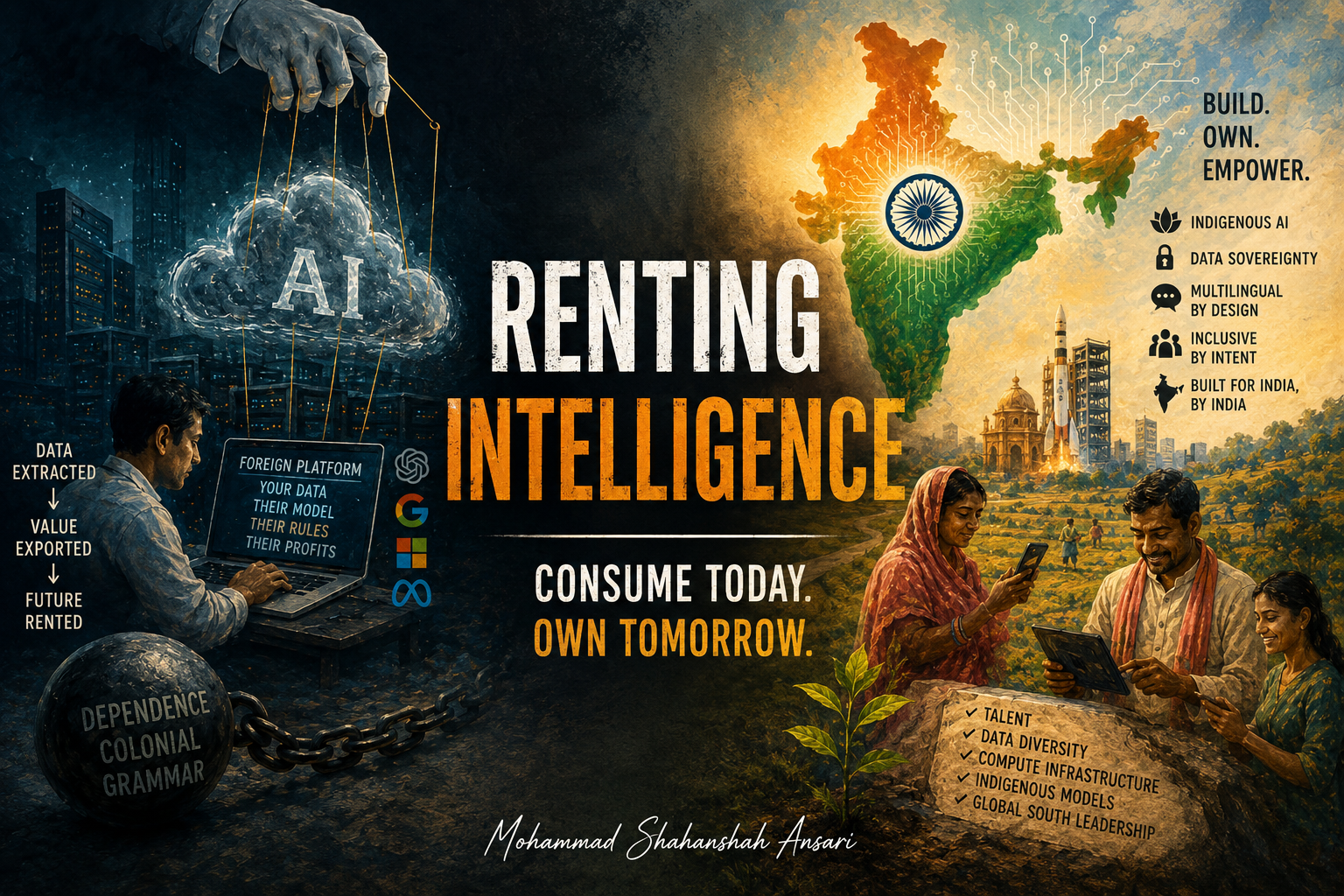
When an Indian enterprise runs its operations on a foreign AI platform, it’s feeding data — often sensitive, often proprietary, always valuable — into a system governed by foreign law, trained on foreign priorities, and owned by a company with no particular obligation to India’s interests. When a farmer in Maharashtra uses an AI-powered agriculture advisory app, the underlying model is almost certainly American or Chinese. The insight goes to the farmer. The data goes elsewhere.
This isn’t paranoia. It’s the basic logic of the technology economy. The value in AI doesn’t come from the query — it comes from accumulating millions of queries, refining models on them, and building systems that become indispensable. Countries that build those systems collect that value. Countries that use them only pay for access on an indefinite basis.
There’s a colonial grammar to this arrangement that India, of all countries, should recognise immediately.
And then there’s the subtler problem: cultural and linguistic erasure by default. India has 22 scheduled languages, hundreds of dialects, and a population whose primary relationship with the world is not in English. A large language model trained overwhelmingly on English-language Western internet data does not understand India — not its idioms, not its contexts, not its needs. When such a model is what a village health worker in Chhattisgarh or a small business owner in Coimbatore relies on for guidance, the model’s blind spots become their blind spots. They don’t just get bad answers. They get confidently wrong answers delivered in a language that isn’t theirs.
Sovereignty isn’t only about geopolitics. It’s also about whether the tools your people use actually understand your people.
India’s window is genuinely open, which is why the stakes of getting this wrong are so high.
The talent base is real. AI skill penetration in India is 2.5 times the global average. India was the second-largest contributor to GitHub’s AI projects in 2024. The country produced around 17,000 AI research papers in 2023 — under 4,000 a decade ago — and has overtaken the UK in research output.
The data advantage is equally real, and almost entirely underexploited. India sits on one of the most diverse and voluminous datasets in the world — across health, agriculture, finance, public administration, and a dozen languages that no major foreign model has been seriously trained on. That’s not a nice-to-have. That’s raw material for AI systems that could serve a billion people in ways that foreign models structurally cannot.
The market scale is obvious. India is already the second-largest user base for ChatGPT. The demand exists. The question is who captures the value from it.
And the economic logic is stark. PwC estimates AI could add up to 15 percentage points to global GDP by 2035. But that growth will not be distributed evenly. It will go to countries that build and own AI infrastructure, not to those that merely use it. Nations that remain consumers will find themselves in the same position as nations that only consumed software in the 1990s — permanently paying, permanently dependent, permanently a generation behind.
The government has recognised this, to its credit. The IndiaAI Mission — approved in March 2024 with an outlay of ₹10,372 crore over five years — is an attempt to move India from a consumer to a producer. The compute infrastructure is being built out: 38,000 GPUs are now accessible to startups and researchers at subsidised rates. The AIKosh platform hosts over 5,500 datasets across 20 sectors. Twelve startups — Sarvam AI, Soket AI, Gnani AI, BharatGen, among them — have been selected to build India’s own foundational models. Four Centres of Excellence in healthcare, agriculture, sustainable cities, and education are operational or in progress.
Bhashini, the government’s multilingual AI platform, offers perhaps the clearest illustration of what indigenous AI could actually do: a woman in a remote tribal village calls a helpline, describes a medical symptom in her native language, and receives accurate guidance in the same language. No English required. No digital literacy assumed. That is what it means to build for India rather than to sell India someone else’s product.
But the honest assessment has to follow the optimistic one.
Thirty-eight thousand GPUs may seem significant until you consider that India’s AI demand is projected to exceed 3 million by 2030. The brain drain remains the most stubborn structural problem: India produces exceptional researchers, and Silicon Valley, London, and Singapore absorb them before they can build anything here. The semiconductor gap is a long-horizon threat — without indigenous advanced chip fabrication, India’s AI ambitions will always be capped by what it can import. And the data ecosystem, for all its potential, remains fragmented and poorly governed.
The mission is necessary. The execution is early. The gap between the two is where honest policy conversations need to happen, instead of the triumphalism that tends to dominate.
There’s a version of India’s AI future in which this country becomes what it has never quite managed to be in tech: not the back office, but the source. Not the talent pool that drains into foreign companies, but the country that builds systems used by the Global South — systems that actually understand what it means to operate in a context of multiple languages, limited infrastructure, and immense human diversity.
That version is available. The talent, data, and market exist. The government has, at least on paper, recognised the imperative.
India’s gap isn’t in vision or planning. What’s at stake is whether we can move with the urgency needed to turn potential into true AI sovereignty.
Because the window doesn’t stay open forever. The countries that capture AI’s economic and geopolitical upside in this decade will be the ones that made the hard investments — in compute, in indigenous models, in retaining their own talent — before it became obvious they should. India is at that inflexion point now.
Using foreign intelligence fits short-term needs. But if India continues to rent AI instead of building its own—letting value and control slip away—that’s not just a missed strategy: it risks surrendering the future we should own.
References
- AI Readiness Index 2026: Global, Regional, and Country Rankings — Index.dev https://www.index.dev/blog/ai-readiness-index-statistics
- The India AI Adoption Edge 2026 — Zinnov × OpenAI × Z47 https://zinnov.com/automation/the-india-ai-edge-2026-report/
- India Ranks as World’s Third Most Competitive Nation in AI — Stanford University Global AI Vibrancy Tool, via GK Today https://www.gktoday.in/india-ranks-as-worlds-third-most-competitive-nation-in-artificial-intelligence-after-us-and-china/
- AI Growth by Country 2026: Top Stats and Trends — Index.dev https://www.index.dev/blog/ai-growth-statistics-by-country
- AI@Work: Driving Productivity, Jobs, and Innovation — Press Information Bureau, Government of India https://www.pib.gov.in/PressNoteDetails.aspx?id=157310
- Global AI Adoption Rate by Country 2026: Statistics, Rankings & Forecasts — AllAboutAI https://www.allaboutai.com/resources/ai-statistics/global-ai-adoption/
- India Pursues AI Sovereignty Amid Expert Warnings on Dependency — WhalesBook https://www.whalesbook.com/news/English/tech/India-Pursues-AI-Sovereignty-Amid-Expert-Warnings-on-Dependency/6995984ad25eafd9cdfd5e16
- IndiaAI Mission — Official Portal — Office of the Principal Scientific Adviser, Government of India https://www.psa.gov.in/ai-mission
- IndiaAI Mission: Building Inclusive and Sovereign Artificial Intelligence in India — RICE IAS https://riceias.com/indiaai-mission-building-inclusive-and-sovereign-artificial-intelligence-in-india/
- Decoding the India AI Governance Guidelines — Saikrishna & Associates https://www.saikrishnaassociates.com/decoding-the-india-ai-governance-guidelines/
- The AIdea of India 2026: Sovereign AI in India — EY India https://www.ey.com/en_in/insights/ai/agentic-ai-india/sovereign-ai
- Indian Artificial Intelligence: Vision, Ecosystem and the IndiaAI Mission — Organiser https://organiser.org/2026/01/03/333328/bharat/indian-artificial-intelligence-vision-ecosystem-and-the-indiaai-mission/
- The Sovereign AI Race: Why India Can’t Afford to Depend on Foreign Tech — Business Today https://www.businesstoday.in/technology/news/story/the-sovereign-ai-race-why-india-cant-afford-to-depend-on-foreign-tech-489104-2025-08-12
- Digital Sovereignty and AI: Developing India’s National AI Stack for Strategic Autonomy — ScienceDirect https://www.sciencedirect.com/science/article/pii/S187705092500434X