This isn’t a coincidence. Today, with screens taking up so much of a child’s time, it’s worth asking what we might be losing and what we can still give back.
It Began with Stories
Before reading became a school task, it was a bedtime tradition. Grandmothers told stories. Fathers read from old, illustrated books. Children gathered around voices, not screens, and listened to Panchatantra tales, Akbar-Birbal stories, Chacha Chaudhary stories, Aesop’s fables, and stories about clever animals, foolish kings, and the quiet rewards of honesty.
No one called it education. It didn’t seem like learning. But something important was happening that worksheets couldn’t match. Children were meeting language as something alive: hearing the rhythm of sentences, feeling how a pause adds tension, and enjoying stories that made the world feel right. They learned, without realising, how stories work, how actions have consequences, and how a character’s choices show who they are.
Those children grew up able to write better letters, argue more clearly, and listen more carefully. The link was never a mystery; it just wasn’t often pointed out.
What Reading Actually Does
For a child under fifteen, a book isn’t just a way to get information. It’s a workout for the mind.
When a ten-year-old reads a story, they do many challenging things at once: they imagine a whole world, keep track of characters, guess what might happen next, and feel emotions for people who aren’t real. Doing this again and again over the years builds what researchers call “deep reading”—the ability to focus, handle complex ideas, and stick with a problem until they truly understand it.
Reading also grows vocabulary in a way no app can. A child who reads a lot learns words in context, not just as definitions, but as words used in real sentences. By age fifteen, a child who reads and one who doesn’t can have a vocabulary gap of tens of thousands of words. That gap is hard to close, and it shows in how they speak, write, and move through the world.
What the West Got Right
If you visit a typical primary school in Finland, the US, the UK, or Canada, you’ll notice something surprising: time set aside just for silent reading. Their libraries are well-funded, and teachers are trained to see reading not just as a subject, but as the foundation for all other skills.
In many British primary schools, children take home a reading diary. Parents are expected to read with their children each evening and sign it. This isn’t about the school interfering, but about recognising that literacy is too important to leave just to school hours.
The results are visible not just in test scores but also in how young people present themselves. Teenagers who have read a lot usually speak more clearly, argue more logically, and write with more confidence. These are big advantages. In today’s world, where communication matters more than ever, these skills can shape a career.
As a country with one of the world’s great literary traditions, in a dozen languages, across thousands of years. And yet, in most Indian schools today, reading means reading a textbook. The library, if it exists, is often locked. The English curriculum is built around grammar exercises and comprehension passages that no child would voluntarily read. The message, received early and clearly, is that books are instruments of examination — not objects of pleasure.
This is a real loss, and it shows up later in life in ways we might not expect. An engineering graduate who can’t write a clear email. An MBA who struggles to give a convincing presentation. A manager who knows their job but can’t keep an audience’s attention. These aren’t failures of intelligence. Often, they are language failures—the result of growing up in a system that never taught them to enjoy reading.
The Way Forward
The good news is that this can be fixed. It’s not just about policy, but about adults giving children books and making time for reading. Schools should treat the library as essential, not just decoration. Parents should read in front of their children, because kids pick up habits by watching adults.
It’s enough to say this: communication is the most professionally underrated skill in India. We train children in mathematics, in science, in rote memorisation of historical dates — and we send them into workplaces where the single greatest determinant of their growth is how well they can express an idea, write a proposal, speak in a meeting, and make another person understand what they mean.
You don’t learn these skills in a quick corporate training. They develop slowly, over years, through reading—by seeing how good writers organise their thoughts, build arguments, and use strong sentences to make a point.
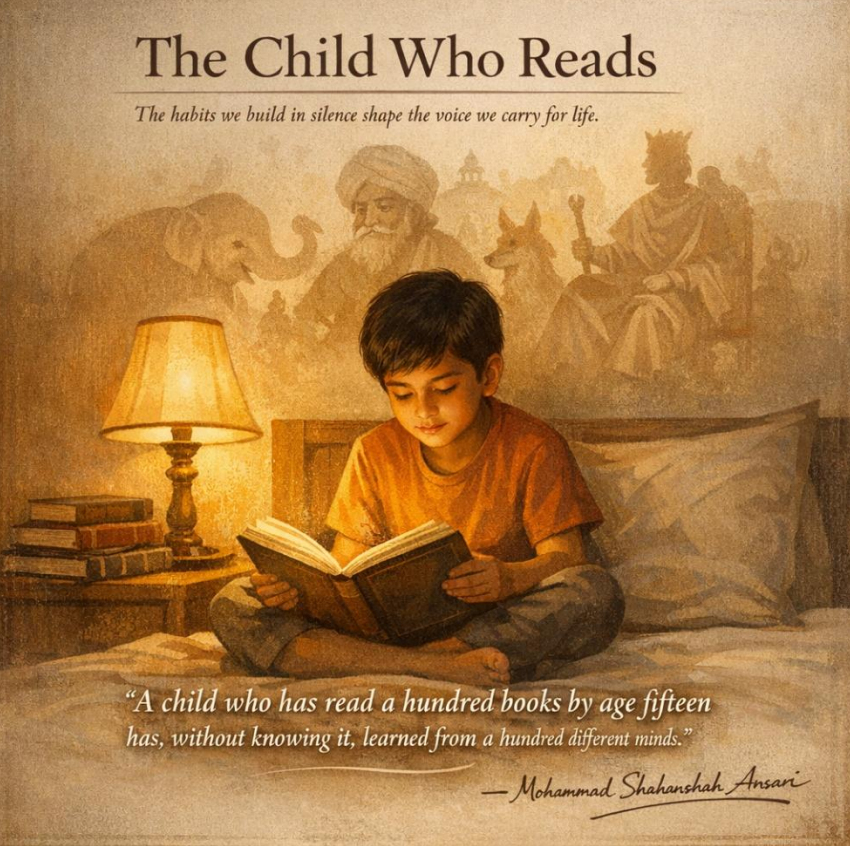
A child who has read a hundred books by age fifteen has, without knowing it, learned from a hundred different minds. They’ve seen how to start an argument, handle complex ideas, and make a strong point. When they sit in a boardroom or write an important email, they draw on years of experience built through reading.
A Simple Shift
No great revolution is needed here. No overhauling of syllabi or We don’t need a big revolution or huge government programs—though those could help. What’s needed is simpler and closer to home: a book in the house, a parent who reads, a teacher who shares a story for its magic, not just its lesson.
Give a child twenty minutes before bed with no screens or schedules, just a lamp, a blanket, and a book. They tend to become people who think more clearly, write more persuasively, and live more richly inside their own minds.
That sounds like a good return for just twenty minutes a night.