She leaned over her laptop, staring at the bright screen, unsure if she would get good news or another letdown.
Another email blinked into her inbox.
Another curt rejection.
There was no explanation or feedback. Just one short, impersonal sentence:
“We regret to inform you…”
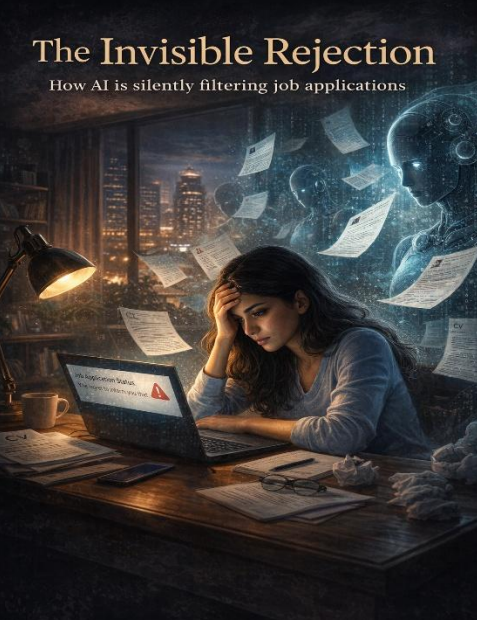
She stopped for a moment and counted how many times she had tried.
10 applications.
Then 25.
Then 50.
Eventually, the number quietly went over 100.
She was an Indian student in the UK, working hard on her degree, building up internships and experience, and doing everything that used to mean success. She studied science and did everything people said was ‘enough.’
But something in the world had changed.
One day, she found a job that felt like the perfect fit.
She pressed Submit and held her breath.
Just two minutes later, a rejection appeared in her inbox.
It wasn’t even enough time for someone to read her resume. Suddenly, she realised what was happening.
“Maybe no one is seeing my application…”
She said what many people in her generation feel but rarely say out loud:
“This feels really horrible. I think AI is rejecting me.” (Hindustan Times)
The Hidden Barrier
This is not the story of just one student.
It’s the story of thousands of others, too.
These days, your resume has to get past a computer before a person ever sees it.
An algorithm decides:
• Whether your profile is relevant
• Whether your skills match
• Whether you deserve a chance. If the answer is ‘No’ again and again…
It can feel like you never even applied.
The Strange Reality of Today
Companies use AI to filter candidates.
Candidates use AI to write resumes.
AI is now evaluating AI.
Somewhere in this back-and-forth with technology, people’s talents often go unnoticed.
The Emotional Cost No One Talks About
She shared something even more personal:
Sitting alone, recording video interviews,
answering questions on a screen,
“You start feeling like a robot… your personality disappears.” (Hindustan Times)
No human warmth.
No connection.
No opportunity to be seen.
You become just another file, processed and forgotten.
The Real Problem
The real problem is that no one taught us how to handle a world run by algorithms.
We got ready for the working world, but not for dealing with algorithms.
We learned skills.
But we never learned how to show them to computers.
A Wake-Up Call for Every Young Professional
If you are:
• Applying blindly to hundreds of jobs
• Using the same resume everywhere
• Ignoring networking and visibility
Here’s the truth: It’s not always companies rejecting you. Unseen systems are filtering you out before you even get a chance. Learn how these systems work so you can stand out.
The Shift That Will Define Your Future
The rules have changed without much notice.
Earlier: Apply more → Get selected
Now: Apply smart → Get noticed
Learn how hiring works today:
• Resume optimisation for ATS
• Build a strong digital presence.
• Focus on referrals and networking.
• Develop skills that AI cannot replace.
Remember, in today’s world, your first interview is with a computer, not a person. Make sure your application stands out to AI.
Final Thought
The student keeps searching.
Still applying.
Still hoping.
But her experience has a lesson for everyone:
AI is not here to stop you.
But if you don’t adapt, it will move on without you.
So, the real question is, will you keep applying…
Or will you learn how to be seen?
Reference
Reported by MSN and covered across multiple outlets based on a BBC interview of an Indian-origin student in the UK, highlighting AI-driven hiring challenges.